
Unit 1 Year 7 Unit 1 Unit 2 Year 7 Unit 2 Unit 3 Year 7 Unit 3 Unit 4 Year 7 Unit 4 Unit 5 Year 7 Unit 5 Unit 6 Year 7 Unit 6
Mungkin Anda Juga Suka
Kids Songs by CoComelon
Learn Colors with CoComelon!
Year1 English
CoComelon & Friends Holiday and Christmas Videos for Kids | Little Baby Bum | Go Buster and More!
CoComelon
Alphabet (ABC) Songs by CoComelon
CocoMelon | Little Baby Bum | Blippi - Nursery Rhymes & Kids TV Shows
CoComelon - Happy Holidays
Year3 Spanish
Year7 Spanish
KS4 Spanish
Year 7 Spanish
Spanish Vocabulary: Careers and Social Events
Spanish Vocabulary Project
Spanish Vocabulary: Sports, Travel, and the Home
Have a Fun Time Learning Spanish
KS1 Drama
SS 1 Mathematics
Sheriff Labrador - Kids Cartoon | Safety Cartoon for Kids
Year9 Spanish
Year4 Spanish
Year8 Spanish
Year 10 Spanish
SS 2 Physical
Komentar
10 Komentar
In this lesson, we will revise what people can, must and want to do, using the 3rd person singular forms of the verbs 'querer', 'deber' and 'poder', and learning the 3rd person plural form. We also revise the possessive adjectives tu (your) and mi (my) in singular and plural forms.
In this lesson, we will continue our analysis and exploration of a Spanish poem, 'La playa', by Juan Guinea Díaz.
In this lesson, we will explore and analyse a Spanish poem, 'La playa' by Juan Guinea Díaz.
In this lesson, we will learn how to describe using future plans using the verb 'ir'.
In this lesson, we will describe where people go and when using the verb 'ir'.
In this lesson, we will describe where people go using the singular person of the verb 'ir' and practise the use of 'al' and 'a la' with a place.
In this lesson, we will describe where people go and when using the 1st and 3rd person singular of the verb 'ir' with 'al' and 'a la', meaning 'to the'.
In this lesson, we will learn to use the plural possessive adjectives 'mis' for my and 'tus' for your and we revise the use of question words.
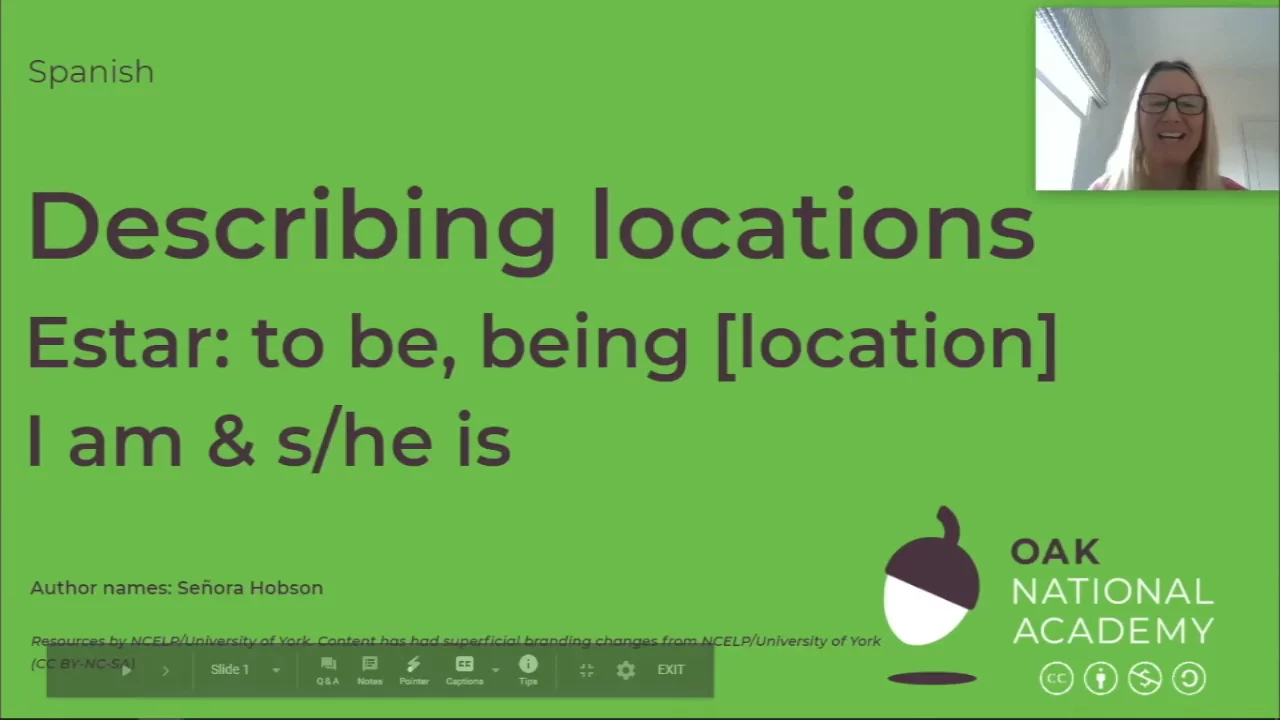
In this lesson, we will talk about our possessions, using the possessive adjectives 'mi' for 'my' and 'tu' for 'your' and revisiting the use of 'es' and 'está'.
In this lesson, students will complete an assessment in applying their knowledge independently. They will be assessed on phonics, vocabulary and grammar through listening, reading, writing and speaking exercises.