
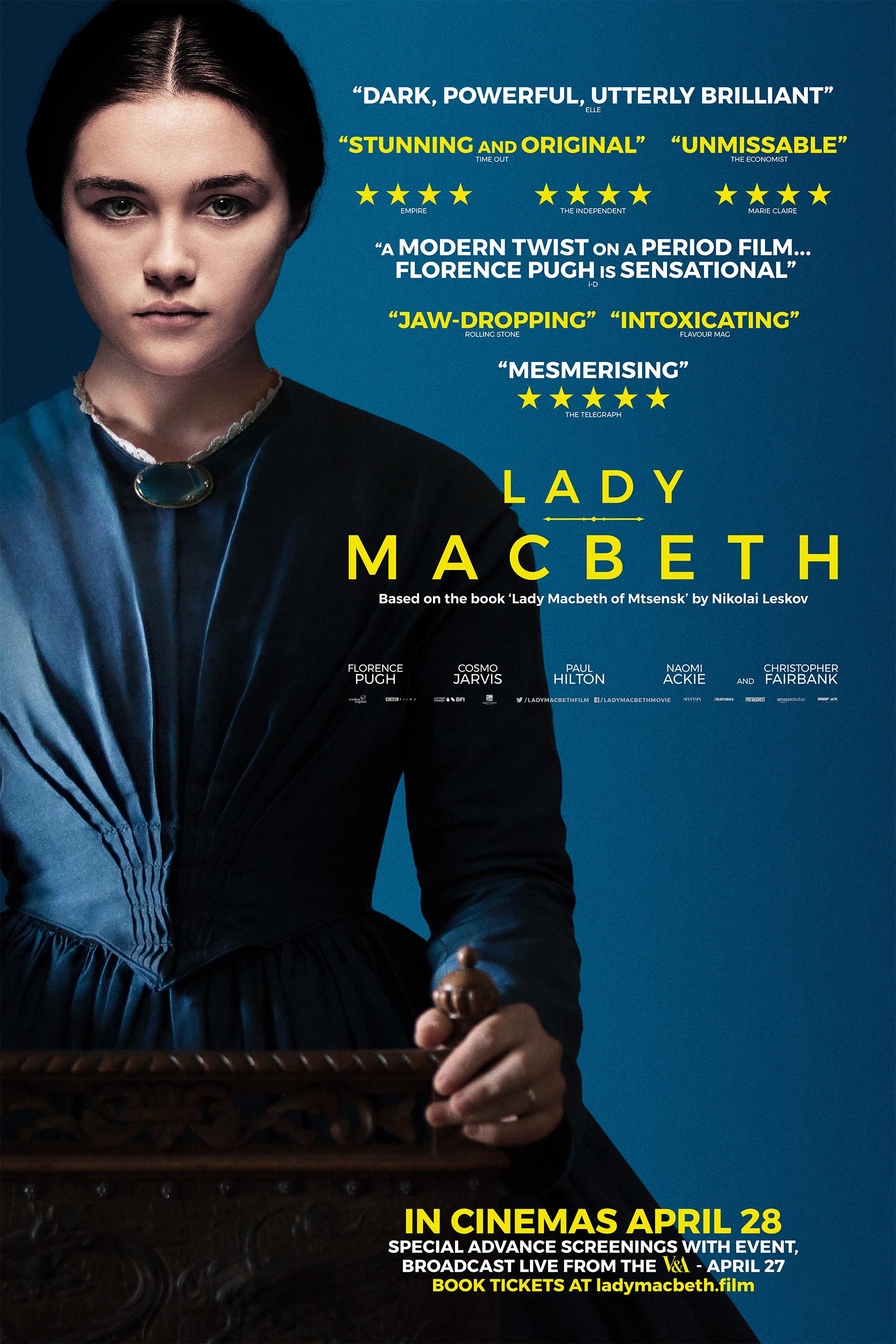
उन्नीसवीं सदी के ग्रामीण इंग्लैंड में, एक युवा दुल्हन जिसे शादी के लिए बेच दिया गया है, उसे अपने भीतर एक अजेय इच्छा का पता चलता है जब वह अपनी संपत्ति पर एक कार्यकर्ता के साथ संबंध बनाती है.
ट्रेलर
कलाकार
Florence Pugh
Katherine
Cosmo Jarvis
Sebastian
Paul Hilton
Alexander
Naomi Ackie
Anna
Christopher Fairbank
Boris
Golda Rosheuvel
Agnes
Anton Palmer
Teddy
Rebecca Manley
Mary
Fleur Houdijk
Tessa
Cliff Burnett
Father Peter
David Kirkbride
Edward
Bill Fellows
Dr. Burdon
Nicholas Lumley
Mr. Robertson
Raymond Finn
Mr. Kirkbride
Ian Conningham
Detective Logan
Finn Burridge
Farmhand
Jack Robertson
Farmhand
Kema Sikazwe
Farmhand
आपको ये भी पसंद आ सकते हैं
Sodom
Six Days of Sistine
Tuberose
Nocturnal
Marvellous Love
Poldark
Sanditon
Little Birds
Ackley Bridge
Miss Austen
Bridgerton
Zhu yu
If Loving You Is Wrong
Bai se gan lan shu
Young Royals
Safe Skies, Archer
Shuang cheng
Knock Out
The Wicked Game
The Secret of Us
Forever and Ever
Monster Next Door
Ye Gou Gu Tou
Love Story in the 1970s
टिप्पणियाँ
10 टिप्पणियाँ
If I were the producer of this film, I'd have chosen a different title. I'm sure lots of moviegoers are going to be misled: this film has nothing to do with Shakespeare. It's an adaptation of a novel by the Russian author Nikolai Leskov, set in early 19th century England. The film seems to be a pre-feminism manifesto for women's rights. It shows Katherine Lester, the submissive wife of a wealthy but abusive landowner, living in a secluded manor in the British countryside. During a prolonged absence of her husband, she rediscovers her freedom and starts an affair with one of the stable boys. Not willing to give up her newly acquired status, she starts a series of increasingly extreme actions. The interesting thing is how Katherine evolves from victim to culprit. She seems to have learned from her husband how to use and misuse power. The lack of social conscience of which she at first is a victim, becomes a driving force for her own behaviour. Her selfishness and lack of morality is so extreme that, in the end, she betrays innocent servants. The viewer has to shift his allegiances: at first, it's impossible not to sympathize with Katherine, enjoying a free life without her heartless husband. But halfway through the film, it becomes clear that Katherine is just as heartless, as soon as she is in power. The story is filmed in a very effective, sober style with beautiful cinematography. The lack of any music is remarkable: some elongated scenes are striking because of the silence. The oppressive atmosphere in the manor is emphasized by the camera work. The camera repeatedly shows scenes from exactly the same viewpoint. Four or five times, we see the servant Anna entering Katherine's bedroom in exactly the same way. As much as 'Lady Macbeth' is about gender, it is also about class. It is striking that Katherine, who as a woman is considered a lower form of human life by men, herself considers the servants to be a lower form of human life. She shamelessly uses them for her own purposes and enjoyment, but doesn't care at all about their fate afterwards. 'Lady Macbeth' is a beautiful film, about issues that even nowadays are worth thinking about. But I would have named it 'Lust and loneliness' - after all, it's set in the same period as the Jane Austen novels.
This small independent film from the United Kingdom is an astonishing portrait of the bleak realities of how Scottish culture viewed class, race, and (especially) gender in the nineteenth century. The film does this without ever needing to be preachy or overtly politically correct. It is very dark and rather disturbing, and it will get under your skin--but it is brilliantly made. It is the best film of the year so far. It should also, however, be noted that this film is not an adaptation of Shakespeare's "Macbeth." Rather, it is an adaptation of a Russian novel about a woman who begins to exhibit deranged behaviors after being forced into an arranged--and loveless--marriage. Despite using minimal set pieces and little music, the aesthetics of this film are truly sublime. They add to the simple feel of the film, rather than the extravagant sense of many period dramas. The costume design is also simple rather than outlandish or flamboyant. Once again, this makes the film feel realistic and tense, rather than removed from reality. The film's cinematography is top-notch as well, reflecting the dark tone of the film in its entirety. Florence Pugh is exceptional in the lead role as Katherine. Despite the actions that her character commits in the second half of the film, she manages to generate sympathy while still portraying herself as a twisted individual--almost an impossible trick to pull off. But what elevates this film to utter brilliance is that it is not solely a defense of her--or a defense of anyone. Rather, it is simply a unique reflection on the notion of social status at the time period that skewers all preconceived notions of judgment--including morals and morality--to the point of ambiguous analysis. The film's true messages are quite complex, even though its direct plot is not difficult to follow. This is why even simple, dialogue-free scenes such as moments when the camera stares at Katherine's face as she is seated, tell you so much about her as a character and her mood to a degree that I have not really seen in any film of recent memory. Such complexity, though, is what makes the film an unforgettable watch. (Of course, the uniquely simple look and feel to the film and its excellent, slow-burn-style pacing also contributes greatly to it.) Recommended to the highest degree. 10/10
As "Lady Macbeth" (2016 release from the UK; 90 min.) opens, we see a young woman (we later learn her name is Katherine) getting married in what looks to be 19th century England. On her wedding night, she is left untouched by her (older) husband. Her father-in-law, also living there, is equally unpleasant. Katherine is utterly lonely and depressed. Then one day, both her husband and father-in-law must go out of town for business. It's not long before Katherine strikes up a torrid affair with one of the groomsmen. At this point we're about 10 min. into the movie. What will become Katherine and her lover? To tell you more of the plot would spoil your viewing experience, you'll just have to see for yourself how it all plays out. Couple of comments: you may think this is yet another movie adaptation of the Shakespeare play, but in fact this is based on the Russian novel Lady Macbeth of the Mtsensk District by Nicolai Leskov. I will leave it to the Shakespeare experts to comment how different this story is from Shakespeare's. What I can say is this: the movie is very much story-driven. Things happen, and happen fast, and it doesn't let up! There is hardly any music in the film. Another unusual fact: the movie does not have a title. There are no opening credit, and when the end titles start, it simply says "Based on Lady Macbeth of the Mtsensk District by Nicolai Leskov", and that's it. (The Katherine character is regularly referred to as "Mrs. Lester" or maybe that should be "Leicester".) The star of the movie for sure is Florence Pugh, an up-and-coming British actress, whom I can assure you we will see plenty more of (she reminds me of a young Kate Winslett). Played by Pugh, Katherine is passionate and ruthless. Last but not lest, the movie was filmed (according to the end titles) in Northumberland, the area just below the border with Scotland, just beautiful. "Lady MacBeth" premiered at the 2016 Toronto International Film Festival to positive buzz. It finally opened this weekend at my local art-house theater here in Cincinnati, and I couldn't wait to see it. The Friday early evening screening where I saw this at was attended dismally (4 people, including myself), which does not bode well for this movie, considering it was the opening night. That's a shame. Maybe this will gather a larger audience through Amazon Instant Video, or eventually on DVD/Blu-ray. If you like a strong story-driven movie with great acting, you could do a lot worse than this particular "Lady MacBeth"!