
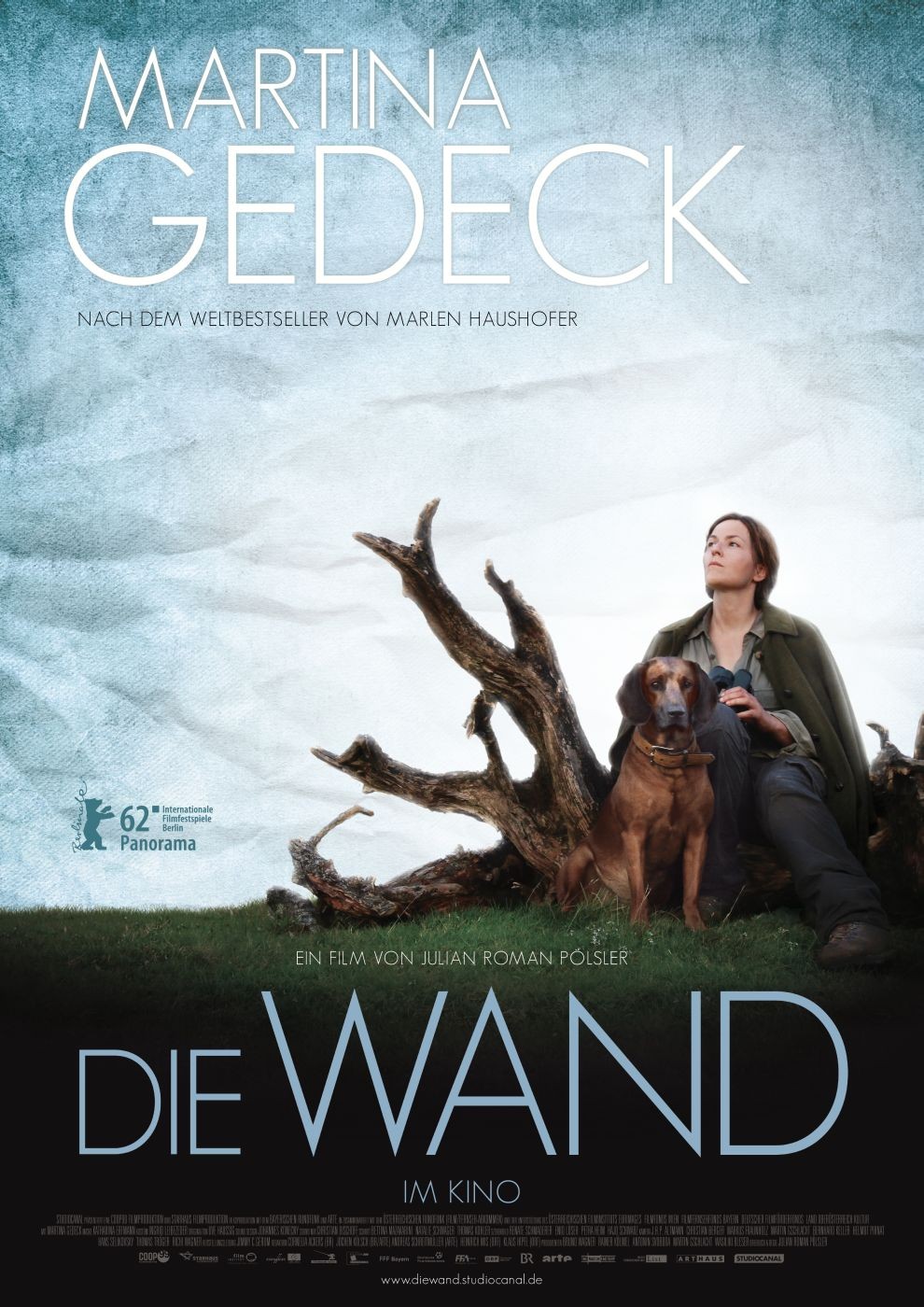
Une femme se retrouve inexplicablement coupée de tout contact humain lorsqu'un mur invisible et inflexible entoure soudainement la campagne.
Casting
Martina Gedeck
Woman
Luchs von Kyffhäuserbach
Luchs
Karlheinz Hackl
Hugo
Ulrike Beimpold
Luise
Julia Gschnitzer
Cottager
Hans-Michael Rehberg
Cottager
Wolfgang M. Bauer
Man
Vous aimerez aussi
Le mur invisible
The Trouble with Being Born
I Am Mother
Parallel
Under the Dome
La Brea
Westworld
Périphériques, Les Mondes de Flynne
All the Queen's Men
Beauty in Black
Fatal Seduction
The Boys
The Expanse
Severance
Debris
Les Voyageurs du Temps
Sense8
The Society
La Guerre des mondes
The Rig: Dans le brouillard des abysses
The Feed
Projet Blue Book
Bloom
Somewhere Between
Commentaires
10 commentaires
The best word to describe this film is "pretentious". That means that it is giving itself airs, claiming to say something important that we lesser mortals have not yet appreciated, and, in so doing, boring us to bits. (POSSIBILITY OF SPOILERS) I understood the film in the following way: the invisible wall is just a way of telling us that the woman had made the decision to cut herself off from the rest of humankind so that whenever she seemed to be wanting to approach someone her inner fear sprang up to restrain her. She has chosen to live alone, having marked out a large swathe of beautiful barely inhabited highland country wherein to live and have her being. She doesn't want to die. Even though she is intensely depressive, and very boring to watch and listen to her low-pitched whine, she gets to know the local animals and is pretty good at keeping herself alive. She bonds with a dog. She apparently has some isolationist experiences which may be valuable for her mental state, though they sound weird or trite to the ordinary viewer. But everything she offers is manna from heaven for art-house patrons and the superior sort of film critic, who would probably quite enjoy watching paint dry. This is similar to that, but it is better in that the countryside and the photography are lovely and worse than that in that there is the additional element of the miserably depressed woman. The couple who bring her to her cottage play ghastly pop music very loudly in their car, presumably a ham-fisted way of telling us, perhaps through her perception, how boorish they (or all other humans) are. Whether we see it as catharsis or denouement or, as I do, merely as confirmation of her hatred of mankind, we see in the final moments of the film that the one human who somehow manages to penetrate the wall is cruel and vicious and the woman, whose hatred of mankind may be seen as being responsible for creating this figure in her world, expresses that hatred and takes her revenge by being extremely nasty to him. End of story. Yawn yawn.
THE WALL is an interesting--though people who want a really tangible storyline and/or fast action and suspense might choose the word "boring"--little film. How to describe it? Quiet, somber, original, going deep without trying too hard. Fantastic in the most literal sense. Well-acted and well-filmed: The Austrian Alpine scenery, perhaps the single best thing about THE WALL, is just spectacular. Still, there are a number of plot-holes and incomplete threads, things that don't add up and are not apparently supposed to--"Kafkaesque" is another word that kept running through my mind as I watched. Though it's nothing great, I'm happy to have seen THE WALL and, most of all, am eager to read the original novel by Marlen Haushofer, which, even if it doesn't make completely logical sense, based on the reviews, apparently has more sense of completion.
This is the synopsis from Netflix: "Vacationing with a couple in their mountain retreat, a woman finds herself alone at the cabin one afternoon, inexplicably trapped by an invisible wall. Her isolation behind the barrier grows more surreal as hours, then days, then weeks pass." Sounds like a cool premise, right? I mean, how is she going to get out? I mean, she's going to spend most of the movie figuring out the nature of this wall and then trying to escape it, right? When she first encounters the wall, she's on a path. Next to the path is a river, where water is clearly flowing through the wall – wouldn't you, I don't know, try to swim in the water to see if you could get under the wall? Throw rocks at it to try to see how high it goes (it does seem like birds are able to cross in and out of the wall and rain, snow and wind still exist, so it's not like a dome). If you happen to see someone two years after this journey, wouldn't you maybe try to talk to him to see where he came from (even if he just killed your dog) instead of just murdering him? You and I probably would because we are not vehicles for philosophy. "The woman," however, exists solely as a vehicle for philosophy, so nothing she does makes any sense. She's too busy contemplating her aloneness than to try to do anything about it. So we, the viewers of this beautifully shot movie (it really is gorgeous!), must suffer through her loneliness with her rather than see her try to do ANYTHING about it. She never digs a hole on the border of the wall to see how deep it goes. Instead she spends 10 days waiting to be rescued and then just accepts her fate. And that happens about 10-15 minutes into the movie, so get ready to philosophize!
This movie is so deep that it will make you ponder on how we live today, in the big cities, disconnected from nature and our real nature. Here are some ideas from the movie: 1. We only stay with ourselves and look inside when life forces us to do so. 2. Being alone is not loneliness. Loneliness is a state of mind. Being alone is taking time to know yourself and to find company in everything around. 3. Nature is the greatest teacher and healer. 4. Everything we need we can provide for ourselves. 5. Inside everyone of us there's a strong being. 6. Animals are a faithful and loving company. 7. A quiet mind is the first step to ourselves. http://lotuspocusfocus.com/2014/02/movie-recommendation-the-wall/
This film will not appeal to everyone, but it certainly appealed to me. I'm a big fan of films and books depicting people in isolated, alienated circumstances, whether physically alone or within the boundaries of society. The Wall effectively portrays this unnamed woman's solitary confinement behind an invisible wall, while the world outside has stopped functioning as she knew it (the apocalyptic reason is never brought to light and is really not necessary, and the couple at the cabin is an effective symbol of the frozen state of time and circumstance). The woman develops a tender-hearted relationship with the animals she must nurture and care for as she learns to care for herself and survive. Certainly the viewer (like the reader) can draw many conclusions about the nature of solitude, isolation, alienation, and human psychology. The film invites that kind of thinking, if not open dialog. The woman experiences a wide range of emotion, desperation, yes, but also solace and even joy in her steadfast self reliance and the beauty of the world to which she is given access (scenes of the night sky are particularly moving). The outlook is ultimately a bleak one, though, and expect no clear resolution. This ambiguity may be off-putting to viewers who would prefer the woman find a way out, encounter a rescuer, or at least discover a partner in her exile (which makes one of the events in the film all the more horrific). If for no other reason, watch the film for the fine acting, exquisite scenery, and dramatic depiction of nature. I have not yet read the book on which the film is based, but am looking forward to doing so. I congratulate the filmmakers for bringing this story to a wider audience.
I guess it is a fair assessment to call me a cynic. So it should be nor surprise that I wrote that topic line. I am aware there is a book (which is not on a shelve on my wall), that I haven't read. I can also imagine, that reading it might be more satisfying than actually seeing it. Especially considering the fact, there is a lot of voice over. Something people in film industry would call a total "no-go". But you have to break rules from time to time. It fits the movie and the barriers are not only physical, but psychological too. And you don't have to think too much about to understand what the movie tries to tell you. You could wonder though, why there is no sign. And by that I mean an actual sign, that you can hang on "the wall". It might not have helped, especially since this is more a spiritual journey (or stay if you will), than anything else. Performance wise there is nothing to be said, except: Great! Gedek might be one of Germanys finest.
The protagonist finds herself in an unexplained silent disaster and in complete isolation which immediately intrigues. Particularly since it plays in the right-there present. There is no reminiscing about the past, her background, people she knows. Although she makes some effort to find out more about this invisible wall the story zeros in on her sole surviving and loneliness. I was completely sucked in to the narration, the beautiful scenery and the phenomenal acting. The performance is stunning and breathtakingly intense. This one I have to see a few more times just to get the complete gist of it. Beautiful! I wonder though if there is any significance to the radio channel playing in the beginning, the language is undetectable. Maybe it was done to intensify the sense of alienation.
If I had to believe all the positive reviewers on here I would be watching masterpieces every day. And also for The Wall, whom for a lot of reviewers is a masterpiece apparently. But for me it isn't. Why? Because you don't get any explanation about the invisible wall around her. If there would have just been a little attempt to explain I would have scored it a six. And also if the woman in question that is trapped for so long would at least try something to pass the invisible wall by digging, looking how high it is or whatever but no none of that all happens. Instead you get a narrating voice of the woman in question during the entire movie. There is basically only one human character played by Martina Gedeck, and then you have her animals. The narrating voice teaches you a lesson in life. It's about loneliness, compassion, the meaning of life, pain, struggle, solitude and so on. Not bad but not enough to make it exceptional.
While browsing on IMDb for interesting scifi flicks to watch I stumbled upon this Austrian science fiction film. A scifi concept movie I should say: there are no lasers or spaceships or any other hi-tech stuff to be seen. A woman (her name is never mentioned) goes on weekend in a mountain cabin with and elderly couple. The couple leaves to take a walk but never returns. Reason: the Wall or 'Die Wand', an energy forcefield which keeps everything from going out or coming in. This leaves this woman completely cut off from civilization, society and basically everything she knows and loved. Obviously this is what this film is about. It's not about explaining why this wall is there or who built it or for what reason. It's about the mental, emotional and ethical problems that arise when there is no more society to live, work and function in. This film was apparently based on a successful 1963 Austrian novel. The whole film is told via the voice-over of the woman (she never has any direct dialogue) and all the acting is delivered through expressions or actions. This was smart on the part of the filmmakers coz it works well and it feels a lot like a book. Although the film lasts only 103 mins it does have a slow pace, but like a book you have to take time to see it at the pace it's intended to. Recommended!
Movies are art, some good & some bad. This abstract movie is bad art in my opinion & it's more like a Yoko Ono, Jackson Pollock, or poop on a canvas as opposed to a John Lennon, Salvador Dalí, or art done with some skill. To the average person this movie is just a lame medium-high budget movie with no beginning or end. The smug artsy-fartsy crowd like this movie because it strokes the ego to know it has a hidden meaning, but the hidden meaning of this film does not uplift mankind like a They Live (1988). It has the same lame, apathetic, give up & go along hidden meaning of the junk film Larry Crowne (2011). Symbolism explained: Apathetic woman doesn't want to know why she is trapped in a big bubble so she keeps the animals she finds around her in a little bubble to give her inauthentic life meaning, the end. "How you like them apples."