
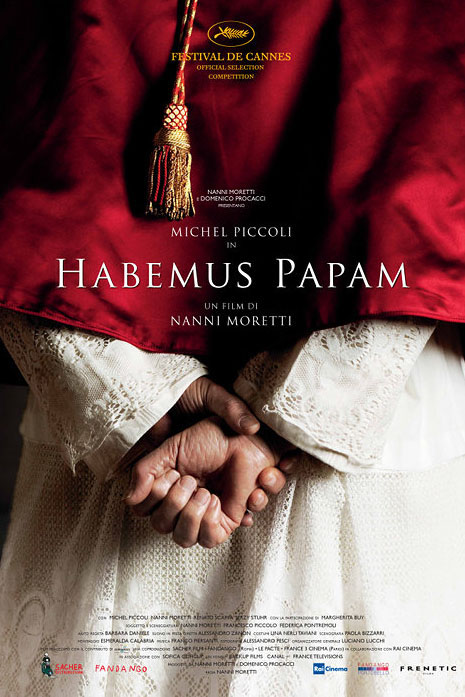
A newly-elected pope has paralyzing doubts about his own worthiness to take up the job.
Cast
Michel Piccoli
Il papa
Nanni Moretti
Lo psicoanalista
Jerzy Stuhr
Il portavoce
Renato Scarpa
Cardinal Gregori
Franco Graziosi
Cardinal Bollati
Camillo Milli
Cardinal Pescardona
Roberto Nobile
Cardinal Cevasco
Ulrich von Dobschütz
Cardinal Brummer
Gianluca Gobbi
Guardia svizzera
Margherita Buy
La psicoanalista
Camilla Ridolfi
Bambina
Leonardo Della Bianca
Giulio
Dario Cantarelli
Attore
Manuela Mandracchia
Attrice
Rossana Mortara
Attrice
Teco Celio
Attore
Roberto De Francesco
Attore
Chiara Causa
Attrice
You Might Also Like
We Have a Pope
Poern
The Palace
Amanda
Riv4li
Everything Calls for Salvation
My Family
Ginny & Georgia
Never Have I Ever
Elle
Margo's Got Money Troubles
Call My Manager
Good Trouble
Run the World
Workin' Moms
Smile Code
Hacks
Twist of Fate
Peach and Me
Adarsh Baal Vidyalaya
Maamla Legal Hai
Malcolm in the Middle: Life's Still Unfair
No Pain No Gain
Shrill
Comments
10 Comments
This movie seams to be about the next Pope. And many would see the story in some relation to the Chatolic Church or the faith. However it is not. It is about a person confronted with a situation which should be his maybe the biggest challenge or even greatest honor but for some reason it is not. It does not matter what is a cause of this dissociation. It does not matter how serious the situation looks like in the eyes of other people. In a specific moment, when the man realizes that it is just not his life, everything looks like a charade. Even the very importance of the cardinals or expectations and worries of all the followers around the world. The movie guides spectators through the inner struggles of the person who is still in doubt because of the outer image and because of the social pressures. In the contrary to the possible trivial ending that is so common in real life, where we so often loose this inner struggles and just give up, the main role next-to-be Pope succeeds in his efforts to find the way. There is no psychoanalysis, no politics and no dirty tricks of the administration to break this man. He does not loose his faith and puts his future in the hands of God, believing that he will be understood. Sometimes such decisions require the strength of the man that could even be no-less but the Pope himself. On the other hand, there should be no situation in the world where you could not say "NO, THANK YOU", if the next-to-be Pope can say NO to the world and his God.
"We Have a Pope" was advertised as a comedy, but it's really more of a drama with a few lighthearted moments. I was looking forward to this movie after seeing the trailer, which made it seem like a laugh-out-loud comedy ("hilarious" according to a Huffington Post critic quoted in the trailer). When the movie started, though, I was thinking, "Wow, this is a slow start for a comedy." Minute after long minute of cardinals walking through the Vatican and chanting as they prepare to elect a Pope. Unfortunately, this snooze-inducing pace doesn't pick up much as the movie progresses. Oh yes, the premise is intriguing: The elected Pope has a crisis of confidence at the last minute and decides that he can't go through with it. He slips away from his handlers and wanders the city, trying to resolve his dilemma. But surprisingly, given a storyline with so many interesting possibilities, the script flounders at this point. The Pope wanders from place to place, never meeting anyone we care about, never having a meaningful conversation. He never learns anything, never resolves anything. Meanwhile, back at the Vatican, the cardinals organize a volleyball tournament. (What the heck?) The director apparently thinks the idea of cardinals playing volleyball is so amusing that he even shows them in sports-movie slow motion. Yawn. As boring as the Pope's adventures are, this ball game is even more boring. About two-thirds of the way through the movie, we finally get a hint of an interesting subplot. The cardinals discuss the odds published in the local paper regarding each of their chances of being elected. It turns out that the Pope was selected despite long odds. But alas, the whole matter is quickly forgotten. "We Have a Pope" has very little character development, a skeleton plot, only two or three funny lines, and a disappointing ending. I can't recommend it.
This film has had a very diverse range of reviews, and this is probably because its full appreciation requires a finger on the pulse of the Catholic world. Moretti makes a statement about the current state of the Church, which behind its omnipotent facade seems to be unable to truly face the challenges of remaining relevant to its followers. Rather than set up an intricate political plot of intrigue and betrayal, Moretti chooses to represent this powerlessness through a single person, an unassuming cardinal who feels unable to take on the responsibility. At the same time, though, he reveals that the state of unease is widespread among the cardinals, who dread the thought of having to take on this leadership, as much as the thought of losing their leader. A banal way forward would have been for the cardinals to turn against each other, or against the Pope; instead, here they find relief in reverting to games and simple everyday activities, as if the isolation inside the Vatican walls is lifting an unbearable oppression from them, as they can do normal things as normal people do. The film has several imperfections, and one feels sometimes the story gets somewhat contorted, especially when the new Pope rekindles his old love for the theatre. Still, it is a visually attractive film, sensitively scripted and well acted. This is a surprisingly sympathetic film made by a non-believer who is often critical of the Church. Moretti is appreciative of the magnitude of the problem faced by the church, but most of all one has the impression that he cares deeply about the people involved: those on the balcony, those behind the curtains and especially those down below, in the square.
This is going to be one of the most watchable films of the year, a conversation piece to shoot the breeze around religion. It is about a new Pope elect who, after the elaborate ritual has drawn thousands of people in anxious anticipation outside the Holy See, discovers that he cannot go out on the balcony and give his blessing. He cannot be what he's expected to be. So the eye turns inwards for self-discovery. On that level the film adopts a tone of melancholy yearning. It is sad, just to see a man weighed down by the will of god, possibly dismayed at the silence. On the flipside it is funny, when all the ordained officials are worried about is the ceremonial shibboleth or a cup of cappuccino. It is generally bittersweet with old life greeting itself from a pulpit that demands closure, revelation. Meanwhile conjecture and idle speculation are continuously throughout the film being blabbed from the TV. But does it matter, which is to say can it weigh down on us or instill a silence in which to seek our words? I'm not just idling here, what I mean is this; although enjoyable on a very plain level, melancholy with red curtains fluttering in absence, and since it competed with both Tree of Life and Melancholia this year at Cannes, does it offer its own ascetic images to contemplate? The answer is likely no, but not for failing to provide opportunities. Exemplified in two instances, double perspectives both; one is of course at the beginning, with outside the triumph and celebration of organized faith, faith in god's will, but from inside there is only the confused, agitated mind of a plain man who must embody that will. The other is when the cardinals rejoice that the Pope is finally doing better; but of course, from our perspective, we know that inside the chambers is only an even more plain man as substitute, baffled at his newfound importance. He stages behind the papal curtains a play of light and shadow for the gathered congregation outside, this is a fitting image of what Moretti is looking to exemplify. So in both cases we are directed to recognize a charade of profoundest deception or false hope. Where god should be made manifest, we have instead the same hapless poor schmucks as the rest of us. There is no higher wisdom, atheists will rejoice in this. Another opinion is that his depiction of cardinals, despite the odd sour face, as kindly old men, overgrown children really, is not as scathing as some might have hoped. But the old man heard at the sermon, about the wisdom that comes from humility. Some weighs we let fall on our shoulders, because there's no two ways around it. So even though this spiritual absence becomes deafening in the finale, I just cannot embrace any of it. Catholicism may or may not deserve our modern scorn, but faith isn't doctrine. Faith being a personal attainment, it is not an old man greeting us from a balcony.
The description of the movie is wrongly understood. This movie is definitely NOT about the relationship of Pope and his therapist. The failed therapist has and episodic side-role. The movie is about a Bishop who cannot take the burden of responsibility and attention that falls upon him. How he struggles and how he finds courage to solve the situation. There is no relationship between a Pope and therapist who have a 10 sentence conversation. Even the other therapist - therapists wife does not have any major impact or role in the movie whatsoever. Okay she kind of connects with the Pope but has more of a satirical role considering the outcome and storyline. Misleading is this introduction. Please change it.
Not much to look at, commercial film with no foundation in reality, a tool for bringing religion back to disappointed believers.Clumsy attempt at imitation of the movie "La vita è Bella" which makes it even more transparent. The role of the Pope was entrusted to a good actor, I admit to that. I thought the concept of rapid mixing of unusual, funny and serious situation used only to receive a consolation prize at film festivals, but there are still people who would throw big money at the same thing. On the other hand, one can see why they selected the actors of this caliber and the language of course had to be Italian. Making it to be like some Hollywood blockbusters would not fare well, but at least this can be used by the Vatican, provided they obtain a minimal positive reviews.
I am a Catholic and this film breaks my heart for the lack in respect some people can have towards a faithful religion such as the Catholic Church. The film leaves no message of hope and contains varied and mixed portrayals of the Catholic Church. In the history of the Church, it has been necessary to use secrecy within its walls, just as most nations do, but to suggest that Cardinals and leaders are simply blind sheep, being strung along by their faith without reason is enough to be mad at this film. The Church leaders are not whimsical or frivolous in nature. Nor are they weak minded, as the film suggests. They may be filled with humility, but they are not weak. Nanni Moretti is bold for making this film. He does, to some extent, capture the grandeur and solemnity of the Vatican and its practices, but then he destroys it by making the cardinals looks like a bunch of drug dependent old fools. I strongly suggest looking else where for a cheap laugh because the implications the director wants to convey weaken the Church, her honor, and the ability she has to continue to be one of the remaining moral voices this world still has. Also, the ending is, as wikipedia points out, a big let down.
We have a Pope, or Habemus Papem, starts with the death of the Pope and the funeral procession at the Vatican. The scenery is spectacular with Cardinals from all over the world reciting prayers. The story then switches to the voting for the new Pontiff. The election of the new Vicar of Christ, played brilliantly by Michel Piccoli, is a very interesting concept. Piccoli has severe doubts as to his ability to lead the Catholic Church and refuses to accept his fellow Cardinals decision appointing him to be in charge of the great bureaucracy of Rome. The best psychiatrist in Italy is brought in to help the newly elected Pope deal with his anxiety. He leaves the Vatican for a few days to travel incognito and find himself among the common people. I won't continue so as not to spoil the rest of the film except to say that it remains interesting throughout. It never becomes preachy and the cast is excellent, led by Michel Piccoli.
I saw the movie a few days ago and, even though I did not like the ending, I gave a 9/10, because I loved how the Cardinals were made to look so godly and so human at the same time. Michel Piccoli did such great acting. Last but not least, besides being very entertaining, the movie now has proved to be prophetic, as Pope Benedict has resigned to everyone's surprise. That alone makes this movie, a great movie. PS: For the person who wrote: "Waste of time, written by an atheist so what do you expect", and then complains of "an insult to all Believers". I am not an atheist; I believe in God. But my thinking brain felt deeply insulted as I was reading the rant.
Moretti is an interesting director and his documentaries and movies (like "The Son's Room") shows us why. But what in the name of the Holy Spirit is he trying to tell us here? To get a foothold inside the Vatican, the nucleus of one of the great (well, at least by numbers) religions in the world, is a daunting task. It becomes clear that the director had been more interested in the the mindset of the man who's to be the next pope, than in any political or human machinations of the electors. We know our popes of the past - Peter O'Toole's or John Goodman's pope are a delight - but any effort to get into the inner workings of the Vatican has eluded us: Preminger's "The Cardinal" and Anderson's "The Shoes of the Fisherman" just scratch the surface and are too reverential, so Fellini still steals the show with his delightful religious fashion show in "Roma". And that for a job description to head a congregation of over a billion, elected by a college of a mere hundred or so cardinals. Stuff for either historical pageantry (we all love our Borgias) or an insight into the mindset of electors or popes-to-be, about why a job can make or break a man, or how the past does influence your future. Instead we're offered the choice of an ass between two bales. Is it is meant to be a farce? Then the bunch of actors hired to play a bunch of totally idiotic cardinals playing volley-ball in the aftermath of the conclave are right fitting in. But because of that it is very difficult to sympathize with the turmoils of a Pope-to-be with those allusions to All the world's a stage, the heavy references to Chekhov and all that. I mean, who wants to be a pope over this lot of twittering morons? And Piccoli is certainly not a fool, but a tormented soul who seems to have lost his confidence and the past. How does that fit in with farce? With a bunch of blabbering idiots playing pinocchio or volley-ball and a man in crisis? So, is it then meant to be a probing insight into the soul of a man who's thrown into this world as the next Pontiff? Is this a probe into the turmoils of a Pope-to-be? After all, apart from power-hungry popes in fiction, it is indeed an almost inhumane job. Then the bunch of actors hired to play a bunch of totally idiotic cardinals inside the conclave or playing volley-ball in the aftermath are totally unbelievable. They deny us any symphatising with the main character as we're lead to believe that some of the most powerful men in the world are blabbering idiots playing pinocchio. Alas, the director, playing the part of an atheistic psycho-analist, fits right in with this cardinal bunch. The director should have known that the real world is barging in with almost every frame, with a church and its board of managers wading through a lot of controversial items. As a viewer you can't exclude that: we don't live in a vacuum. Moreover, the allusions to John XXII, Paul VI and John-Paul I are drawn with heavy strokes indeed. So, we're stuck between two bales of hay. Bad choice. The director couldn't make an artistic choice and left us with no choice at all. In the end we can understand the Pope's decision, but not because we care for him or his struggle, but who in his or her right mind would govern a church with a council of idiots? Mmm that may be the point the director is making?