
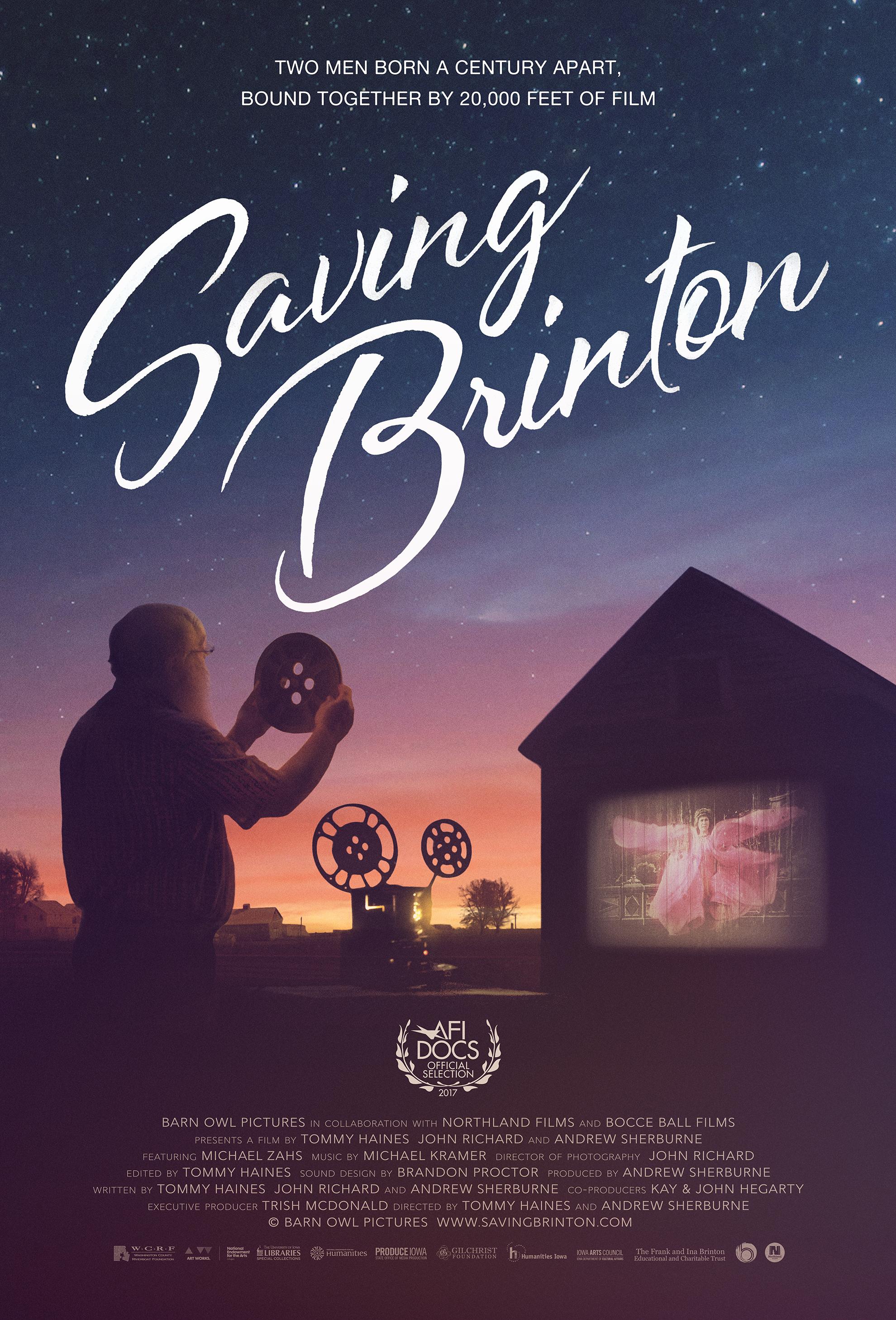
In rural Iowa, a beloved history teacher uncovers the century-old showreels of one of America's first motion picture impresarios and sets out to premiere the films at the world's oldest continuously operating movie theatre.
Trailer
Cast
Tommy Haines
Director
Andrew Sherburne
Director
Michael Zahs
Self
Serge Bromberg
Self
Greg Prickman
Self
Kathryn Fuller-Seeley
Self
Rick Altman
Self
George R. Willeman
Self
Jan Boland
Self
Carey Bostian
Self
John Dowdall
Self
Charity Nebbe
Self - Radio Host
Harvey Solberger
Self
Mitch Thompson
Self
Elaine Zahs
Self
Julie Zahs
Self
Tommy Haines
Writer
John Richard
Writer
Andrew Sherburne
Writer
You Might Also Like
Saving Brinton
Addicted to Sexting
Rat Film
Stormy
Bad Cop
Sex, Explained
Sex Sells
Marines
The BMF Documentary: Blowing Money Fast
The Principles of Pleasure
Trust Me: The False Prophet
Michael Jackson: The Verdict
Cosmos: A Spacetime Odyssey
Eat the Rich: The GameStop Saga
The Chef Show
The Takedown: American Aryans
The UnXplained
Should I Marry a Murderer?
Working: What We Do All Day
Earthstorm
Black Love
Trafficked with Mariana Van Zeller
The Planets
The Hair Tales
Comments
10 Comments
source: Saving Brinton
I found Saving Brinton to be a great documentary, owing partially to its unusual and interesting topic and its wonderful images. However, what I loved most about the documentary was its three-layered narrative: At face value, the documentary is about the uncovering of the history of the Brintons' contribution to film projection. However, I think that the Brintons comprise the second layer of the narrative of the documentary. I think that the broadest, outermost, and perhaps most central layer is the story of Michael Zahs, a perseverant storyteller-historian who dedicated more than 30 years of his life to researching and communicating the evidence about the lives and work of two people whom happen to have lived in the same house as him 120 years ago, the Brintons. The third layer is the discovery of the few remaining copies of Georges Melies' movies in color, which were owned and projected by the Brintons.
Touchingly capturing a man who saves things only when they seem to be beyond disrepair, "Saving Britton" is an uplifting documentary that, while at times needlessly meandering and amateurish, is decidedly enriching. A Washington, Iowa man, seemingly in the guise of Dumbledore, has faithfully kept a myriad of olde tyme things, but most notably a treasure trove a film canisters and artifacts from the dawn of cinema (as far back as 1895). With the aid of archivists and restorationists some movies that were believed to be forever lost have been found. And that is wonderful and fascinating, but the movie isn't as concerned with that as one might expect. The documentary is clearly focused on the man and his philosophy, which is rural Iowan to its core, utilizing everything to its fullest. It is indeed touching and even at times profound. Unfortunately a better editor could have made a top notch film, but at no point is the heart of the movie lost. I had a wonderful time at the cinema, basking in the wonders of ancient film and learning again that the past forever speaks to us.
This movie turned out not to be about saving a collection of early movies and associated paraphernalia -- including Star Films and Pathe Freres catalogues -- pardon me while I wipe the drool from the keyboard -- but about Michael Zahs, a self-described "saver" who saw the stuff being thrown out, saved it and spent thirty years telling people gently, politely and repeatedly "This should be saved," before anyone listened. I wept.
This documentary centres on Michael Zahs, who is a historian and collector from Iowa who came into possession of some ancient films which once belonged to the cinema exhibitors Frank and Ina Brinton, who operated over one hundred years ago. These films became known as the Brinton Collection and they contained many old movies long believed to be lost, including work by the most important early film-maker, the one and only Georges Méliès. The documentary looks at both these films, Zahs himself and the Iowa community he is from. I have seen a good number of silent movies from the earliest years of cinema and always marvel at the trick photography and invention which are a core feature. Méliès films in particular showcase visual invention by the bucketload. So, from the perspective of this alone, Saving Brinton is a very worthwhile film. Many of the recovered films are really rather beautiful, especially when presented in their original colour tinted glory. Any fan of cinema history should spend a little time checking these out to see how it all began. As a film itself, the documentary is admittedly a little bit lacking in focus, with no real sense of narrative urgency. There is no build up to a finale where we finally see the films themselves and I think a little more emphasis on the drama of the story would have served it well and improved it. Nevertheless, this still remains a very interesting little doc about a fascinating man and some glorious old, no longer lost, films.
source: Saving Brinton
I found Saving Brinton to be a great documentary, owing partially to its unusual and interesting topic and its wonderful images. However, what I loved most about the documentary was its three-layered narrative: At face value, the documentary is about the uncovering of the history of the Brintons' contribution to film projection. However, I think that the Brintons comprise the second layer of the narrative of the documentary. I think that the broadest, outermost, and perhaps most central layer is the story of Michael Zahs, a perseverant storyteller-historian who dedicated more than 30 years of his life to researching and communicating the evidence about the lives and work of two people whom happen to have lived in the same house as him 120 years ago, the Brintons. The third layer is the discovery of the few remaining copies of Georges Melies' movies in color, which were owned and projected by the Brintons.
This documentary centres on Michael Zahs, who is a historian and collector from Iowa who came into possession of some ancient films which once belonged to the cinema exhibitors Frank and Ina Brinton, who operated over one hundred years ago. These films became known as the Brinton Collection and they contained many old movies long believed to be lost, including work by the most important early film-maker, the one and only Georges Méliès. The documentary looks at both these films, Zahs himself and the Iowa community he is from. I have seen a good number of silent movies from the earliest years of cinema and always marvel at the trick photography and invention which are a core feature. Méliès films in particular showcase visual invention by the bucketload. So, from the perspective of this alone, Saving Brinton is a very worthwhile film. Many of the recovered films are really rather beautiful, especially when presented in their original colour tinted glory. Any fan of cinema history should spend a little time checking these out to see how it all began. As a film itself, the documentary is admittedly a little bit lacking in focus, with no real sense of narrative urgency. There is no build up to a finale where we finally see the films themselves and I think a little more emphasis on the drama of the story would have served it well and improved it. Nevertheless, this still remains a very interesting little doc about a fascinating man and some glorious old, no longer lost, films.
This movie turned out not to be about saving a collection of early movies and associated paraphernalia -- including Star Films and Pathe Freres catalogues -- pardon me while I wipe the drool from the keyboard -- but about Michael Zahs, a self-described "saver" who saw the stuff being thrown out, saved it and spent thirty years telling people gently, politely and repeatedly "This should be saved," before anyone listened. I wept.