
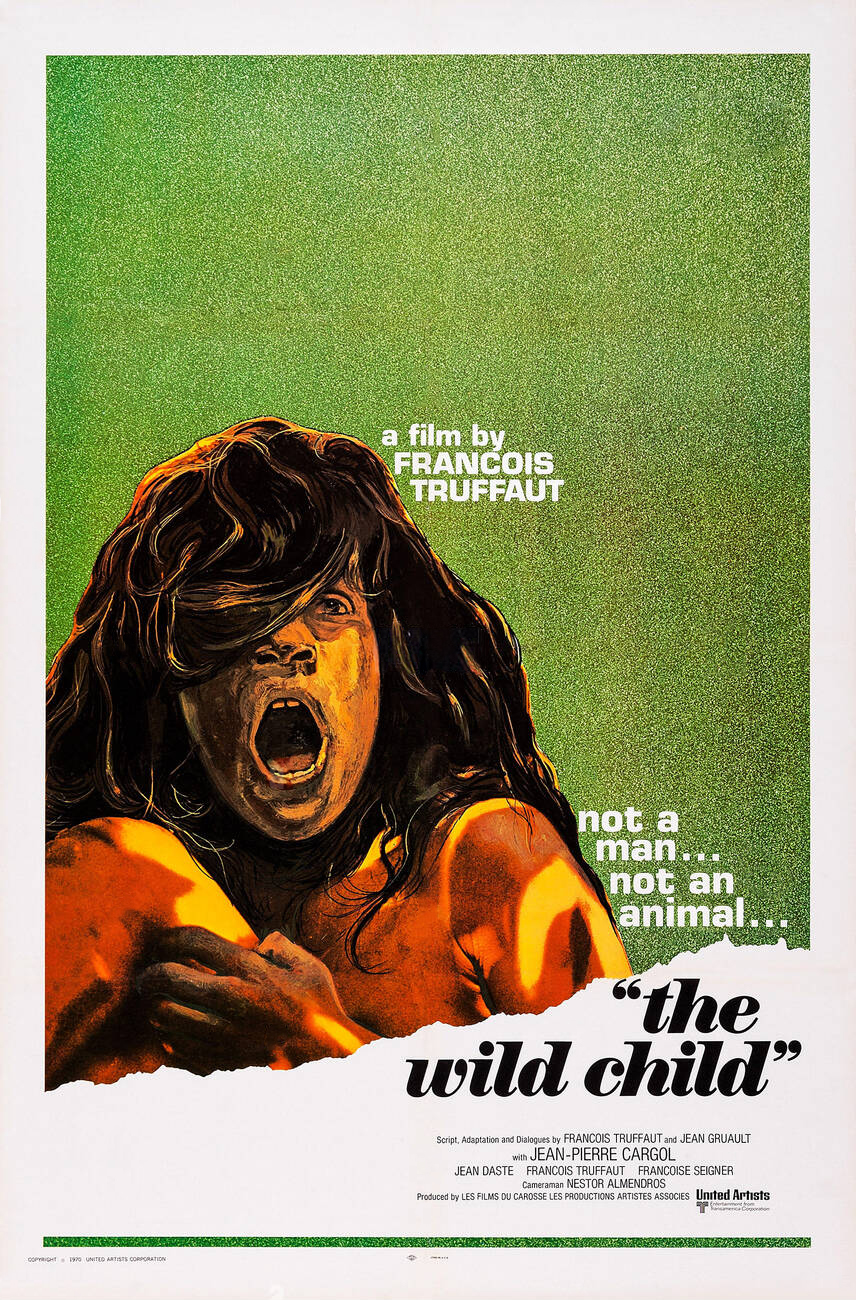
In a French forest in 1798, a child is found who cannot walk, speak, read or write. A doctor becomes interested in the child and patiently attempts to civilize him.
کاسٹ
François Truffaut
Dr. Jean Itard
Jean-Pierre Cargol
Victor - Wild Boy of Aveyron
Françoise Seigner
Madame Guérin
Paul Villé
Rémy - The Old Man
Pierre Fabre
Orderly at Institute
Jean Dasté
Professor Philippe Pinel
Robert Cambourakis
Aveyron Countryman
Tounet Cargol
Boy at Farm
Eric Dolbert
Boy at Farm
Frédérique Dolbert
Girl at Farm
Jean Gruault
Visitor at Institute
Dominique Levert
Child at Farm
René Levert
Police Official in Rodez
Gitt Magrini
Aveyron Countrywoman
Jean Mandaroux
Dr. Gruault - Itard's Doctor
Annie Miller
Madame Lémeri
Claude Miller
Monsieur Lémeri
Nathan Miller
Baby Lémeri
آپ کو یہ بھی پسند آ سکتا ہے
The Bible Collection: Jeremiah
Holding the Man
Mark Felt: The Man Who Brought Down the White House
Corsage
Borgia
Versailles
The Spy
Becoming Karl Lagerfeld
The Chosen
Genius
Victoria
Carême
Queen
Strange Angel
Leonardo
Self Made: Inspired by the Life of Madam C.J. Walker
A Small Light
Made in India - A Titan Story
Death by Lightning
Catherine the Great
Mrs. America
Mussolini: Son of the Century
Zelda
Sistas
تبصرے
10 تبصرے
The Wild Child is a film that resurfaces the true story of a young boy who is found living wild along the French countryside. The boy is like an animal in the sense he is untamed, self reliant, has a fear of humans, bares no clothing, and is accustomed to the elements of nature. The film begins with the capturing the eleven year old boy and his subsequent introduction to the civilized world. The child's fascinating story makes newspaper headlines in 1798 and among the many Parisians whose interest is sparked is that of a doctor played by Truffaut himself. Interested in studying the boy and discovering his potential, the doctor takes the young ruffian into his own home and begins a methodical series of learning experiments. Truffaut uses this remarkable story and creates a wonderful film set in the late eighteenth century. He also avoids the all too common trap of over dramatizing a film set in this era and simply concentrates on the subject matter at hand – the discovery of a wild youth and his introduction into civilized world. The film is beautifully shot and Truffaut's simplistic narrative keeps the viewer's attention at all times. Although one of Truffaut's most unique films, The Wild Child is not quite a masterpiece, but has much merit and is definitely worth viewing.
Wild Child, The (1970) *** 1/2 (out of 4) Brilliantly made drama about a wild child (Jean-Pierre Cargol) who is found in the woods and taken into society. Some see him as a dumb beast but Dr. Itard (Francois Truffaut) thinks he might be able to teach the kid something and turn him into something society would accept. This was my first Truffaut feature and I must say that its beauty really took me by surprise and makes me embarrassed to not have sampled the director sooner but at the same time it makes me happy because I know I have so many more films to check out. I think a lot of films would have fallen into a wild, more exciting story to tell. By that I mean a lot film, especially those in America, would have centered the story on more than just teaching this child. There would have been some sort of added drama about the doctor's personal life or some sort of drama about another doctor wanting to keep the kid locked up. There are a few minor things that happen outside the teaching but for the most part we are simply focused on this young "animal" and the doctor trying to teach him to be more human. We don't really learn what happened to him or why he turned into a wild child but it's really not important. I'm sure there could have been a great film made about it but this isn't that movie. It didn't really dawn on me until the final minutes of the movie but in a lot of ways this is a beautifully told love story. The love the doctor shows this boy was quite touching and the message of not judging someone is certainly on full display. What makes this work so incredibly well is how laid back the film is. There's never one scene more important than another but instead the entire film stays at the same pace and one thing is never given more credit than something else. A lot of movies want to build up drama for one climatic scene or payoff but that's never the case here. I guess calling the movie brave for doing that wouldn't be an overstatement. I was really amazed by the performance of Cargol who clearly steals the film. He doesn't have a single line of dialogue but he says so much just with his actions and movements. I would call it one of the greatest silent performances I've seen because that's pretty much what it is. Truffaut and Francoise Seigner are also great in their roles. This is certainly a very memorable adult movie that I think some kids could even enjoy. I can't help but look at the kid in the same way that I'd see Frankenstein's monster in the 1931 film. Kids certainly see themselves in the monster and I don't think they'd have any trouble seeing themselves in this wild child. I think adults could also easily see themselves in the role of the doctor here, trying to teach and bring this child up. The wonderful editing, terrific music score and extremely touching ending makes this a very enjoyable movie.
French director François Truffaut always had a penchant for stories made for children.He has converted many brilliant stories about innocent children into wonderful films where children have been shown as people with their own psychological problems.L'Infant Sauvage is a different film for children.It must be hailed as a victorious effort for Truffaut.It is one of those rare films which gives full opportunity to its actors to succeed well in order to reveal the truth regarding inexplicable social phenomenon.It is a nice thing that through such a bold film Truffaut has decided to tackle obscurantism which was very much prevalent in the past.For those who have seen Kaspar Hauser directed by Werner Herzog,it is quite natural that certain comparisons would surely be made.However,it must however be kept in mind that although both of these films dealt with almost the same topic historical topic,their treatment is different from one another.It is because of Jean Pierre Cargol that "L'Enfant Sauvage" appears to be a purely,authentic tale of how a country doctor restored the dignity of a human being.
In France during the 1700s there was a considerable interest in discovering the character of mankind in its natural state. That is, what would we be like without the benefits of society? Some philosophers, like Hobbes, argued that we'd be pretty rotten to one another without the control of some central authority over our animal passions. ("The war of all against all.") Jean-Jacques Rousseau thought that human would be rather nice, that we were born with compassion for others. ("The Noble Savage," which is a misrepresentation of Rousseau's anfractuous argument.) After all, even animals showed nurturance for each other. (He should have seen a herd of elephants coming across a skeletonized specimen. The herd goes ape, picking up the bones and running this way and that in confusion. You get the feeling they'd like to give the deceased a proper funeral and bury him.) Well, when the wild child of Aveyron came out of the wilderness in a state as close to nature as it was possible to get -- no clothing, no speech, no table manners, no religion, no nothing -- what an opportunity to test the theories of people like Hobbes and Rousseau. The boy was about eleven or twelve when he was brought to Jean Itard, a scientist who ran a school for deaf mutes near Paris. Itard brought him into his own house and raised him with the help of a housekeeper. The film is a kind of docudrama describing Itard's attempts to instill some social and linguistic skills in the child -- after they cut his hair, scrub him down, and put some clothes on him. Francois Truffaut, the director, is Itard. Jean-Pierre Cargol is the child, who is named Victor, and he's not bad for a kid his age. Now, the approach to the subject that Truffaut uses is likely to be off-putting for some viewers. If you had to choose a single word to describe it, "clinical" might do the job. Truffeau the director does not elicit any pity for the churlish Victor. He could be pretty bratty when he wanted to be. And Truffaut the actor is detached throughout. His narration, which sounds as if it had been taken directly from Itard's notes, is cold and almost Listerian. Itard rarely shows any warmth towards Victor -- and vice versa. Victor isn't much more than the subject of a longitudinal case study. What drama there is, is built around small incidents, like Victor's learning to drink milk from a bowl instead of lapping it up with his tongue. Compared to this, "The Elephant Man" is a blatant tear jerker. However, the script gives the story something of a happy ending. It ends after Victor learns to say "lait" and to spell it, too. The implication is that the kid will go one to master language and become a full-fledged adult human. It didn't happen. In Victor's case he never got much beyond "lait" and a couple of grunts, and that was apparently the state in which he died. There are other cases of children growing up in isolation. Probably the best known is that of Genie, a Los Angeles girl who was confined to an attic room by her father for twelve years, strapped to a potty. She didn't acquire more than the most fundamental of social skills. And she didn't learn to speak any better than Victor, though both were probably of normal intelligence. There seems to be a kind of launch window when it comes to learning a language. Once that critical period is past, it's gone for good. As for Hobbes and Rousseau, their theories were interesting thought experiments but in the few authenticated cases of real childhood isolation, the kids don't seem either warlike or compassionate. Mostly they're uninterested in adult activities. They lack curiosity and aren't eager to learn. As Rousseau might have put it, plus ca change, plus ca meme-chose, eh?
From my summary you might think this is a fictional story. Well, it isn't exactly. Instead, the movie is BASED on the true story of Victor, a feral child that was discovered roaming the countryside in late 18th century France. Much of the movie is true BUT somehow Truffault succumbed to the Hollywood idea that true-life stories need to be changed to make them more palatable to the general public. This is very odd indeed considering Truffaut was a founding "New Wave" director--a group who usually avoided clichés and Hollywood's style. Unfortunately for the real Victor, his life did NOT end positively (as the movie strongly implies) but he remained functionally retarded through his SHORT life. However, I still recommend the movie and I use the film in my high school psychology class. Despite much of it being subtitled, I have found that high schoolers enjoyed the film very much. It also gave us the opportunity to compare and contrast the true story with the film. In particular, I loved how this film showed the very detached and clinical manner in which Victor was raised--it really pulled at your heart and made you feel for this poor kid.
I recently read T.C. Boyle's book of short stories "Wild Child: and Other Stories". The final story in the book was "Wild Child" that is about this same boy "Victor". Boyle actually refers to this story as a novella. It is quite a bit longer than all the others. After hearing T.C. Boyle in a radio interview mention this movie, I decided to get a copy from my library after finishing the book. Compared to his story, the movie is very disappointing. I find his writing to be almost incomparable, and this story really captures "Victor" far better than this movie. If you have seen this movie and liked it, I can only recommend that you read "Wild Child: and Other Stories". And I'm certain that if you haven't seen the movie and read the book first, you too will be disappointed in the movie.
In terms of storytelling, It is hard to judge Wild Child outside the terms of the Cinema Verite system in which it operates. It is a simple and very literal film, and like all French new wave films, the story is more of a train of thought than a compelling narrative. At least is not flat out cold. there are enough moments of charm and insight to make Wild Child watchable. Truffaut's performance is not warm or fuzzy. He is frank and sincere and logical. It could be argued that his representation of good parenting is the film's biggest accomplish. He doesn't pander to his child's every need but he abandon him or resort to heavy abuse to fortify him. The biggest problem is that there is no ending, and subsequently no punchline. The themes of bringing civilization to the uncivilized have no visible consequences that can be related to. Truffaut teaches the Wild Child simple lessons such as right and wrong but nothing of love, or caring. He succeeds in taming a vulnerable creature but falls short of making him a human being.
Has the end of the 18-th century, a Parisian doctor tries to educate a wild child, arrested in the forest where from he had never gone out. Being inspired by authentic facts, François Truffaut signs a fascinating work. Deeply moving.
If it weren't for several other strong works from Truffaut, this one would be my favorite. And it somes ways it is my favorite. The interaction between Victor and Dr. Itard was splendidly done. It was a joy simply to watch Truffaut on- screen directing the boy's progress, much like he must have done off-screen to get some very human reactions. At no point during this film did I think a scene was overdone or unnatural. It just seemed to flow from one small triumph to the next. My only complaint was that the whole experiment ended abrubtly, and so too did the movie. We are told by Dr. Itard that Victor is a extraordinary boy, but he has much training left to master. There were many points along the way where doubt lingered as to whether the wild child could be fully trained at all until the final scene. There we learn that Victor has a new home. This movie was based on a true event which took place in the late 1700s. Unfortunately for the audience, the most pressing question of what became of Victor in his adult life is left unanswered. But fans of Francois Truffaut will find him even more engaging than in his role of Claude Lacombe in "Close Encounters of the Third Kind". The roles are similar in many ways. If Lacombe could have taken home the child-like aliens to instruct, I'm sure he would have been much like Dr. Itard.
A child left to fend as hunter gatherer, a late 18th century, French forest forager, brought into society, just wants to run, escape and flee, but Jean Itard will take him in, become his shelterer. After spending many years in isolation, nobody knows the level of, the boys cognition, can he learn to read and write, show less aggression, resisting flight, a start is made to change his ways, make transformation. An incredible film, mainly down to the incredible performance of Jean-Pierre Cargol as the boy recovered from the forest, who leaves you under no illusion that he could literally have grown up in isolation, in the middle of nowhere, with only the flora and fauna of the forest for company. Still holds up all these years later, which is not as common as you might think for many films made around this time - well worth further investigation.