
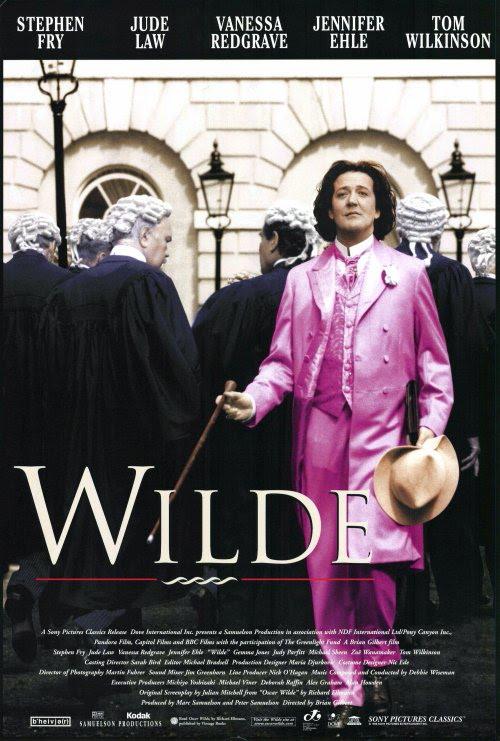
अपनी समलैंगिकता का पता लगने के बाद, कवि/नाटककार, ऑस्कर वाइल्ड के जीवन में उथल-पुथल मच जाती है.
ट्रेलर
कलाकार
Brian Gilbert
Director
Stephen Fry
Oscar Wilde
Jude Law
Lord Alfred Douglas
Vanessa Redgrave
Lady 'Speranza' Wilde
Jennifer Ehle
Constance Wilde
Gemma Jones
Lady Queensberry
Judy Parfitt
Lady Mount-Temple
Michael Sheen
Robbie Ross
Zoë Wanamaker
Ada Leverson 'Sphinx'
Tom Wilkinson
The Marquess of Queensberry
Ioan Gruffudd
John Gray
Matthew Mills
Lionel Johnson
Jason Morell
Ernest Dowson
Peter Barkworth
Charles Gill
Robert Lang
C.O. Humphreys
Philip Locke
Judge
David Westhead
Edward Carson
Jack Knight
Cyril Wilde
Jackson Leach
Cyril Wilde, aged 4
Julian Mitchell
Writer
Richard Ellmann
Writer
आपको ये भी पसंद आ सकते हैं
A Hidden Life
Vita & Virginia
Postcards from London
The Aspern Papers
Staged
Love Story
Pam & Tommy
Good Doctor Thailand
Tumhare Husn ke Naam
Pam & Tommy
Sistas
Beauty in Black
Bel-Air
Stranger Things
The Chi
The Rookie
From
Power
Into the Badlands
Legacies
Power Book II: Ghost
SEAL Team
S.W.A.T.
टिप्पणियाँ
10 टिप्पणियाँ
Stayed up till the wee hours to catch this on IFC. What should have been engrossing, I found distant and rather boring. The film seeks to make Wilde a revolutionary, but we're not given a profound insight as to what made him tick. No mention of the woman (yes, woman!) he fell in love with who left him for Bram "Dracula" Stoker! No mention of his role in the aesthetic and decadent movements and the socialist writings that sprang from it. Or his trashing rooms in drunken rampages. While he was, as shown, well-received in the rough-and-tumble Leadville during his tour (the film doesn't mention he was in America to repair his wilde-man rep and counter the popular backlash against aestheticism), it omits that he was ripped by the upper-crust, especially in San Francisco, of all places! Worse, Fry's and Law's performances reek of the gay stereotypes of cattiness, selfishness and narcissism. I got little feel for how big Wilde was (George Bernard Shaw was a fan) and how truly spectacular his fall was. Nor does it show him conflicted in the least. You get the impression he knew he was gay, married because it was expected, and expected the Mrs. to put up with his shenanigans. The film then alters the key episode of his life. Douglas was arrested (not shown) after Bosie egged Oscar to charge the old man with libel (as shown). Since, on the trial's second day, our hero admitted to perjuring himself (also not shown), it's understandable why it was revised to make Wilde the ultimate poster boy for "the love that dare not speak its name." How ironic that Oscar's great love (besides himself) later converted to Catholicism, married, and spent the rest of his life attempting to bring gays to "justice."
The acting in this film was superb. As had many viewers--I suspect-- I had only seen Stephen Fry in the Blackadder and Wodehouse series. How delightful to find another actor intelligent and flexible enough to range from Melchett to Oscar Wilde! One cannot help but watch his face very carefully, waiting to see the mask slip. He seems strangely delicate in his huge, crushing frame...A nice follow-up movie to Velvet Goldmine, especially once you know that some of the dialogue from the latter was lifted from the works of Oscar Wilde.
If you have seen Wilde as portrayed by Peter Finch in `The Trial of Oscar Wilde' (1960) then Stephen Fry will seem very wooden indeed. Fry's only saving grace is that he looks the part but his acting is that of an overweight pudding. The rest of the film looks just like one of those tedious BBC costume dramas. Queensbury`s ridiculous stick on sideburns typify the quality of the wardrobe department. I suspect that the character of Bosie (played extremely well by Jude Law,) was entirely based on the performance by John Frazer in the 1960 Finch film This film is the result you can expect when a production is based around a single actor's (Fry,) desire to do the part rather than a competent director's vision.
Wilde is a film about a man's passions destroying his life. Oscar Wilde was a very interesting man and discovered his dormant homosexuality late in life. The film was very tragic in a lot of ways. The love story between Wilde and Douglas was venomous and sweet. The performances by Jude Law and Stephen Fry were top notch. The direction was a little sluggish I thought and the film could have been better paced. The production design was great though and I loved listening to Wilde's sarcasm of the British class system. If you are a fan of Oscar Wilde, you will probably like this film more than the average movie fan.
Not really knowing alot about the life of Oscar Wilde, I looked forward to viewing this film, hoping that it would fill in one of the many gaps in my education. I was not disappointed. This is a film of exceptional human warmth and I can highly recommend it. It deals matter-of-factly with the "issue" of homosexuality, it doesn't condemn or condone what happened in Wilde's private life, the viewer just gets a look at the man underneath the legend. Stephen Fry does a great job as the title role, making Wilde a sympathetic character with whom the audience empathises. How he contrasts with the Marquess of Queensbury! I will long remember the confrontation between the two men, with Wilde giving as good as he gets against the Marquess' pathological hatred. Jude Law gives an expert performance as Bosie (or Lord Alfred Douglas), with his deeply contrasting nature shown to full effect, sometimes being tender and loving, at other times changing into a screaming "madman". Overall, I thoroughly enjoyed this film and can heartily recommend it to anyone who likes good films.
Playwright, celebrated wit and persecuted homosexual Oscar Wilde is excellently portrayed by Stephen Fry in this biopic but without a hint of the expected waspishness. Instead, we see Wilde as a kindly, sensitive, almost avuncular man. What's more surprising is the parallel absence of manifest sordidness, self-loathing, or desperation, which one might have assumed would have been par for the course in an age where homosexuality was stigmatised and criminal. But as 'Wilde' tells it, Oscar, on discovering his true nature in early middle age, then enjoyed a number of halcyon years in a gay literary milieu, tensioned only by the childish behaviour of his lover, Bosie, and was taken quite by surprise when he suddenly became a figure of public scandal. Which may have been the case, but it makes for a less pressing and gripping drama than one might have hoped for. What's interesting is Wilde's defence in court, which has very little to do with "normal" homosexual behaviour or ordinary human relationships, but which rather comprised a divine idealisation of the bond between a wise older person and a beautiful younger one: hardly the sort of argument that gay rights campaigners would make today. A special credit should go to the team responsible for allowing Fry to appear so convincingly both a dashing young twenty year old and a ruined man, on the verge of death. But this is a mild and indulgent film.
My review is a bit of a mixed one. To start off with, I really like Stephen Fry, seeing as I'm a proud owner of the complete Jeeves & Wooster. I also like Jennifer Ehle, who played Constance Wilde, though I've only ever seen her in Pride and Prejudice before. I didn't consider this a bad movie, but I didn't consider it an extraordinarily good movie, either. I kept having the feeling that it could be more than what it was. The plot seemed to jump from incident to incident without much time for the audience to fully appreciate each. In the first couple of scenes the relationship between Oscar and Constance is starting, then before I know it they're married. Before I could get a full grasp of the dynamics of their marriage Oscar is sleeping with Robbie, and before I could figure out how the relationships with Constance and Robbie were reconciling themselves in Oscar's mind, he was onto the next one. Then before I could figure out how he felt about that, he was meeting Bosie... Bosie was one of my favorite things in the film. Just when I thought he was a spoiled little rich brat he was cuddling Oscar, and then once I decided he was all right after all he was whining about how boring Oscar was when he was sick. (I'm sure you're witty and charming when you're ill, Bosie...*rolls eyes*) Then there were the renters. I liked the renters if only because they reminded me of the parts in the book At Swim, Two Boys where MacMurrough is thinking about Oscar Wilde, his hero. Of course, I am not going to complain about Jude Law in bed with a naked renter, either. Seeing as each relationship didn't have sufficient time to be developed, however, some of the nudity came across as gratuitous. Gratuitous nudity can be fine, but after a while my thoughts were less "Oh, nice arse" and more "Here we go, another naked renter, again." I found the dynamics of the Douglas family quite intriguing, and I'd love to see a movie in which Bosie and not Oscar is the main character. Bosie's father was sex-obsessed, had a fixation with cremation, and drove one of his sons to suicide (according to Bosie, that is). He carried a whip everywhere and apparently used it on various members of the family. Forget the naked renters, let's examine how Bosie became the way he was. Oscar on trial was of course fascinating to watch, as the real-life facts of the trials could never be ruined by any screenwriter or director. However, seeing as I didn't have much time to develop feelings about Oscar and his situation, I wasn't emotionally drawn in. Things I liked: Constance's slightly suspicious innocence of her husband's relationships. I was also fond of the scenes with their children, and the fairy tale that Oscar writes and tells to them; it serves as a metaphor for large portions of the film. My favorite Oscar/Bosie scene was early on, when they're walking around arm in arm while Bosie tells Oscar how he's being blackmailed. Oscar's advice on how to get rid of the blackmailing former lover was insightful as to the initial attractions Bosie has for him. In conclusion, the film certainly had its great moments, but it was choppy and sometimes sensationalized, which in my opinion prevented it from being truly powerful.
I've seen Oscar Wilde portrayed on film before. I remember Robert Morley and also Peter Finch. They both provided inklings into the heart and mind of of one of the literary giants of the 19th Century. But one aspect of the tragedy, because, let's face it, it is a tragedy. His relationship with Alfred Douglas that in a very direct way, will mark his destiny. It was so difficult to believe that Peter Finch's Wilde will go to war for someone like John Frazer's Bosie. Good looking yes but devoid of the most important element, if you are going to believe in the power that Bosie had over Wilde. Finch and Frazer have the sexual chemistry of two slices of white bread but here, in this 1997 Wilde with Stephen Fry in the title role the mystery is revealed, Jude Law makes the whole thing totally believable. The desire he inspires we see in Oscar Wilde's eyes. Stephen Fry is another Humbert Humbert to Jude Law's Lolita. Amazing when the most incomprehensible action becomes totally understandable in the face of an actor. That alone, makes this Wilde my favorite.
"Wilde" is an elegant film with sterling performances by Fry, the title character, and a superb supporting cast. However, "Wilde" is also a shaded and skewed partial portrait of the 19th century playwright, poet, and master of the epigram. The film is not so much a biopic as it is a drama: A drama which spends too much time on the sensational aspects of the writer's life and not enough on his history, early life, idiosyncrasies, works, and last years. Nonetheless, "Wilde" is solid entertainment for anyone interested in Victorian period dramas or the man himself. (B+)