
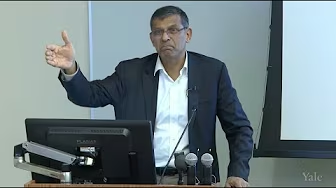
The Castle Lectures were endowed by Mr. John K. Castle. They honor his ancestor the Reverend James Pierpont, one of Yale’s original founders. Given by established public figures, Castle Lectures are intended to promote reflection on the moral foundations of society and government and to enhance understanding of ethical issues facing individuals in our complex modern society.
आपको ये भी पसंद आ सकते हैं
How to Be a Better Human
Recent videos we think you’ll love
Top Videos
Berklee Holiday Videos
7 Bears | Netflix Jr
AI, Technology and Society 2025
Campus Chronicles
Year1 Music
JSS9 Other
Learn English With Disney Movies
CoComelon #shorts
Test Your English with TV Series and Movies
All New Akili & Me
Educational Cartoons for Kids | Learn with Sheriff Labrador
Sheriff Labrador New Episodes
🎃🕯️🧛♀️ HALLOWEEN STORIES 2025 🕷️🧹👻
Charlie and Lola Full Episodes
🎮⭐ Play & Watch | Trailers and Gameplays
Emanuella And Success Comedy
Sheriff Labrador Popular Live Stream
Learn about Good Habits & Good Manners for Kids
🎬⭐️ BRAND NEW Episodes | Talking Tom Shorts: Season 3 🤣💙
Sleepytime! 💤 | Learn Words with Yakka Dee |BBC Kids
Numberblocks & Alphablocks - Learn to read and count #readingmonth
टिप्पणियाँ
10 टिप्पणियाँ
Samuel Bowles, Research Professor at the Santa Fe Institute and Professor of Economics at the University of Siena, gave three public lectures presenting evidence that explicit incentives and constraints often diminish ethical motivations. This is the first lecture of a three-part series.
Samuel Bowles, Research Professor at the Santa Fe Institute and Professor of Economics at the University of Siena, gave three public lectures where he presented evidence that explicit incentives and constraints often diminish ethical motivations. This is the third lecture of a three-part series.
Michael W. Doyle, Harold Brown Professor of International Affairs, Law and Political Science at Columbia University, gave three public lectures where he examined the legal and ethical arguments supporting nonintervention, engaging in a dialogue with John Stuart Mill's famous remarks on the subject. This is the second lecture of a three-part series.
Michael W. Doyle, Harold Brown Professor of International Affairs, Law and Political Science at Columbia University, gave three public lectures where he examined the legal and ethical arguments supporting nonintervention, engaging in a dialogue with John Stuart Mill's famous remarks on the subject. This is the third lecture of a three-part series.
Samuel Bowles, Research Professor at the Santa Fe Institute and Professor of Economics at the University of Siena, gave three public lectures where he presented evidence that explicit incentives and constraints often diminish ethical motivations. This is the second lecture of a three-part series.
Fifty years and more of research on the beliefs and fears of citizens have emphasized their vulnerability to prejudice and political intolerance; their minimal levels of political knowledge; the wobbliness of their political preferences; and, not to run on interminably, the feebleness of their commitment to core democratic values. The three lectures will re-examine this portrait of citizens.
Fifty years and more of research on the beliefs and fears of citizens have emphasized their vulnerability to prejudice and political intolerance; their minimal levels of political knowledge; the wobbliness of their political preferences; and, not to run on interminably, the feebleness of their commitment to core democratic values. The three lectures will re-examine this portrait of citizens.
Fifty years and more of research on the beliefs and fears of citizens have emphasized their vulnerability to prejudice and political intolerance; their minimal levels of political knowledge; the wobbliness of their political preferences; and, not to run on interminably, the feebleness of their commitment to core democratic values. The three lectures will re-examine this portrait of citizens.
The 2015 Castle Lectures - Africa: The Last Frontier for Development – Lecture 1: The Unfulfilled Dreams of African Independence Africa has lagged the rest of the developing world in terms of economic development, health, the establishment of social order, and the consolidation of democracy. For development outcomes, compared to other regions of the world, Africa is the “last frontier”. This lecture series will first survey the dimensions of development failures, and then will identify the historical and political sources accounting for this lag. Finally, it will point to some hopeful trends. Speaker: David Laitin, James T. Watkins IV and Elise V. Watkins Professor of Political Science, Stanford University.
The 2015 Castle Lectures - Africa: The Last Frontier for Development – Lecture 2: A Half-Century of Dysfunctional Politics Africa has lagged the rest of the developing world in terms of economic development, health, the establishment of social order, and the consolidation of democracy. For development outcomes, compared to other regions of the world, Africa is the “last frontier”. This lecture series will first survey the dimensions of development failures, and then will identify the historical and political sources accounting for this lag. Finally, it will point to some hopeful trends. Speaker: David Laitin, James T. Watkins IV and Elise V. Watkins Professor of Political Science, Stanford University