
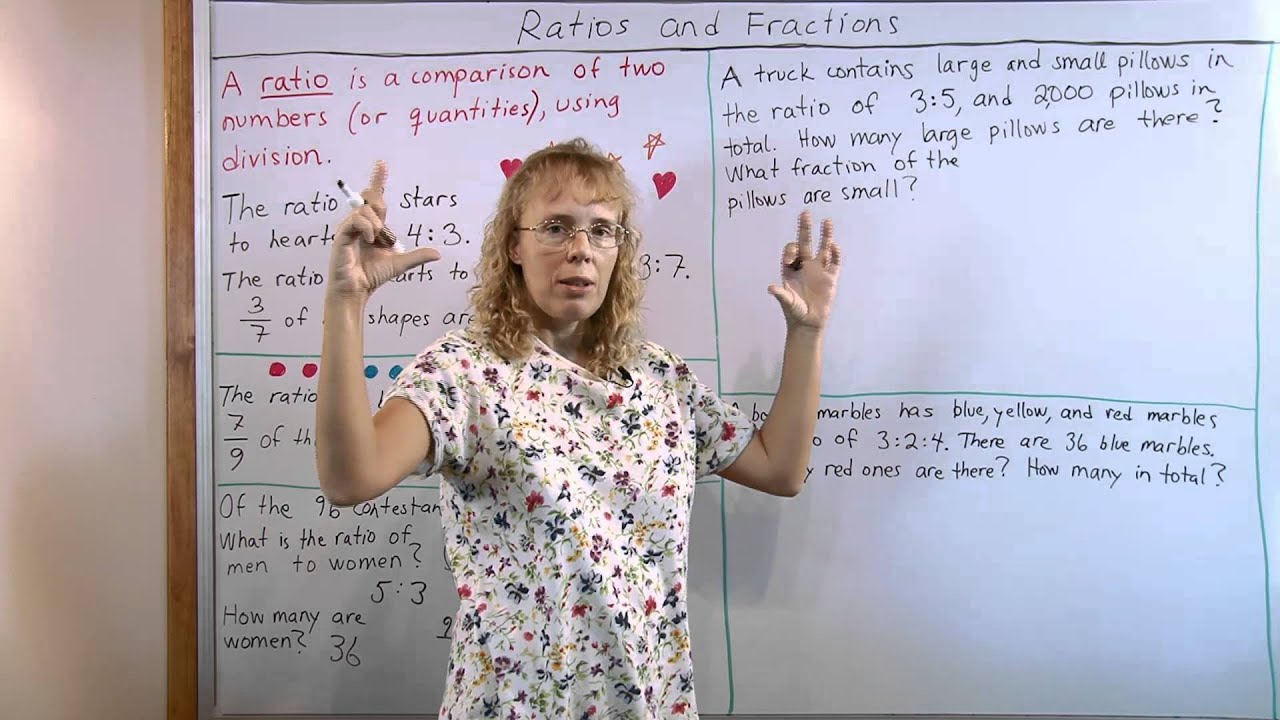
A ratio is a comparison of two numbers (or quantities) using division. For example, if I have 4 hearts and 3 stars, then the ratio of hearts to stars is 4:3 (four to three). We can often "translate" between ratio language and fraction language. Lastly I work several word problems that involve ratios and fractions, using a bar (or block) model, a powerful visual aid that helps students from grade 4 onward solve problems that would otherwise require algebra.
Vous aimerez aussi
Functions and their graphs | Algebra II | Khan Academy
Trigonometry | High School Math | Khan Academy
A savoir faire en mathématiques en Seconde
1st Grade Math Course
Fresh Starts with Numberblocks! ❄️ | Learn to Count for Kids
Cambridge primary maths lectures
Cambridge Primary Mathematics Workbook 5
Multiplications! ✖️
Numberblocks - Number Adventures | Learn to Count | Maths for Kids
Numberblocks Special Moments ✨
Introduction to Software Engineering
Letters and Letter Sounds
Kids Songs by CoComelon
CoComelon
Alphabet (ABC) Songs by CoComelon
CocoMelon | Little Baby Bum | Blippi - Nursery Rhymes & Kids TV Shows
PrePrimary Maths
Year1 Maths
Year 11 Math
Year2 Maths
Numberblocks - Homeschool
Chess Basics
3rd Grade Fractions
Algebra I Math Lessons
Commentaires
10 commentaires
In this problem, we're given the aspect ratio of a rectangle as being 5:3, and its perimeter as 4 inches. The task is to find the side lengths and the area. This involves fraction division and multiplication.
In this problem, we're given the aspect ratio of a rectangle as being 5:3, and its perimeter as 4 inches. The task is to find the side lengths and the area. This involves fraction division and multiplication.
The aspect ratio is simply the ratio of a rectangle's width to height (or length to height). In this lesson, I solve several word problems involving aspect ratio. I use the bar model, visual models, and simple equations to help. This video is part of Math Mammoth 6th grade curriculum - learn more and download samples here: Find more 6th grade math videos:
The aspect ratio is simply the ratio of a rectangle's width to height (or length to height). In this lesson, I solve several word problems involving aspect ratio. I use the bar model, visual models, and simple equations to help. This video is part of Math Mammoth 6th grade curriculum - learn more and download samples here: Find more 6th grade math videos:
In this second part, we tackle two word problems more. The first one involves a ratio and a difference between two quantities. The second one involves fractional parts, a change in the situation, and a given ratio. The first part of the lesson can be found here:
In this second part, we tackle two word problems more. The first one involves a ratio and a difference between two quantities. The second one involves fractional parts, a change in the situation, and a given ratio. The first part of the lesson can be found here:
I solve two word problems that involve ratios, each time with the help of a bar model or diagram - Singapore Math style. The bar or block model is incredibly helpful for these situations and makes the problem solving a breeze.
I solve two word problems that involve ratios, each time with the help of a bar model or diagram - Singapore Math style. The bar or block model is incredibly helpful for these situations and makes the problem solving a breeze.
A set of equivalent rates, such as a set of times & distances when someone goes with a constant speed, gives us a set of NUMBER PAIRS which we can then plot as points on the coordinate plane. We end up with points that look like they're on a LINE... (line - LINEAR - it's a linear relationship).In this video, we first plot a set of equivalent rates having to do a boy riding a bicycle with constant speed. Then we plot TWO sets of equivalent rates - prices per kg - and compare them. (CCSS 6.RP.A.3.a) See the first part of this lesson (about equivalent rates) at This video corresponds to Math Mammoth Grade 6 curriculum; see
A set of equivalent rates, such as a set of times & distances when someone goes with a constant speed, gives us a set of NUMBER PAIRS which we can then plot as points on the coordinate plane. We end up with points that look like they're on a LINE... (line - LINEAR - it's a linear relationship).In this video, we first plot a set of equivalent rates having to do a boy riding a bicycle with constant speed. Then we plot TWO sets of equivalent rates - prices per kg - and compare them. (CCSS 6.RP.A.3.a) See the first part of this lesson (about equivalent rates) at This video corresponds to Math Mammoth Grade 6 curriculum; see