
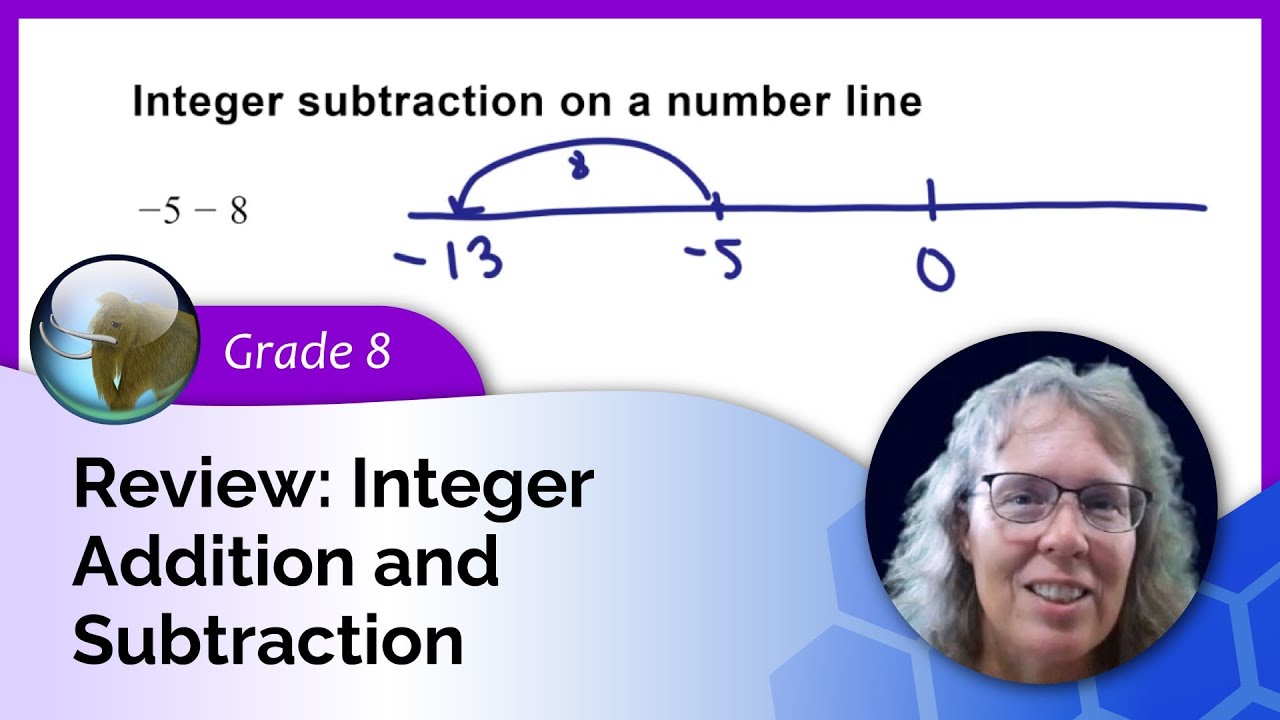
I briefly review the basic principles governing integer addition and subtraction. For example: to add two integers with different signs, check "which side wins" (negative or positive). Subtract the absolute values of the two integers to find out by how much that "side" wins. If you have many positive and negative integers to add, first add all the negatives together and all the positives, separately, and lastly add those two sums. Another principle we look at is that any SUBTRACTION can be changed into an addition... the addition of the opposite of the number to be subtracted. This principle comes in handy if the calculation has both additions and subtractions. Lastly we review how to add and subtract fractions when some of them are negative. Math Mammoth Grade 8 curriculum Play Integers Bingo Game Practice addition and subtraction of integers on a number line
Vous aimerez aussi
Math for Kids
Statistiques 3ème collège Apic
Trigonometric identities
Multiplication Videos for 4th Graders
Year 10 Math
Year5 Maths
Year 4 Math
Year 3 Math
Kids Songs by CoComelon
Learn Colors with CoComelon!
Year1 English
CoComelon & Friends Holiday and Christmas Videos for Kids | Little Baby Bum | Go Buster and More!
CoComelon
Alphabet (ABC) Songs by CoComelon
CocoMelon | Little Baby Bum | Blippi - Nursery Rhymes & Kids TV Shows
Learn English With Disney Movies
PrePrimary Maths
Year1 Maths
Year 11 Math
Year2 Maths
3rd Grade Math
How to Play Chess
3rd Grade Fractions
Algebra I Math Lessons
Commentaires
10 commentaires
Learn to use the distributive property to simplify expressions such as -3(2x - 5) and -(15a - 7y + 4) -- expressions that involve negative numbers. This is a necessary precursor before learning to solve linear equations in general. We also briefly look at factoring, which is the opposite process. Math Mammoth Grade 8 curriculum
Learn to use the distributive property to simplify expressions such as -3(2x - 5) and -(15a - 7y + 4) -- expressions that involve negative numbers. This is a necessary precursor before learning to solve linear equations in general. We also briefly look at factoring, which is the opposite process. Math Mammoth Grade 8 curriculum
I go through several word problems that involve a price increase, discount, and/or sales tax. Writing percentages as decimals is a life-saver when writing an equation for such situations. For example, if the initial price is p, and it is increased by 120%, then the new price is 1.2p. Math Mammoth Grade 8 Curriculum
I go through several word problems that involve a price increase, discount, and/or sales tax. Writing percentages as decimals is a life-saver when writing an equation for such situations. For example, if the initial price is p, and it is increased by 120%, then the new price is 1.2p. Math Mammoth Grade 8 Curriculum
We look at some special situations with linear equations and find that sometimes, an equation can end up (on the last line) to be 9 = 9. This is a case where the equation has an infinite number of solutions. Another example in the video will end up with the equation 5 = 6. This is a false equation and the original equation has no solutions. In a nutshell, there are three possible cases when it comes to a linear equation: it can have no solutions, one unique solution, or an infinite number of solutions. Then you, the viewer, get to practice too... by modifying a given equation so it has an infinite number of solutions. Math Mammoth Grade 8 curriculum
We look at some special situations with linear equations and find that sometimes, an equation can end up (on the last line) to be 9 = 9. This is a case where the equation has an infinite number of solutions. Another example in the video will end up with the equation 5 = 6. This is a false equation and the original equation has no solutions. In a nutshell, there are three possible cases when it comes to a linear equation: it can have no solutions, one unique solution, or an infinite number of solutions. Then you, the viewer, get to practice too... by modifying a given equation so it has an infinite number of solutions. Math Mammoth Grade 8 curriculum
Often, when using a formula, you need to solve it for a specific variable or unknown in it. As examples, we look at the formula for the area of a trapezoid and then the formula for simple interest.
Often, when using a formula, you need to solve it for a specific variable or unknown in it. As examples, we look at the formula for the area of a trapezoid and then the formula for simple interest.
Learn to solve linear equations that have fractional expressions! I go through three different examples in the video. The first one, we could multiply by the LCM of the denominators, but that equation is actually a proportion, so cross-multiplying works, too. For the others, we will use the general technique of multiplying both sides of the equation by the LCM of the denominator(s). Math Mammoth Grade 8 curriculum
Learn to solve linear equations that have fractional expressions! I go through three different examples in the video. The first one, we could multiply by the LCM of the denominators, but that equation is actually a proportion, so cross-multiplying works, too. For the others, we will use the general technique of multiplying both sides of the equation by the LCM of the denominator(s). Math Mammoth Grade 8 curriculum