
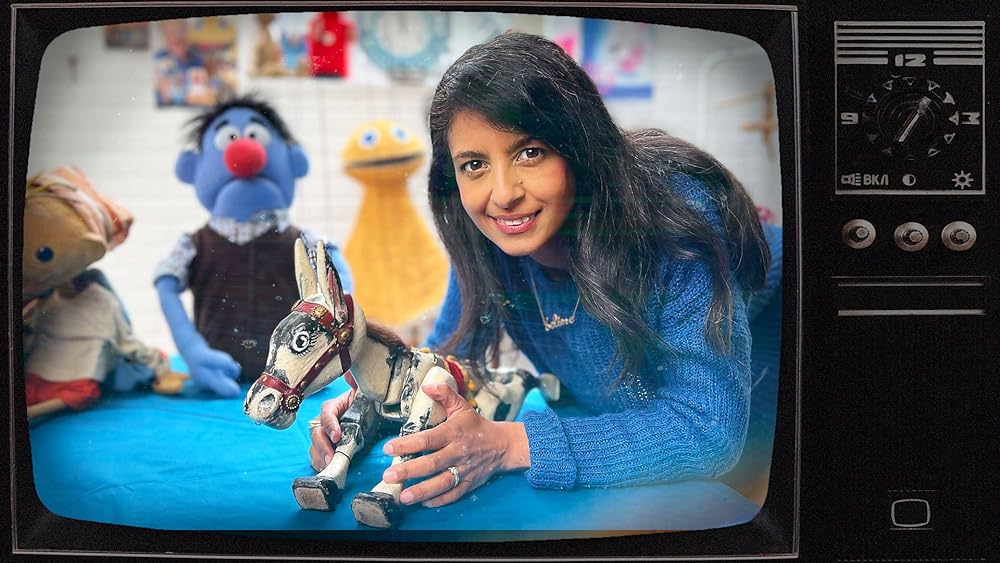
Konnie Huq explores and celebrates the very best of British children's programming from the past 100 years.
Bande-annonce
Casting
Linda Sands
Director
Konnie Huq
Self - Presenter
Floella Benjamin
Self
Claire Essex
Self
Tim Smith
Self
Janet Ellis
Self
Valerie Singleton
Self
Peter Lord
Self
Jennie Brown
Self
Emma Tolland
Self
Zoë Ball
Self
Phillip Schofield
Self
Sarah Greene
Self
Johnny Ball
Self
Dani Harmer
Self
Phil Redmond
Self
Leslie Stewart
Self
Roger Tonge
Self
Cerrie Burnell
Self
Konnie Huq
Writer
Vous aimerez aussi
Kelly + Victor
The Receptionist
Crasse
La Petite Sirène
Dans un autre monde: Les coulisses de La Reine des Neiges II
AGT All-Stars
A Woman of Substance
Teen Wolf
Zatima
Stranger Things
The Chi
The Wife
From
The Boys
Power
Power Book II: Ghost
SEAL Team
S.W.A.T.
Sex/Life
High Potential
Le Seigneur des anneaux : Les Anneaux de pouvoir
Lovely Runner
Marry My Husband
Commentaires
5 commentaires
source: The Surprising Story of Kids' TV
Konnie Huq examines Kids' TV in the prism of diversity and representation. When ITVs idea of representation for families in the late 1970s was Mind Your Language. Kids TV had Lenny Henry on Tiswas and Floella Benjamin on Play School. While news covered the Troubles in Northern Ireland. Why Don't You had kids from Ulster presenting on television with their Irish brogue. Johnny Ball broke down science and maths in easy to understand segments. All in a northern accent. Live unscripted Saturday morning shows with a loose zoo format where anything could happen. You can go behind the scenes and scare the camera man. Huq looked at television that was ahead of ist time. The forerunner of user generated content as YouTube and TikTok. Then there was children's dramas that could be edgy and controversial as they dealt with social issues. Tracy Beaker is a girl in a children's home. Children's Ward dealt with Aids. Press Gang tackled the stigma of suicide. The show that caused both parents and teachers consternation was Grange Hill. Yet it discussed school bullying to heroin addiction. Some of the writers on these shows went on to become award winning writers for adult television such as Russell T Davies and Steven Moffat. Even programmes aimed at toddlers had science behind it. Teletubbies taught them rudimentary communication skills. Huq knew her stuff. She spent years as a presenter of Blue Peter and as an avid watcher of children's television, saw how it changed and developed first hand. It might not had been too in depth. Many shows were left out but this surprising story was worth a look.
source: The Surprising Story of Kids' TV
Konnie Huq examines Kids' TV in the prism of diversity and representation. When ITVs idea of representation for families in the late 1970s was Mind Your Language. Kids TV had Lenny Henry on Tiswas and Floella Benjamin on Play School. While news covered the Troubles in Northern Ireland. Why Don't You had kids from Ulster presenting on television with their Irish brogue. Johnny Ball broke down science and maths in easy to understand segments. All in a northern accent. Live unscripted Saturday morning shows with a loose zoo format where anything could happen. You can go behind the scenes and scare the camera man. Huq looked at television that was ahead of ist time. The forerunner of user generated content as YouTube and TikTok. Then there was children's dramas that could be edgy and controversial as they dealt with social issues. Tracy Beaker is a girl in a children's home. Children's Ward dealt with Aids. Press Gang tackled the stigma of suicide. The show that caused both parents and teachers consternation was Grange Hill. Yet it discussed school bullying to heroin addiction. Some of the writers on these shows went on to become award winning writers for adult television such as Russell T Davies and Steven Moffat. Even programmes aimed at toddlers had science behind it. Teletubbies taught them rudimentary communication skills. Huq knew her stuff. She spent years as a presenter of Blue Peter and as an avid watcher of children's television, saw how it changed and developed first hand. It might not had been too in depth. Many shows were left out but this surprising story was worth a look.
Kids' TV: The Surprising Story