
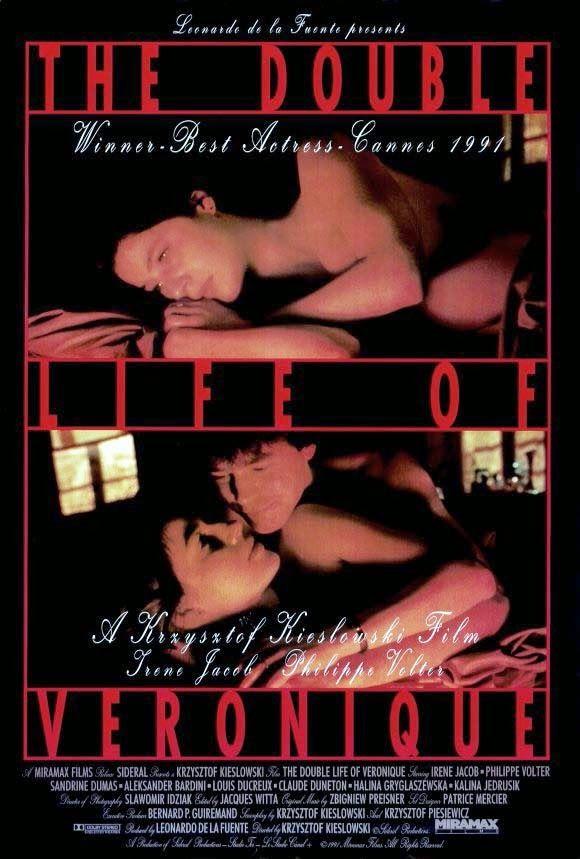
Two parallel stories about two identical women; one living in Poland, the other in France. They don't know each other, but their lives are nevertheless profoundly connected.
Trailer
Cast
Krzysztof Kieslowski
Director
Irène Jacob
Weronika
Irène Jacob
Véronique
Wladyslaw Kowalski
Le père de Weronika
Halina Gryglaszewska
La Tante
Kalina Jedrusik
La femme barjolée
Aleksander Bardini
Le chef d'orchestre
Jerzy Gudejko
Antek
Janusz Sterninski
L'avocat
Philippe Volter
Alexandre Fabbri
Sandrine Dumas
Catherine
Louis Ducreux
Le professeur
Claude Duneton
Le père de Véronique
Lorraine Evanoff
Claude
Guillaume de Tonquédec
Serge
Gilles Gaston-Dreyfus
Jean-Pierre
Alain Frérot
Le facteur
Youssef Hamid
Le cheminot
Thierry de Carbonnières
Le prof
Chantal Neuwirth
La réceptionniste
Krzysztof Kieslowski
Writer
Krzysztof Piesiewicz
Writer
Maaari Mo Ring Magustuhan
Our 30 Minute Sessions
4.48
Hidden Kisses
Wild Diamond
Greta Thunberg: A Year to Change the World
Paradise City
Mood
Oshinoko
Rock and Soul
Teen Wolf
Lucifer
Stranger Things
Legacies
Outlaws
The Night Agent
XO, Kitty
S.W.A.T.
Grimm
Empire
Siren
Suits
Tulsa King
Sex/Life
Mga Komento
10 Mga Komento
I'm a big fan of Kieslowski's work, but I'm not blind to the fact that even the masters can churn out an occasional dud. This is like Kieslowski's unfinished symphony. It had the most promising storyline of all his efforts, but he went nowhere with it. Rather than developing what could have been a real mindbender, he chose to focus on symbolism, mood and camera technique. Film school students should love this flick. He does tons of wacky things like filming through a glass ball, through a man's spectacles (twice), through a distorted train window and, of course, using the trademark Kieslowksi microscopic close up on a cup of tea (ok, in "Blue" it was a cup of coffee, and in Dekalog 2 it was a glass of water...same friggin thing). But to people who don't go ga-ga over that sort of stuff--to people who are searching for good old fashioned literary substance--this'll be a somewhat aggravating experience. If you like impressionistic movies like Fellini's AMACORD or Tarkovsky's ZERKALO, then you'll probably love this film. But if you prefer the clearly-defined work of Kurosawa, Bresson or Kubrick, then I'd advise you to pass on this and check out Kieslowski's other works instead. Try the Three Colours trilogy & the Dekalog series...between those, there's 15 hours of good, classic Kieslowski to pique your brain.
I tried to like this movie. I saw it years ago and was not impressed. I then saw Krzysztof Kieslowski's trilogy Blue, White, and Red which I thought were wonderful so I thought I'd give Veronique another chance. Well it wasn't any better the second time. The movie had no substance. It seems to be enamored with Irene Jacob's beauty lingering on shots of her face. The movie is worthwhile for that, Ms Jacob is indeed a beauty, but it doesn't carry the movie. There were glimpses of what was to come in his subsequent movies though not enough to fill the movie. If you like to look at beautiful women's faces this is the movie for you. I like a bit more from movies, some soul to flesh out the face.
Reviews of this movie were so positive that we were very disappointed. In fact, we only saw the Polish segment and the beginning of the French segment. We thought the movie pretentious, confusing, dull, and shocking (what on earth did the girl die of in the midst of quite stirring music?). Jacob is pretty, no doubt, but a bit of plot would not have been amiss.
I watch a movie to be entertained. This flick was not entertaining. Symbolism be damned. The movie was as annoying as many of the reviews posted on here, a bit over the top. Reviewers at this site are apt to try to impress readers with their literary skill. They read like the nonsense I remember printed on the covers of old LPs. Doublespeak. Please people, lets restrict our comments to plain old everyday English. I'm an American but prefer foreign movies to most of the action crap produced by Hollywood. This one was a bit much. The gloomy photography was annoying. The French Veronique was one short of a six pack. She never bothered to look at the photographs she took in Poland? She decided she was in love with her stalker after inviting him to her hotel room? Love? Both women were totally promiscuous and the viewer never knew the guys the women were having sex with. I'm sorry but I didn't get it. A waste of 100 minutes of my life. I could find similar symbolism watching paint dry. One poster, from Spain, took at swipe at at the American movie industry of which I am no great fan. However, his comments reflect the xenophobia is alive and well in Spain as it here here in the US.
I still listen to the haunting music that weaves it's way through this film and it never fails to move me. The whole film is almost like a modern day ghost story, following its own logic through the simplest but most effective storytelling techniques, beautifully crafted by a master director. Irene Jacob has never been better than here, and I would recommend it highly.
I save films. By that I mean that some films I expect to be so precious that I want to save them for some future drought, or blue period where I need spiritual insulin. Or it may be that a valued filmmaker has died and I know there is only so much to see new and I want to pace it through my life. Kieslowski is something of a demigod in my film world. It isn't that he has mattered so much in the sense of affecting me. Its because he can push geography with the slightest touch, infer emotional richness with the most subtle of motions, show us beauty headon headon without artifice. His the most delicate power I know in cinema. His "Decalogue" is complex, open, engineered to be contradictory in ways that seem natural. But they are not where the real juice is. Its merely where he worked out the way to weave vision and narrative conflict with his companion and creative partner. It's "Three Colors" where it pays off. These are miraculous and I wish them on any open soul. They will tear you gently in ways you will not notice for years, and then know all of a sudden when you meet someone. In between "Decalogue and "Colors," we have this, essentially an adventure in moving from Polish to French vocabulary, both emotional and chromatic. Here we see some of the strokes we will encounter later, in one colored film even with the remarkable Irene. But he seems unsure here. Things aren't integrated between cinema and narrative as they were before and would be afterward. The eye doesn't inform with curious discovery, instead seems to glance around and hover. I suppose it is because the story isn't well developed in the way that others are. The deal with Kieslowski I think (beyond the beauty) is that he is able to infer future urges that probably will loop back into places and persons we see. (He closes a very few of these ordinary loops in the third colors film). But he never closes them, not the ones that matter. So we are left with our own emotions going ahead and anticipating results that matter to us, things started and not finished, breath sent out for us to catch and breath. This film is based on Alice in through the Lookingglass, with a number of less-than-deft fixtures to the source. He tries to build grand arcs of anticipated futures around this symmetry but they aren't fragile and supported by our wishes as we have elsewhere. I think it was simply a time of adjustment for him, and I cannot recommend this, even though I saved it for decades. I will suggest that if you do watch it, see the same story, the same emotional effects, the same tantalizing near-closure in "Sex and Lucia" by someone less gifted with the eye, but more gifted with the mysteries of women. Watch out for the delicate tearing. Ted's Evaluation -- 2 of 3: Has some interesting elements.