
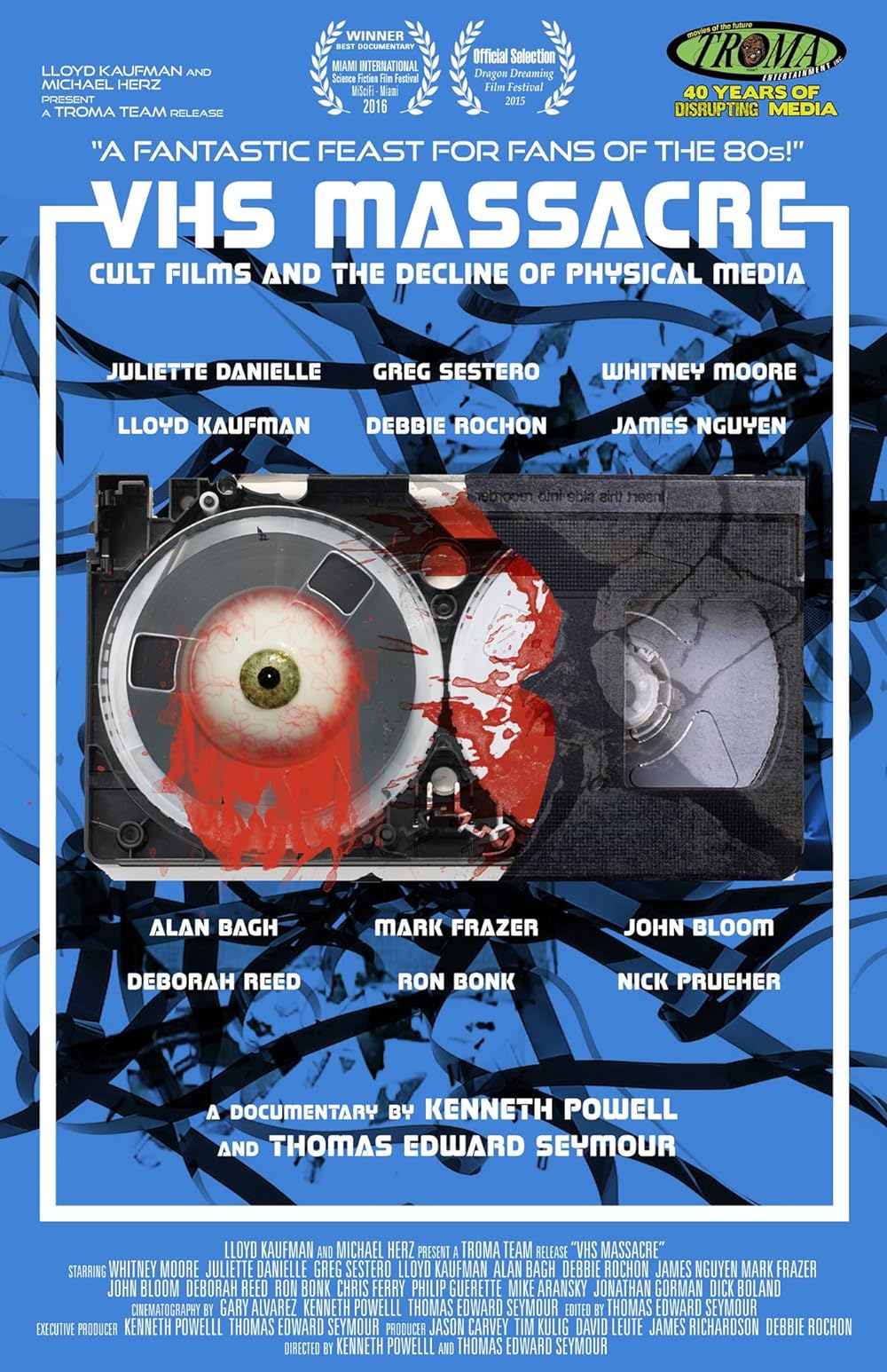
This lively documentary explores the rise and fall of physical media and its effect on Independent and cult films. Ranging from the origin of home movies through the video store era, its sure to entertain. With icons like Joe Bob...
Bande-annonce
Casting
Kenneth Powell
Director
Thomas Edward Seymour
Director
Mike Aransky
Self
Alan Bagh
Self
Troy Bernier
Self
John Bloom
Self - Joe Bob Briggs from Drive-in Theater
Dick Boland
Self
Ron Bonk
Self
Carmine Capobianco
Self
Juliette Danielle
Self
Chris Ferry
Self
Nicola Fiore
Self
Matt Ford
Self - Chef Death
Mark Frazer
Self
Douglas Godino
Self
Jonathan Gorman
Self
Philip Guerette
Self
Phil Hall
Self
Lloyd Kaufman
Self
David Leute
Self
Thomas Edward Seymour
Writer
Vous aimerez aussi
Les Babysitters
Plug Love
Un nouveau printemps
Beautiful Girl
Suparman Reborn
Le Jardin de Zach
The Madison
The Five-Star Weekend
the rise of lycan queen
not the bride he wanted
zodiac epoch
Married to Poseidon by Mistake
knight of the lost heirs
Sweet Temptation
Rivals to Lovers
what she took for granted
Vikings
The Boys
Ginny & Georgia
The Night Agent
SEAL Team
Grimm
The Cleaning Lady
Tulsa King
Commentaires
10 commentaires
source: VHS Massacre
The only VHS this documentary explores are basically less than a dozen classics and most the filmmaker and associates' own post-2000 indie movies, including literal trailer and promos! It's rather shameful and shameless, focusing on a very limited set of people complaining about politics - net neutrality (which in reality concerning prior recent law was a lose-lose scenario and not much to actually do with the topic). This political point was simply a perspective unrelated by any meaningful form or discussion to greater topic. I felt like I was watching a promo for a handful of super-indie film makers from New York extolling their opinions on political issues (without an sufficient knowledge or discussion on what the net neutrality actually entails). There's even a literal end screen text - hammering a call-to-action to 'Write your congressman and ask them to support net neutrality.' In reality Net Neutrality was not a clearcut simple superficial proposal - at the time is had two serious downsides of the coin, each bad - bad proposal in general. But none of this, the: what, how, where, why of net neutrality (or how it even relates) were discussed, just repeated and focused on in agenda in 'documentary' that is only relevant to the actual filmmakers given air time in their own perspective sans rational discussion or data. The rest was half-baked filler to seem credible, self-promotion of participants own films and 2 inserts of two celebrities. Lloyd Kaufman, the most experienced super-producer of trash or lowbrow indies (many that I admittedly enjoy) actually counters much argument of others and provides very logical and rational perspective at a few points on meaningful distribution, file-sharing etc - from an older man, certainly shared wisdom and reality in context. But again, this hardly has much to do with the actually replacement or 'massacre' of VHS. The whole setup was a complaint against and prmo piece for the film's own makers and just another piece of 'net neutrality' promotion at the time. So does this documentary have any lasting, wider objective value - very very little. Very limited maybe 2 points of minor interest. Does not have intent to seriously focus on topic, but instead spray their own self-promoting media interest. Bad form. Speaking of the VHS films actually discussed here you basically get some gratuities of Troma (an inclusive attempt to instill credibility and payback Kaufman participation), some early mentions of early 2000s phenom like The Room (2003) and footage of Blockbuster and Hollywood video as a crux of end of videos, which is true. And some basic detail otherwise on a limited scope or genre of VHS. Again, Joe Bob Briggs is another celebrity harnessed who at one point try to display 'intelligence' and expertise about film stating, to paraphrase, "What is film? What are we talking about here? It is films of the late 1800s? The ethic neighborhood films of the early 1910s(??) or the Lumiere films, or quote "the RIDICULOUS films of 1930-1935 before they had sex in film?" This last portion of statement shows extreme ignorance (and exposure) of Briggs to the wider pantheon of film! But is also displays the range of this 'documentary,' which speaks of nothing but a very very extremely limited set of VHS media and film - zero international, classic Hollywood or other non-niche horror product, which represented collectively the bulk of movies actually rented or sold to the public. Emperor wears no clothes.
Highly insightful and nostalgic look at the VHS era in the 1980s and its eventual decline. Really well made and a must watch for movie fans.
I was expecting more detail and comment on the demise of the VHS market but instead it seemed to try and cover too many bases without actually completing any particular aims. Overall it comes across as a student project with way too many handheld camera shots. Apparently the filmmakers began as podcasters. Perhaps they should concentrate on where their strengths lie as their enthusiasm seems better suited to an audio medium rather than visual.
I ended up watching this documentary on Amazon Prime video (ironic given the title, more on that later) because I wanted to see another documentary on the VHS format. Maybe half the documentary actually plays service to that, the rest is video hunting of VHS tapes in stores that would go out of business before the movie would be released, and complaining about piracy ruining film as an artistic medium, specifically the making of indie films. The thing is, most films these days (speaking in 2019) outside of major studio releases will never make it to physical media, they will go straight to Netflix, or ironically in this case, to Amazon Prime Video. The straight to VOD (video on demand) contract is similar to the straight to video in the 1980s, the only difference is lack of a physical release. Of course, when you go straight to VOD it makes it even EASIER to pirate the film and distribute on file sharing sites from simple capping of it from a digital source. Thus we have a documentary where I appreciate the argument and the love put into it, but it just falls flat on its face as it has become already a piece of history, even though it was shot in 2014 and released in 2016.
I'm a movie geek, but not really an expert on b-movies. I grew up with VHS tho so I found this kind of interesting here and there. Overall I wouldn't say this is very good and that's mostly because it's not very focused. If the makers had ditched focus on their own productions and focused more on the physical media and VHS movies in general it might've been better. Troma etc are interesting, but the documentary feels very subjective with very preachy piracy part (fwiw, I'm against piracy). I wasn't fan of the actual VHS massacre either, imo the diabetes video wasn't a laughing matter. I've seen this kind of movie geeks at local arthouse movie theatre laughing at everything and basically ruining the show for everyone else. So yes, I found the VHS part interesting, cover art appreciation etc, but there was a lot of stuff I didn't find that fitting. The subject calls for a better documentary.
Tries to be personal, tries to be a summary of home media, doesn't really accomplish either. Don't really feel informed by the end of it, don't really get an emotional pay off. Spends a bit too much time focusing on the production of the documentary when there is no real story there. Okay to watch but not likely to hold your interest for the full run time. Feels a bit too much like an overly long youtube documentary
This film plays like an Instagram story. There's no story arc, the exposition is all out of whack, they cover major plot lines by just throwing up titles, and so much of the movie is just dudes talking about how excited they are to interview some no name actor, pointing out all the vhs they buy from stores for cheap, and then filling it out by just getting their friends to talk about vhs. It's an absolute mess! It's also so narrow in scope. VHS culture needs to be explored and documented, but these filmmakers are not up to scratch.
VHS MASSACRE is a fun, appropriately low-fi documentary that explores the glory days of video collecting and renting in the 1980s and 1990s. It has a rather narrow remit, focusing on low budget horror and cult film production mainly during the 1990s and exclusively in America. While the documentary has virtually no material from back in the day, it does fill the running time with plenty of incident and discussion, including many interviews with leading figures in the field. The main emphasis of this documentary is to be fun and it's certainly that. It's designed for like-minded people, not to convert the non-fans. The interview footage is very interesting and explores how the market has changed in the face of streaming movies and illegal downloading. Cult figures like Lloyd Kaufman, Debbie Rochon, and Joe Bob Briggs are all featured here and they all have plenty to say. There are few clips from a handful of films, but mainly this is about showing video box covers and the collecting culture. It's light, breezy, and amusing.