
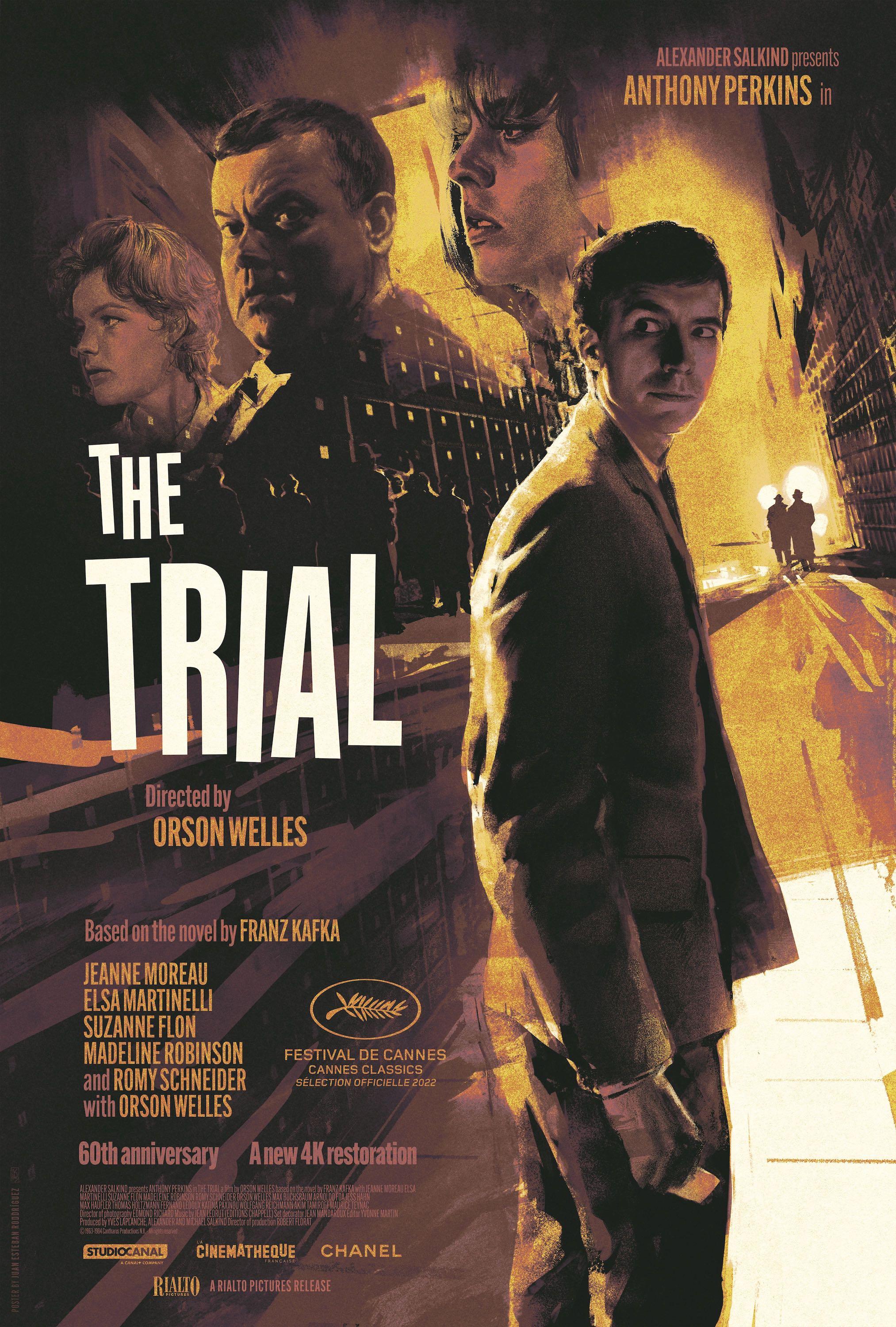
يصحو الرجل (جوزيف كيه) من نومه ليجد رجلين يخبرانه أنه متهم في قضية لا يعرفها، يتركونه حرا فيظن أنها مزحة، لكن عندما يتم إخطاره باقتراب موعد محاكمته في الجريمة التي لا يعرفها، يبدأ في إدراك حقيقة الأمر، فيكتشف أن الأمر أصعب مما يتصور.
الإعلان الترويجي
طاقم العمل
Orson Welles
Director
Anthony Perkins
Josef K.
Arnoldo Foà
Inspector A
Jess Hahn
Second Assistant Inspector
Billy Kearns
First Assistant Inspector
Madeleine Robinson
Mrs. Grubach
Jeanne Moreau
Marika Burstner
Maurice Teynac
Deputy Manager
Naydra Shore
Irmie
Suzanne Flon
Miss Pittl
Raoul Delfosse
Policeman
Jean-Claude Rémoleux
Policeman
Max Buchsbaum
Examining Magistrate
Carl Studer
Man in Leather
Max Haufler
Uncle Max
Romy Schneider
Leni
Fernand Ledoux
Chief Clerk of the Law Court
Akim Tamiroff
Bloch
Elsa Martinelli
Hilda
Pierre Cholot
Writer
Franz Kafka
Writer
Orson Welles
Writer
قد يعجبك أيضًا
The Vanishing
The House
4.48
Wild Diamond
Luther
Lady Voyeur
The Secrets of Hotel 88
Taboo
دبابير السترة الصفراء
كل خطأها
نساء غير كاملات
آخر شيء قاله لي
الخياط
جريمة قتل في نهاية العالم
العودة للوطن
الفتاة المسروقة
المسيح
The Watchful Eye
الزوجة السابقة
Girl from Nowhere: The Reset
يد من حديد
The Clearing
Pine Gap
Hide & Sis
التعليقات
8 تعليق
source: The Trial
Le procès
A clerk is arrested for a crime, but the police do not inform him of the charges. Welles brings his genius to the famous Kafka novel, but only proves that Kafka can't be filmed, as his novels rely too much on internal thought. After a drab and pointless prologue, the film proper starts and is initially amusing enough although the drab setting persists. The stark, cheap-looking sets are quite depressing. Given the premise of the story and the abstract ideas, perhaps this would have worked as a short film or TV show, but at two hours, it severely overstays its welcome. Adding to the absurdity, Perkins' manner of speech weirdly recalls Woody Allen.
Never has any film reached down off its silver screen and shaken me as violently as did The Trial. I came out of my local art house quivering. Even now, as I write, I detect a hint of paranoia. I would go as far as to say Orson Welles' The Trial is the most frightening film I've ever beheld. Watching it for the first time it's safe to say I hated it. There were scenes that held me so close to the edge of madness, it was all I could do not to fly screaming out of the theater. Only afterwards, on the way home, did I realize that its ability to do so was what made the film so remarkable. Definitely a must see, but be forwarned.
It's always a question whether film form should attempt to reproduce literature. Is the film the author's, the director's, or both? With Orson Welles, the question is easily answered. We have Tony Perkins raging against the darkness--walking the dream landscape of a nightmare--spitting in the eye of the law--a victim yet not a victim. He is an existential juggernaut. Unlike the man who waits at the door, he already knows it's his door (he says he knows the story). He knows the door will close, but what happens on his side will be his choice. This is a strange curve to throw, a character devoid of dramatic irony, like Oedipus knowing the Oedipus story. Then there's the asexuality and monomania, the refusal of dissuasion which allows Perkins to "win." Force doesn't affect him. When he is dragged off, we aren't really sure who is doing the dragging. In the book, we know perfectly well. I wonder how Orson Welles would have handled such an arrest.
I found a lot to adore in "The Trial," but just as much to furrow my brow over. The cinematography is stunning; full of visual metaphor and gorgeous composition, it's an unyielding show of movie-making expertise. Welles plays up the bleak, "no tomorrow" nature of the exterior scenes, the structured chaos of the workplace and the hedonistic excess exhibited by the various stages of the trial itself, each to great effect. The story, though, feels too flighty and nebulous for my taste. It should come as no surprise, being a translation of a Kafka novel, that the entire picture often feels surreal and confusing. It continuously floats and sputters just beyond the grasp of understanding, like a moth delicately avoiding a set of flailing hands. The premise may have been established nicely during the slightly more straightforward opening scenes, but as the duration grows it becomes too ambitiously ambiguous for its own good.
Like many of Orson Welles films, The Trial has been imitated by other filmmakers. Patrick McGoohan borrowed part of The Trial's interiors for the famous opening of "The Prisoner", and David Lynch borrowed part of the exteriors for "Eraserhead". Neither, however, approaches the relentlessly grim paranoia of the Welle's original. I don't believe that Kafka ever published The Trial during his lifetime. In his will he left instructions that all his literary manuscripts should be destroyed after his death. In what was, perhaps, the final irony of Kafka's life, it was only the disobedience of the executor of the writer's estate that made the peculiarly paranoid world Kafka had created available to the public at all. See this film and, afterwords, try to get a peaceful night's sleep.