
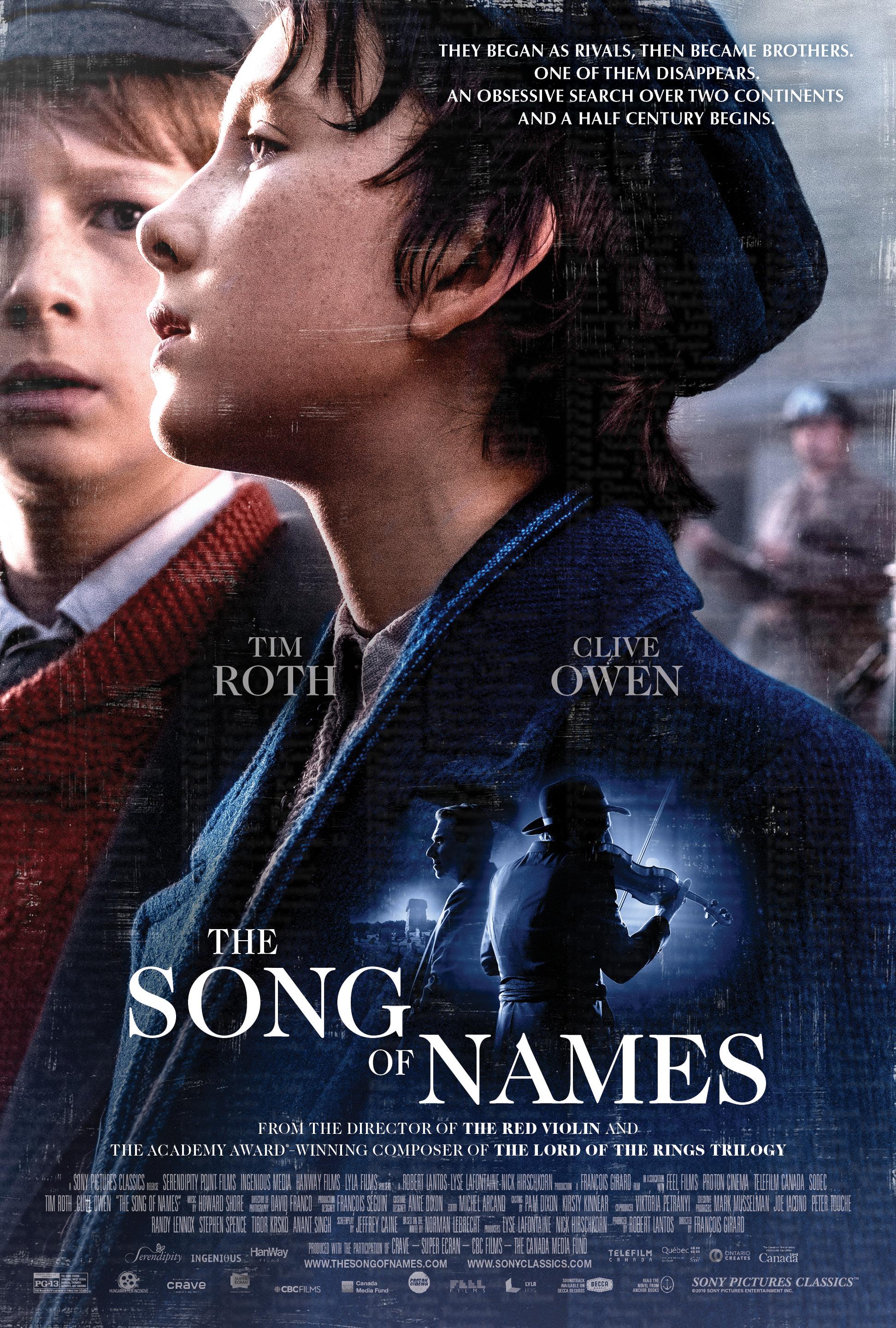
Several years after his childhood friend, a violin prodigy, disappears on the eve of his first solo concert, an Englishman travels throughout Europe to find him.
ٹریلر
کاسٹ
François Girard
Director
Eddie Izzard
BBC Radio Announcer
Gerran Howell
Martin (17-23)
Stanley Townsend
Gilbert Simmonds
Amy Sloan
Enid Simmonds
Marina Hambro
Young Helen
István Fazekas
1951 Conductor
Tim Roth
Martin Simmonds
Catherine McCormack
Helen Simmonds
Steven Hillman
Mayor Froggatt
Sharon Percy
Jenny Burrows
Eszter Lugosi
Clarinet Girl
Áron Rátkay
Cello Boy
Eszter Túrós
Piano Accompanist
Annamária Makai
Piano Girl
Viktoria Kay
Ellen Stemp
Max Macmillan
Peter Stemp
Misha Handley
Martin (9-13)
Luke Doyle
Dovidl (9-13)
Jeffrey Caine
Writer
Norman Lebrecht
Writer
آپ کو یہ بھی پسند آ سکتا ہے
The Song of Names
Only People
Seven Veils
Desire: A Temptation Story
Beauty in Black
Lucifer
Zatima
The Originals
Wednesday
Power
The Night Agent
Adulting
Empire
Suits
Tulsa King
Sex Education
Blood & Water
See
9-1-1
Queen of the South
All of Us Are Dead
Nemesis
The Four Of Us
تبصرے
10 تبصرے
The acting is poor, the story is not credible, the motivations of the violinist is not believable, and the goals of the boy and then man MARTIN not supportable.
Greetings again from the darkness. The title refers to a sacred Jewish ritual where the names of the Holocaust victims are recited in a musical style. It's a process that (sadly) covers a few days. In this film, it takes on a personal, as well as historical, significance. British cultural affairs expert Norman Lebrecht wrote the 2001 novel on which writer-director Francois Girard (THE RED VIOLIN, 1998, plus plays, operas and 2 Cirque de Soleil shows) and co-writer Jeffrey Caine based the film. We open in 1951 London just minutes before the scheduled performance of young violin virtuoso Dovidl "David" Rapoport. He is to play Bruch and Bach in a concert sponsored by his "adoptive" father figure Gilbert Simmonds, who has sunk his entire life savings into producing the concert. Despite the assurances of Simmonds' son Martin, who has become like a brother to David, the featured performer is a no-show ... leading Martin to search for him over the next 35 years. The film covers the story from the time Dovidl's Polish-Jewish father (played by Jakub Kotynski) agrees to his leave 9 year old, a violin prodigy, with the non-Jewish Simmonds in an attempt to protect the boy from the German invasion of Poland in the late 1930's. As Dovidl and Martin grow together, their bond become stronger. Martin is present when Dovidl renounces Judaism, even as becomes more proficient with his instrument and more saddened by the Holocaust that he avoided in his home country. Both boys are played at three different ages by three different actors. Dovidl is played by Luke Doyle at ages 9-13, Jonah Hauer-King at ages 17-23, and by Clive Owen in middle age. Martin is played by Misha Handley at ages 9-13, Gerran Howell at ages 17-23, and by Tim Roth in later life. The actors do a good job of capturing Martin's early irritation at Dovidl's arrogance, the shock of the no-show betrayal, and the later in life man who changed everything when he found out about his family, as well as the music teacher so desperate to find his long lost friend/brother. The film bounces between the three timelines so that we have a full picture of the impact they have had on each other's lives, and how Dovidl's disappearing act was quite devastating. Much of the film centers on Martin tracking down leads and talking to folks for some idea of the path taken by Dovidl. Mr. Roth is especially effective (and surprisingly understated) in his performance as a man haunted by the unexplained actions of a loved one. His wife, played by Catherine McCormick, is simultaneously understanding, patient, and emotionally affected. Stanley Townsend plays Martin's father. He cares for Dovidl as if her were a son, and provides what's necessary for the prodigy to develop and be groomed for performance. Three-time Oscar winner Howard Shore delivers a score that follows the good times and bad, not an easy task for a family drama within the shadow of the Holocaust. One specific sequence stands out, and it is filmed on the hallowed grounds of Treblinka - now a memorial, where the extermination camp once stood. There are many facets to the story, and most involve heavy emotions. We see children bearing more than they should. Parents protecting their children in times of crisis. The difference between religion and ethnicity is discussed. Broken trust proves especially damaging. Dovidl's disappearing act could be compared to that of JD Salinger, in that he seemingly disappeared for years. And maybe most of all, the idea of survivor's guilt is a theme, as Dovidl explains, "You don't have to be guilty to feel guilty." The film may have some pacing issues, but it affords such a wealth of conversation topics, that any flaws are easily forgiven.
I caught this film when it was was screened at DSS-IFF in Spain last week. i'm a fan of Tim Roth, my mom was a classical trained musician, and I was genuinely optimistic about Song of Names. I was disappointing. This is quite a poorly done work. Another user reviwer here said the ending was "shocking." No it is not, it is predictable. In fact the entire film is a endless run of cliche.
source: The Song of Names
This story is so effective and so emotional, that it sends chills right down my spine. I feel so connected with the story and the characters, that I feel their pain and their anguish. It is a wonderful film.
What a great movie, believable and well scripted. Both lead characters, both young and old are portrayed really well. A good storyline and history. If you enjoy movies relating to WW2 you will find this a touching drama. The musical score is beautiful.
In an age where avitar, special effects & gratuitous sex dominate the big screen, Song of Names resurrects raw human emotion & history to clutch at the hearts of the audience. Not since Dr Zhivago, has a film so compelled me to return for an encore. Although not an epic like Zhivago, Song of Names simply re-awakens the timeless human condition within all of us.