
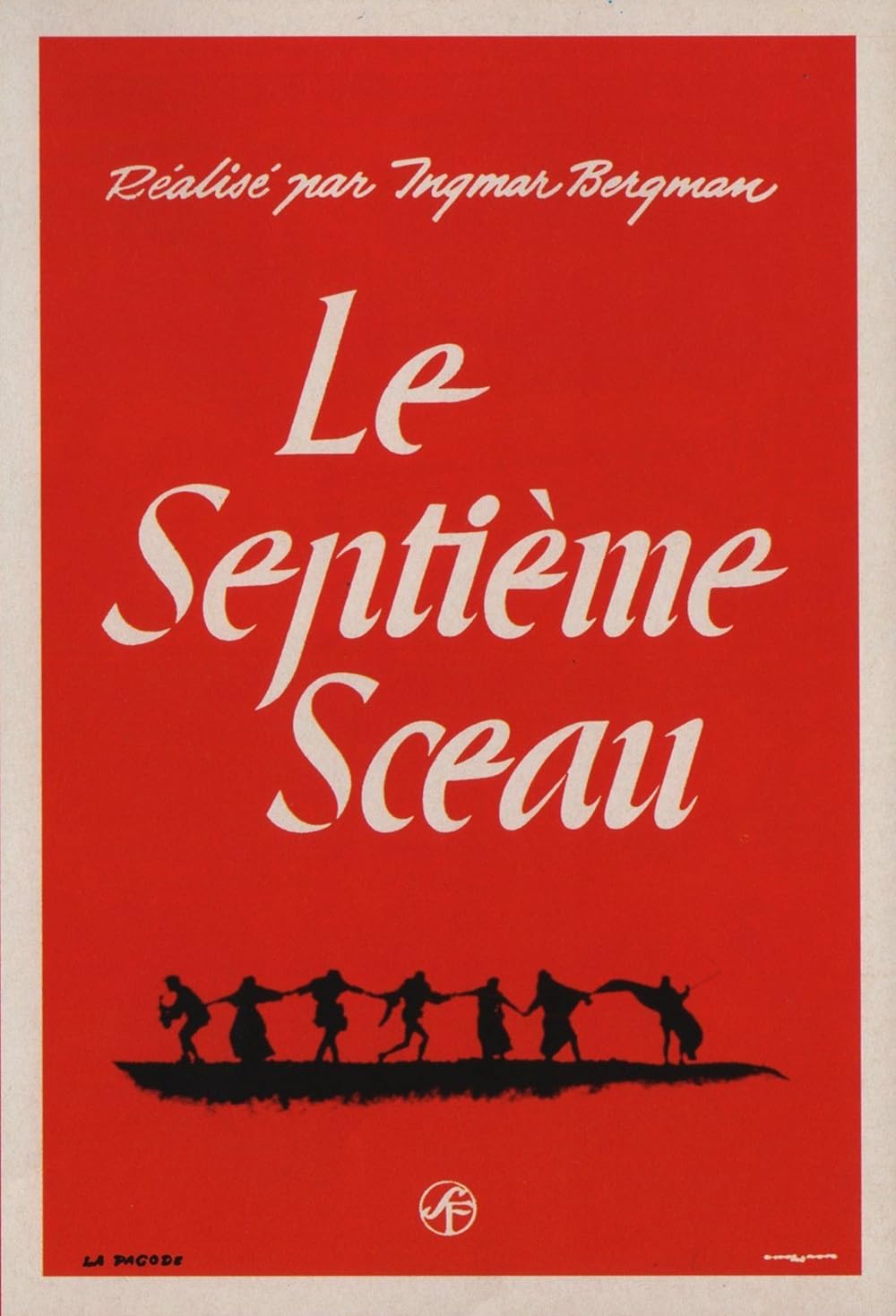
Un homme cherche des réponses sur la vie, la mort et l'existence de Dieu en jouant aux échecs contre la Faucheuse pendant la peste noire.
Bande-annonce
Casting
Ingmar Bergman
Director
Max von Sydow
Antonius Block
Gunnar Björnstrand
Squire Jöns
Bengt Ekerot
Death
Nils Poppe
Jof
Nils Poppe
Joseph
Bibi Andersson
Mia
Bibi Andersson
Mary - Jof's Wife
Inga Gill
Lisa - Blacksmith's Wife
Maud Hansson
Witch
Inga Landgré
Karin - Block's Wife
Gunnel Lindblom
Girl
Bertil Anderberg
Raval
Anders Ek
The Monk
Åke Fridell
Blacksmith Plog
Gunnar Olsson
Albertus Pictor, Church Painter
Erik Strandmark
Jonas Skat
Siv Aleros
Flagellant
Sten Ardenstam
Knight
Harry Asklund
The Landlord
Benkt-Åke Benktsson
Merchant at the Inn
Ingmar Bergman
Writer
Vous aimerez aussi
Piaffe
The Wishing Forest
White Fox Love Affair
Dou Po Cangqiong·Zhi Ge
Vampire Academy
Anikulapo: Rise of the Spectre
Yun zhi yu
Oh! My Emperor
Camelot
Wicked City
Resurrection
Gyaarah Gyaarah
Kara Mia
Wu
Absolute zero
L'Éternelle Sorcière
Zhi Bi
Red Queen
Life After Life
Der Greif
Bloody Smart
Fah Jarod Sai
Yüz Yillik Mucize
Lucifer
Commentaires
10 commentaires
source: The Seventh Seal
Det sjunde inseglet
I truly love black and white films and this is certainly one of the best. One of the best looking, that is. Yeah, lots of really cool looking images but they just don't add up to anything. "The Seventh Seal" is the very definition of what's known today as "Independent Film". It looks good enough that people believe that there just has to be some substance floating around in there somewhere, but I'll be darned if I'll ever be able to point any of it out. Because of Bergman's recent death, I once again had a chance to see it on TCM. And once again I barely made it past the "famous" opening scene with Death playing chess on the beach. I finally do have one thing figured out though. The opening scene is the best known scene from the film because hardly anyone can get beyond it. Oh sure, the Black Leather Art Crowd will tell you they watched the whole film, but don't believe it. They watch that stupid Death plays chess on the beach scene, rate the film a "10" and then post a glowing review here on IMDb to prove they know art when they see it! When it comes to Bergman films though, I'm simply too stupid to "get" them. So please don't flame me for my obviously ignorant opinion. After all, my misguided views DO give the whole artsy black leather wearing community someone to shake their collective heads at while muttering "He just DOESN'T get it!" BTW, there's a great parody of the chess scene in "Bill and Ted's Bogus Journey" with Death challenging the boys to a game of Battleship. Very funny indeed.
What could have been the best movie of the 1950s is mitigated by not sticking with what it did right. Bergman could have documented the effects of the plague on citizenry of Sweden with a harsher, more real tone and had the religious issues be discussed, but instead he reversed that, and a much weaker movie is the result. (The hideous plague is simply not established strongly enough: one corpse, while a nice quick scare, doesn't establish enough since so many other people just seem to go about their business fine, never mind that roughly one fourth of them are supposed to be dying) The extremely moody opening: waves, rocky beaches, barren, a a knight drained of strength sprawled on the beach, a great attention grabber. And then, the appearance of a dark caped, white faced man, and BANG, the movie hits a huge snag. This death character, which seems to be the most memorable aspect to the movie for most, is a grave blunder. He might resemble some folkish rendition from Swedish tales and icons, but that doesn't make him totally wrongheaded. His face makes him far too human, and too obviously an actor walking around. Concealing his face, if nothing else, until the very end to show that perhaps death is not a thing to fear, works much better, and embarrassingly, the Monty Python Meaning Of Life presents a much more interesting rendition of him, and it's their worst movie. YThis character is also far too clean: death is decay, the rot, often very slow: he shouldn't look like he just took his rob from the store this morning. Also a great problem is the fact that this totally wipes out any ambiguity: death is revealed to be a force that actually takes you somewhere, hitting the audience on the head that there is some aftrelife, as opposed to just a body that doesn't function and decomposes. A voice or a similar device would have served such purpose, since it might potentially just be the Knight's own cynicism working against him. Then the knight and Death begin playing chess. Even if you don't count the fact that Death said five seconds before they start playing that he grants no reprieves, this is a transparent McGovern, just a way for us to know that this movie has a structure and is going somewhere. More problems spring up as more characters make their way into the movie. There's the Knight's Sancho-type assistant, whose character simply isn't as interesting as Von Sydow. We get a travelling troupe, who are supposedly very important because of their biblical names, but frankly, do little more than stop the movie for a painful, irritating performance which is then paralleled with a bunch of wandering, chanting Christians in a scene so staged and pompous it seems to be begging for you to be glib about it. There's Odious comic relief in the shape of a woodsman and his cheating wife, which just goes to show, as good as Bergman is, the man is not capable of putting comedy on screen. There is one subplot that struck me as really powerful: the girl said to be a witch who will be executed. Here is more of Bergman showing the skill that he is so famed of: we (well, certainly I) pitied the girl, and the fact the Knight doesn't seem interested in her except as someone to ask questions makes him seem more like a cold, layered human than just a whining agnostic. She is the only one who doom is believably hanging over her head. If only Bergmna had made more of the movie in this vein....
Let me make this pretty quick -- a friend brought this Ingmar Bergman "classic" to the house last night (on Blu-ray), and it was my first experience with this acclaimed filmmaker. All I can say is, I was immediately struck by the cinematography, and I started getting interested in the idea of a knight (Max Von Sydow) playing chess with "Death" himself, as a means of deciding the fate of his own soul.... but that's as far as it went. From then on, nothing made much sense and the noble core idea of the film (presumably about questioning death, and the existence of God) seemed to go out the window, as we spend our time with secondary characters I just could not become interested in. I wanted to focus more on Max von Sydow's troubled crusader and his crisis of faith, especially since I myself am presently going through some personal bouts of despair in my personal life with my own crosses to bear... but he was only sparingly used, and I just could not follow any type of coherent storyline to this thing, for all its pretty picture style. There was no story, just images... and it's not that this approach never works for me in other films, but it didn't connect for me this time. I can't say that this is going to be my last visitation with Bergman, but this is not a promising start, considering this is allegedly one of his greatest works, if not THE greatest. Apologies to Woody Allen. Okay, let the slings and arrows fly. ** out of ****
I went into this pretty excited. After all, it's far and wide described as one of the best, if not *the* best film ever made. Frankly, I didn't see it. The first problem I had with The Seventh Seal was the acting. The knight, Death, and the squire were highlights, but the rest of the cast had an almost pantomime-like quality that is very, very distracting. In fact, this may not simply be an acting problem - many of the set-ups of the film are pretty pantomime: there is a scene with the actors playing out a song involving a * crowing while, behind the stage, another actor tries to seduce a girl, which is not only sonically grating but completely ludicrous. I tried to work out if it was intended to be satirical but it actually comes off more like the Benny Hill show. In another scene, in which one of the actors is made to dance like a bear on the table in an inn, the camera cuts to reaction shots of the crowd who burst into hysterical laughter in a completely non-spontaneous, false and bizarre manner. It just doesn't work. The second problem I had was the contrived nature of the situations the knight finds himself in: at one point self-flaggelists walk into the village in a long procession waving incense and everyone kneels and weeps. This has been set up in advance by an explanation of who these flaggelists are. And, because of the set up, it, again, doesn't work. Similarly, when the troupe are in the woods towards the end of the film, they are faced with a character (who has previously been shown to be a *not very nice man*) with the plague. Why, other than to have the troupe look death in the face and make the terribly unsubtle point about whether forgiveness should be given to those about to die, is he in the woods miles from anywhere? Once again, it doesn't work. Every question the film is trying to pose is given its own scene, so that the whole story plays like a series of distinct vignettes linked only by the knight character and two or three characters who are obviously set up to take a fall later in the film. *However*, Bergman sets up the film as a linear progression between the knight's knowing he is going to die and his ultimate death. You can't have it both ways - you either go down the vignette route or you go the linear route. You can't have the scene in the bar, the flaggelists, the burning of the "witch" all supposedly happening in a linear fashion, since they are all a little too random to gel together. And, for me at least, the result of all this is that this is not a film that could ever be described as "subtle". You see every question coming even before Bergman gives it its ten-minute moment of screen time. The only thought left in your mind is what weird contortion of the plot Bergman is going to put us through to get to that question. And, as a result, the film is very boring to watch. At times I found myself begging that Death would show up just to add a little spice. And that's without even mentioning how *excrutiating* the songs are.... All in all, I'd say The Seventh Seal is very disappointing and I couldn't really recommend it. That said, though, any film that is rated so highly by so many people is always going to deserve at least a glance. It's clearly not trash.