
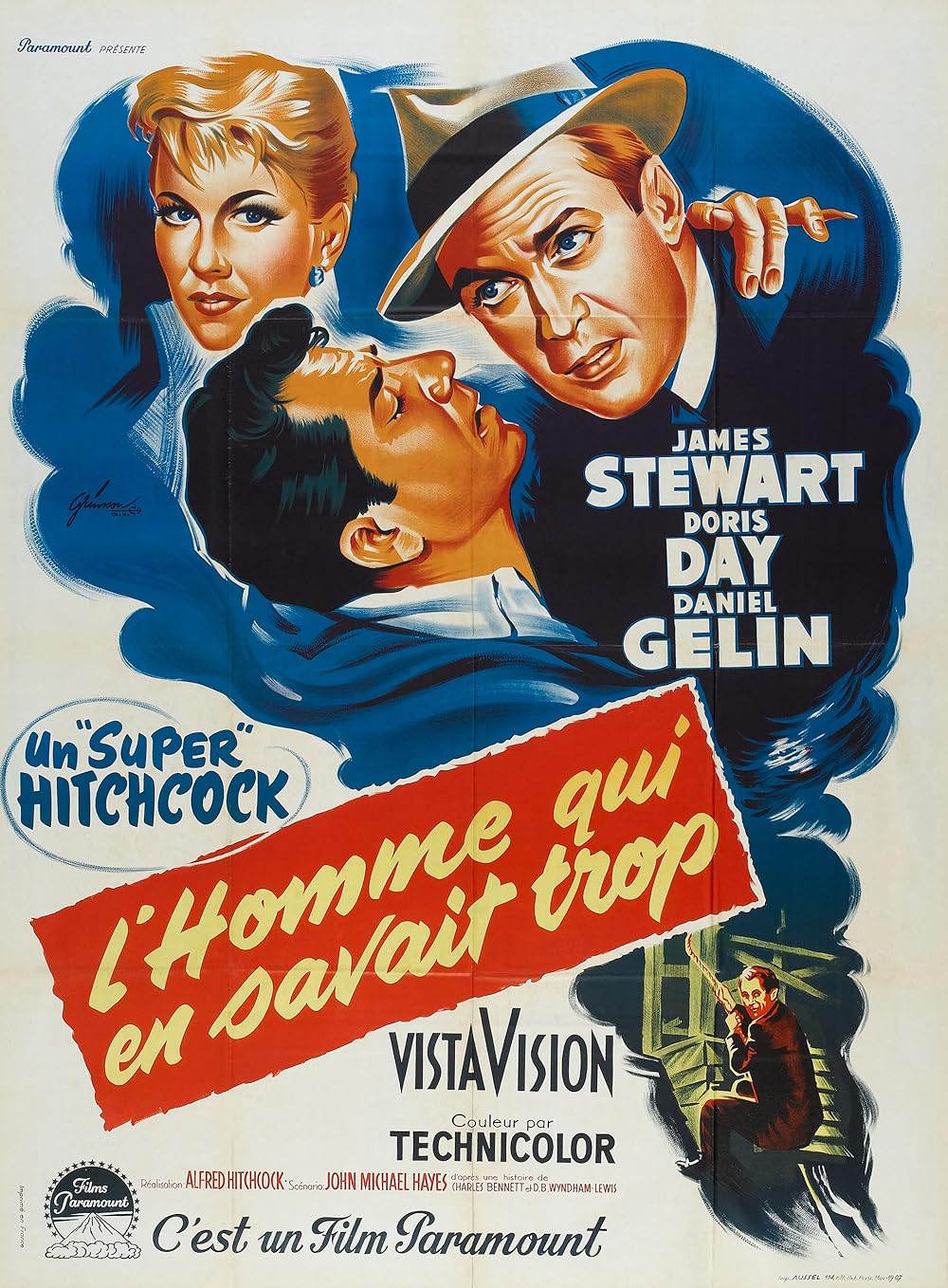
Une famille en vacances au Maroc tombe par hasard sur un complot dassassinat, et les conspirateurs sont bien déterminés à lempêcher dintervenir.
Bande-annonce
Casting
Alfred Hitchcock
Director
James Stewart
Dr. Benjamin McKenna
Doris Day
Josephine Conway McKenna
Brenda de Banzie
Lucy Drayton
Bernard Miles
Edward Drayton
Ralph Truman
Inspector Buchanan, Special Branch
Daniel Gélin
Louis Bernard
Mogens Wieth
Ambassador
Alan Mowbray
Val Parnell
Hillary Brooke
Jan Peterson
Christopher Olsen
Hank McKenna
Reggie Nalder
French Marksman
Richard Wattis
Albert Hall Assistant Manager
Noel Willman
Woburn, Special Branch
Alix Talton
Helen Parnell
Yves Brainville
French Police Inspector
Carolyn Jones
Cindy Fontaine
London Symphony Orchestra
London Symphony Orchestra
Bernard Herrmann
Conductor
John Michael Hayes
Writer
Charles Bennett
Writer
D.B. Wyndham-Lewis
Writer
Angus MacPhail
Writer
Vous aimerez aussi
Kiss Me, Kill Me
L'affaire McClain
Le bel arnaqueur
A Love Story from the Streets
Riverdale
La Défense Lincoln
His & Hers
Dexter: Original Sin
The Deuce
Mindhunter
Secrets and Lies
The Sinner
Good Behavior
Watchmen
Scarpetta
Dark Winds
Clarice
Allie & Andi
Bet
Dark
Black Mirror
Absentia
The Better Woman
The Alibi
Commentaires
7 commentaires
source: The Man Who Knew Too Much
The Man Who Knew Too Much
This isn't among my favorite Hitchcock films, though I must admit it's still pretty good. Among the things I really liked were the presence of Jimmy Stewart (he always improves even the most mediocre material) and the incredibly scary looking assassin (who looks like a skeleton with just a thin layer of skin stretched over him). Although it cost the studio a lot of money, I didn't particularly care for Doris Day in the film--she seemed to weep a lot and belts out "Que Sera" like a fullback. Yes, I know that she was supposed to sing in that manner, but this forever made me hate this song. Sorry. The other complaint, though minor, I had about the movie was that it was a little "too polished" and "Hollywood-esque". The original version (also done by Hitchcock) just seemed a lot grittier and seedier--and this added to the scary ambiance.
As we learn early in the movie, Doris Day's character has left the stage for marriage and motherhood in a city far from the bright lights. Then her child is abducted and in order to find him she has to return first to the place where she was famous and the people who knew her, and finally to the songs she sang. It's strange, in a movie by Hitchcock, to find we are watching the story of a woman who sacrifices her identity to her husband's and then finds it again, but I find it hard to ignore the parallel between the child held hostage by killers and the singer's career held hostage by her husband. Heavy stuff for 1956.
Alfred Hitchcock's remake of his own 1934 suspense-drama comes dangerously close to being an hysterical melodrama instead of a thriller, as The Master of Suspense is far too leisurely in working this convoluted plot up to a boil. American couple James Stewart and Doris Day (a convincing husband and wife) are swept up in an assassination plot while vacationing in Morocco, and are frantic when their young son is kidnapped. Despite Hitch's usual class and an exceptionally handsome production design, the film has few thrills. Scenes drag on interminably, the characters mumble and shoot terse looks at each other, but the threads of the story are kept far too opaque, and only the star-leads are able to hold interest. Doris introduces the big hit song "Whatever Will Be (Que Sera, Sera)", which serves as a plot-function and yet gets perhaps too much screen-time here. ** from ****
I hadn't seen it since I was in college. I remembered it like a fun, absurd movie. Now in 2018 what hit me the most was the wife played by Doris Day. She is spectacular and the absurdity becomes totally real just by looking at her. James Stewart is great of course but he seems to be the foil here rather than the center that keeps us connected to that essential leap of faith. The scene in which he gives her the tranquilizers before telling her the terrible news. What Doris Day manages to do with her character is extraordinary. Brenda de Banzie is a terrific villainess and Bernard Herrmann's score another major plus. I'm sure that even my grandchildren's grandchildren will talk about The Man Who Knew Too Much and about Doris Day.