
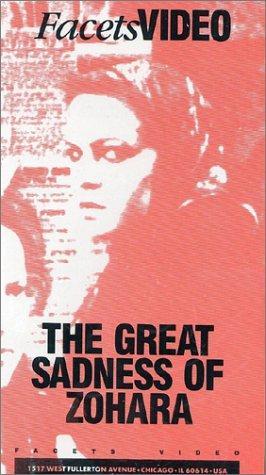
A young, orthodox Jewish woman is alienated from her Jerusalem community and drawn into the world of spirit. Surrounded by dark sounds of the "Other Side," she moves into remote and increasingly desolate regions of Arab lands. Her journey, like a mystical quest through her own inner landscapes, culminates in her return to Jerusalem. There, indelibly marked, she confronts her deeper loneliness and a devastating sense of exile.
Trailer
Pemeran
Nina Menkes
Director
Tinka Menkes
Zohara
Mungkin Anda Juga Suka
Love Duo
L Lag Gaye
Spa Secrets
Becoming Male in the Middle Ages
Greta Thunberg: A Year to Change the World
Two Weeks
Elite Short Stories: Omar Ander Alexis
Wrong Number
Launchpad
Return of the Reaper
The Lie We Lived In
Sistas
Lucifer
Zatima
Bel-Air
The Originals
The Rookie
The Boys
Power
The Witcher
Ginny & Georgia
Ruthless
My Demon
Komentar
5 Komentar
source: The Great Sadness of Zohara
This movie is the first real approach of Nina Menkes to show detachment and alienation. The Movie has many layers of emotions, the sound, the images, the environment, the people and Tinka Menkes. The Book of Job guides us, connects us, try's to explain what is happening in the images. We always watch, we are always the voyeur and we never participate, we never have a voice. The Camera is always passive but interested and fascinated. The Camera is impersonating us, we don't have a choice, we can just watch what is going on. The City's and Landscapes, Morocco, a constant traveling, by train, by ship, next scene, next place. The people of the places, in the city, they are always included, the are the contrast, the force, the rule and the border around Zohara (Tinka Menkes). Zohara, with short hairs, colored blue, always changing, sometimes forced into the world, wearing the traditional clothes. She gets hurt, is escaping and running away, free and open in the desert, in the river. Hiding in the shadow, hiding from the sun and the people. It is hard to judge or rate this Movie. It is such a personal Work of Nina and her Sister Tinka, the documentary aspect only allows us to accept the movie as "real". Even so, the movie is much more then a documentary, the voices, the alienation and detachment of Zohara, the experimental and emotional approach - in the hole, this movie is transporting what Nina Menkes want's to tell us. So listen to the silent girls. -- Occam, Berlin, Oct 2008
source: The Great Sadness of Zohara
This movie is the first real approach of Nina Menkes to show detachment and alienation. The Movie has many layers of emotions, the sound, the images, the environment, the people and Tinka Menkes. The Book of Job guides us, connects us, try's to explain what is happening in the images. We always watch, we are always the voyeur and we never participate, we never have a voice. The Camera is always passive but interested and fascinated. The Camera is impersonating us, we don't have a choice, we can just watch what is going on. The City's and Landscapes, Morocco, a constant traveling, by train, by ship, next scene, next place. The people of the places, in the city, they are always included, the are the contrast, the force, the rule and the border around Zohara (Tinka Menkes). Zohara, with short hairs, colored blue, always changing, sometimes forced into the world, wearing the traditional clothes. She gets hurt, is escaping and running away, free and open in the desert, in the river. Hiding in the shadow, hiding from the sun and the people. It is hard to judge or rate this Movie. It is such a personal Work of Nina and her Sister Tinka, the documentary aspect only allows us to accept the movie as "real". Even so, the movie is much more then a documentary, the voices, the alienation and detachment of Zohara, the experimental and emotional approach - in the hole, this movie is transporting what Nina Menkes want's to tell us. So listen to the silent girls. -- Occam, Berlin, Oct 2008