
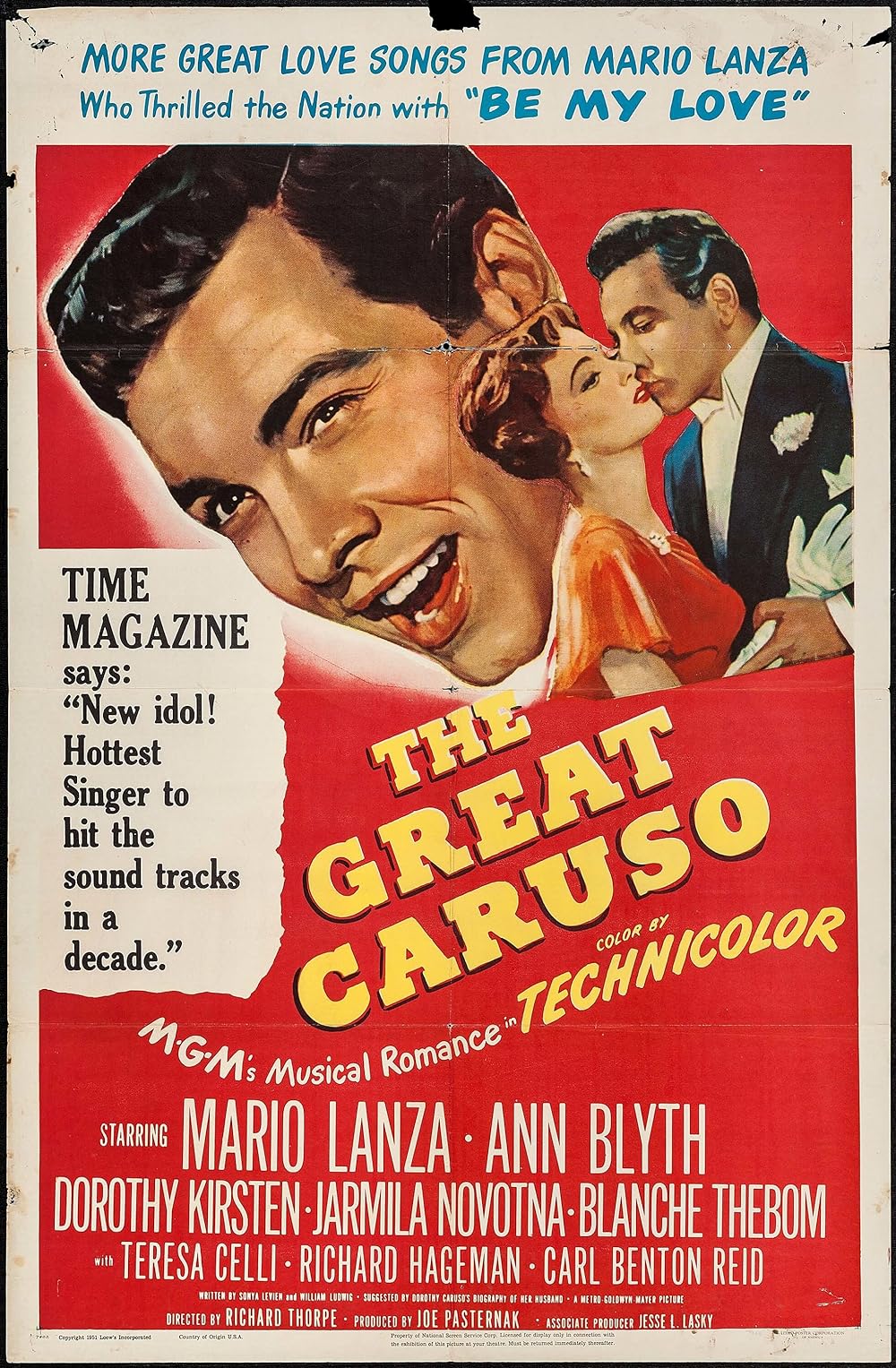
The film explores the life of tenor Enrico Caruso, a vocalist who faces rejection from Musetta and Dorothy, and struggles to find acceptance in New York.
Bande-annonce
Casting
Richard Thorpe
Director
Mario Lanza
Enrico Caruso
Ann Blyth
Dorothy Benjamin
Dorothy Kirsten
Louise Heggar
Jarmila Novotna
Maria Selka
Richard Hageman
Carlo Santi
Carl Benton Reid
Park Benjamin
Eduard Franz
Giulio Gatti-Casazza
Ludwig Donath
Alfredo Brazzi
Alan Napier
Jean de Reszke
Pál Jávor
Antonio Scotti
Carl Milletaire
Gino
Shepard Menken
Fucito
Vincent Renno
Tullio
Nestor Paiva
Egisto Barretto
Peter Price
Caruso (as boy)
Mario Siletti
Papa Caruso
Angela Clarke
Mama Caruso
Ian Wolfe
Hutchins
Sonya Levien
Writer
William Ludwig
Writer
Dorothy Caruso
Writer
Vous aimerez aussi
A Love Story from the Streets
Missionary
Intimate Betrayals
About Cherry
The New Edition Story
American Soul
The Bobby Brown Story
Selena: La Série
The Playlist
Bosé
Selena: La Série
La Vie en rock de Fito Paez
Pistol
Tell Me Lies
wolves of blood moon
The Five-Star Weekend
Wild Rose
The Last Teal Dragon
not the bride he wanted
I Know This Much Is True
knight of the lost heirs
Zatima
Vikings
Snowfall
Commentaires
8 commentaires
To begin with, this film, whatever its weaknesses, was largely responsible for many young people buying operatic recordings in the early 1950's. Lanza, of course, had a great, though uncultivated operatic voice, and his lack of lengthy formal training is obvious who anyone who knows what real operatic singing is supposed to sound like. Yes, he certainly had the range, power, and volume to sing every opera represented in this film, but his singing is far from polished or "finished". But no matter. He hit with a tremendous impact, and MGM made the most of it. The film itself really does not at all stick to the facts about Enrico Caruso. Caruso, certainly the greatest tenor of his time, died in Naples in 1920 after a somewhat lingering illness. The film opts for a more Hollywood-type ending. Lanza, moreover, was only a minimally competent actor, and, needless to say, his greatest moments are when he's singing Puccini, Donizetti, etc. Ann Blyth makes a positive account of herself as his wife Dorothy, and the celebrated Metropolitan Opera soprano Dorothy Kirsten actually comes off convincingly as a celebrated soprano who sang with Caruso (Lanza) in most of his Met performances. The operatic scenes are reasonably well done (by Hollywood standards), but as a biographical document of Caruso ----- it's neither accurate nor minimally plausible. I am sure that this film was lauded with great acclaim upon the time of it's release, but today, is just ends up being a nice two hours of entertainment ----- though it stands as a good testimony to the potential that Lanza had as a great tenor ------ a potential that was never realized. This was a great voice that could have been an operatic talent of the century had Hollywood not intervened and ruined it.
The Great Caruso displays the unique talents of Mario Lanza. He shows great acting capacity and is in top form as a lyrical singer, paired with Dorothy Kirsten, soprano of the Metropolitan Opera. Indeed, I dare to say that he performs some songs better than Caruso (check A'Vuchella from Tosti and La Danza from Rossini). The MGM art and music departments also did a good job. This movie could be perfect, were it not for the awkward presence of Ann Blyth; we see that she is trying her best, dressed in the fifties style in scenes just before 1920 - unforgivable. Lanza deserved a better leading lady, and Blyth should stick to less demanding productions. Also notice that Ms. Kirsten sings most of the opera duets of the film with Lanza, giving the wrong notion that Caruso had a kind of permanent leading soprano.
If you did not know much about the Great Caruso before you watched this film, you will be none the wiser after this film. It really is a bread and butter straightforward romanticised and fictionalised film starring Mario Lanza, filmed in the Hollywood backlot. The film has little to do with Caruso's life. If you want operatic singing and hear Lanza's voice then this is the film for you. I was underwhelmed.
I loved this film and it's both moving and well acted. Lanza's best film I think...he really is terrific and his co-stars as well. Rent this or buy it...it's that good.
I remember seeing The Great Caruso at a Cinema in Melbourne when I was 9 & I've never forgotten it!!!! Unfortunately they don't make movies like that anymore. Ironically that same theatre was where they had the Melbourne Premier of Mario's last film For The First Time on October 7th 1959 the day that Mario Lanza died. I beleive that I speak for most Mario fans around the world, when I say that Mario Lanza was the greatest tenor of them all!!!! I say that with all due respects to Pavartti Carrears & Domingo & many others. I'll never forget you Mario!!!!!
Yes, Be My Love was Mario Lanza's skyrocket to fame and still is popular today. His voice was strong and steady, so powerful in fact that MGM decided to use him in The Great Caruso. Lanza himself thought he was the reincarnation of Caruso. Having read the book by Kostelanitz who wrote a biography of Lanza, he explains that the constant practise and vocal lessons became the visionary Caruso to Lanza. There is no doubt that Lanza did a superb job in the story, but the story is not entirely true; blame it on Hollywood! I used to practise singing his songs years ago, and became pretty good myself until I lost my voice because of emphysema/asthma ten years ago. Reaching the high note of Be My Love is not easy; but beautiful!
I was 12 living in the coastal industry city of Luleå. I had never heard of Opera. My father was a movie projectionist. One evening i happened to see The Great Caruso. It was a breathtaking experience deep into my body. I was caught for ever by opera and I remember the deep sadness I felt in 1959 when my idol Mario Lanza died (similar to my sons feelings some 30 years later when John Lennon was killed). I have the Video and I have seen it many times on TCM Cabel TV - The Great Caruso will stay forever as the film that opened my eyes and emotions for music in general and opera in particular. Thank You MGM, Caruso but in particular thank You Mario Lanza.