
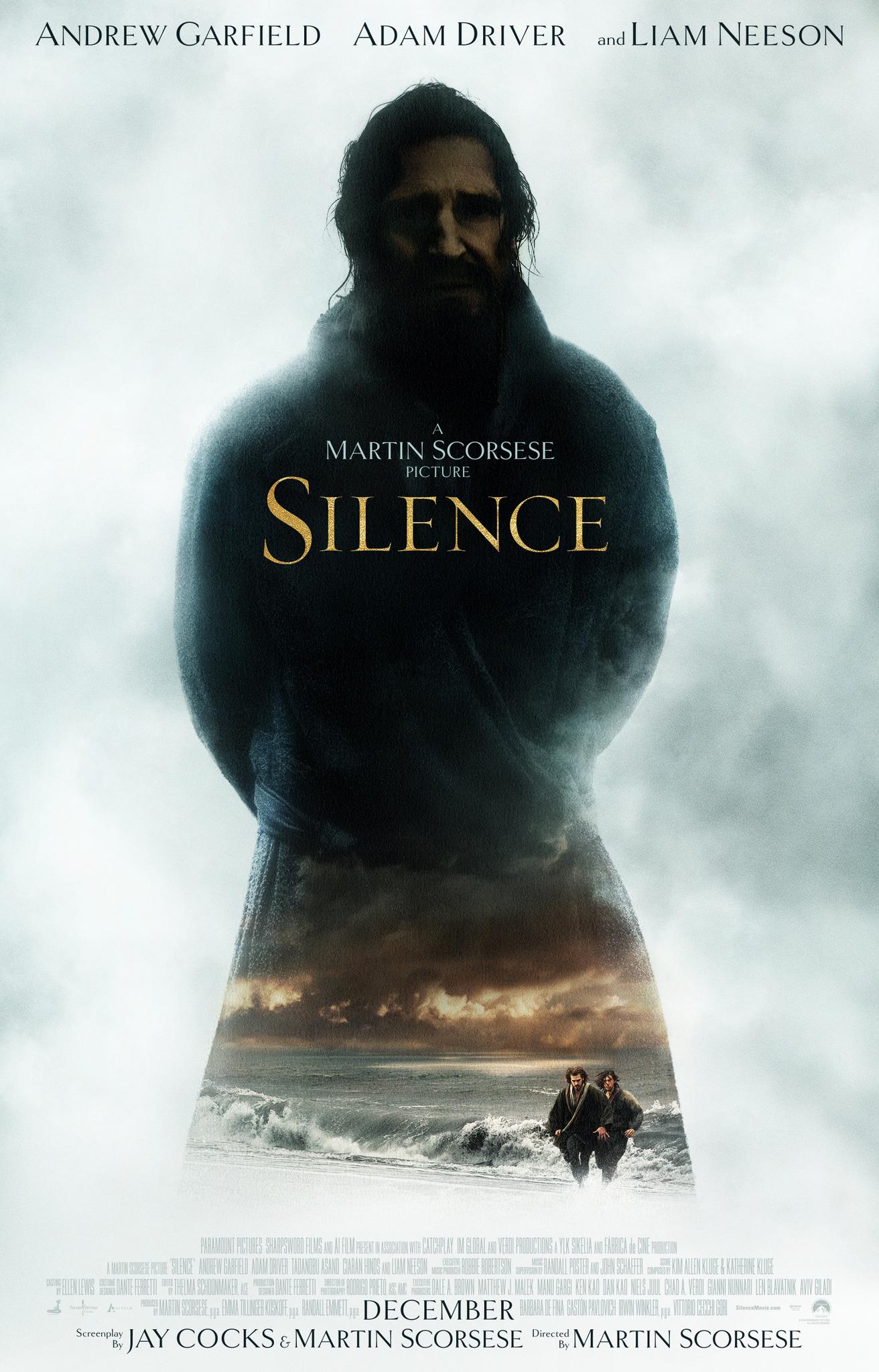
In the 17th century, two Portuguese Jesuit priests travel to Japan in an attempt to locate their mentor, who is rumored to have committed apostasy, and to propagate Catholicism.
Trailer
Pemeran
Martin Scorsese
Director
Andrew Garfield
Rodrigues
Adam Driver
Garupe
Liam Neeson
Ferreira
Tadanobu Asano
Interpreter
Ciarán Hinds
Father Valignano
Issei Ogata
Old Samurai
Issei Ogata
Inoue
Shin'ya Tsukamoto
Mokichi
Yoshi Oida
Ichizo
Yôsuke Kubozuka
Kichijiro
Kaoru Endo
Unzen Samurai (Uneme)
Diego Calderón
Prisoner Augustinian Friar #2
Rafael Kading
Prisoner Augustinian Friar #1
Matthew Blake
Prisoner Franciscan Friar
Benoit Masse
Prisoner Augustinian Friar #3
Tetsuya Igawa
Prisoner Japanese Jesuit
Liang Shi
Chinese Businessman (Mr. Chun)
Panta
Tomogi Villager #1 (Yohei)
Takuya Matsunaga
Tomogi Villager #2 (Toukichi)
Jay Cocks
Writer
Martin Scorsese
Writer
Shûsaku Endô
Writer
Mungkin Anda Juga Suka
Silence
Warrior Queen
The Book of Esther
Paradise Club
1979: The Year of the Islamist Revolution
Call the Midwife
Mary & George
Domina
Lockerbie: A Search for Truth
Great Expectations
The Paradise
The Trial of Christine Keeler
Anne Boleyn
Gunpowder
Banished
A Very British Scandal
Ruyi's Royal Love in the Palace
Dangerous Liaisons
The Looming Tower
Barkskins
Heirs to the Land
The Faithful
The Knick
Freedom at Midnight
Komentar
10 Komentar
good
Chris
In the Seventeenth Century, in Portugal, the Portuguese Jesuit priests Sebastião Rodrigues (Andrew Garfield) and Francisco Garupe[ (Adam Driver) ask permission to Father Alessandro Valignano (Ciarán Hinds) to travel to Japan to investigate the rumors that their mentor Father Cristóvão Ferreira (Liam Neeson) had committed apostasy abandoning his Catholic faith after being tortured by the shogunate. They meet the alcoholic fisherman Kichijiro (Yosuke Kubozuka) that agrees to guide them to Japan. When they arrive at a small village, they learn that the Christians residents live hidden in caves since the Inquisitor kills any villager suspect to be Christian. Along the days, Rodrigues and Garupel propagate Catholicism among the villagers and try to find a lead to Ferreira. But when the Inquisitor arrives in the village with his men, the live of the residents and the priests will change. "Silence" is a film directed by Martin Scorcese that shows how cruel a man can be. Based on historical facts, "Silence" show the powerful Shogunate defending their religion and culture against the European Catholicism that promises easy paradise to the suffered Japanese workers that has to work lot to pay the taxes and survive. The result is a good, but too long and tiresome film. My vote is seven. Title (Brazil): "Silêncio" ("Silence")
source: Silence
In brief, this movie to ENDURE, not ENJOY. It is just WAAAAAAAAAAAAAAAAAAAAAAAAAY. TOO. LONG. Three hours of relentless torture, persecution, despair, poverty, brutality, murder, betrayal, and then more of the same, was just too much, and Scorsese really should have made a 60 minute documentary rather than a movie. Yes, there are moments of lightness (two, we counted), and a brief sequence of hope and purposes where one of the padres felt like he was making a difference to the bleak poverty of the lives of Japanese villagers. Other than that, this movie is one inevitable, ghastly, slow slide to apostasy. On occasions, Mr Scorsese, I want my movies to give hope, humour, courage and good things, and your movie gave none of those. I had high hopes for this: Neeson, Garfield and Scorsese made it an attractive proposition. However, an hour into the movie and I was ready to leave. The plot was muddy and laborious, and Scorsese insisted on showing us short imagistic fragments that led nowhere. Two last gripes. Firstly, the idea that medieval rural Japanese villagers would be able to speak English (or Portuguese as the narrative language) is ridiculous. Secondly, why oh why did Scorsese make us sit through the credits before the house lights came on? A few more minutes of tedium? Whatever you wanted, it didn't work. It gets 2/10 for the cinematography and nothing else. Unless you are a fan of medieval Japanese torture and murder techniques, don't both watching this. Some movies stay with you for days, weeks, months, a lifetime. This one you will want to forget asap and move quickly to something more edifying.
What was Martin Scorsese thinking? Is he trying to set a record for the longest time to bore an audience? It used to mean something when someone said "it's a Martin Scorsese film". Does this now mean it's long and boring? How can anyone who invested 2 hrs and 41 min not say this was way to long and could have gotten the message across in a comfortable say.. 1 hour? Such a waste of talent. No big story here, the summary accounts for the almost 3 gruelling hours of boredom with no real message, although the one I did get made this even more of a time-waster. How can this be rated so high? Is society that bored and have that much time to waste on non-entertainment? Save yourself, you've read the summary, you're better off moving onto another movie.
I have seen this movie three times by now and still think it is brilliant, yet it's not a movie for everybody. It is surely no coincidence that even Martin Scorsese had to struggle for 25 years to scrape together the funds to make it. I can also understand why so many folks feel the movie is boring and too long even if to me it was neither boring nor too long. In fact, it feels just right. The reason I suppose many people do not truly 'feel' this movie -which takes up an unusual position in Mr Scorsese's rich filmography- is because of its theme. For surely, in times of abundant secularism and reductionist materialism, a movie such as this one cannot be else than a fossil. Essentially this is a movie about transcending implicit narcissism into an effulgence of humble, selfless Love. It is therefore a movie about the genuine path of authentic christianity. What makes it a special movie, at least in my heart, is that it not only sharply portrays this process of self-transcendence but also makes the link to the collective missionary adolescence of historical christianity. For surely, the Japanese are refined in their cruelty, yet at the same time they clearly are much more sane and of a deeper (personal and cultural) wisdom as are young missionaries who remain by and large unaware of the unwarranted cultural superiority with which they approach the Japanese. To bring all of this clearly into focus and allow for the story to reach its spiritual and historical apogee took close to three hours of masterful movie-making. Not to make this an overly long review: for those who are knowledgeable about the genuine (christian) path of self-transcendence into humbled Love, this is surely a masterful film. For others it is a boring waste of time. Those who love this movie may also be interested in "The Assassin" by Hsiao-hsien Hou. This movie brings to the screen the taoist version of the same inner path of transcending attachment to emotions and social identity to arrive at ultimate immersion in the Tao or the natural way.
In the Seventeenth Century, in Portugal, the Portuguese Jesuit priests Sebastião Rodrigues (Andrew Garfield) and Francisco Garupe[ (Adam Driver) ask permission to Father Alessandro Valignano (Ciarán Hinds) to travel to Japan to investigate the rumors that their mentor Father Cristóvão Ferreira (Liam Neeson) had committed apostasy abandoning his Catholic faith after being tortured by the shogunate. They meet the alcoholic fisherman Kichijiro (Yosuke Kubozuka) that agrees to guide them to Japan. When they arrive at a small village, they learn that the Christians residents live hidden in caves since the Inquisitor kills any villager suspect to be Christian. Along the days, Rodrigues and Garupel propagate Catholicism among the villagers and try to find a lead to Ferreira. But when the Inquisitor arrives in the village with his men, the live of the residents and the priests will change. "Silence" is a film directed by Martin Scorcese that shows how cruel a man can be. Based on historical facts, "Silence" show the powerful Shogunate defending their religion and culture against the European Catholicism that promises easy paradise to the suffered Japanese workers that has to work lot to pay the taxes and survive. The result is a good, but too long and tiresome film. My vote is seven. Title (Brazil): "Silêncio" ("Silence")