
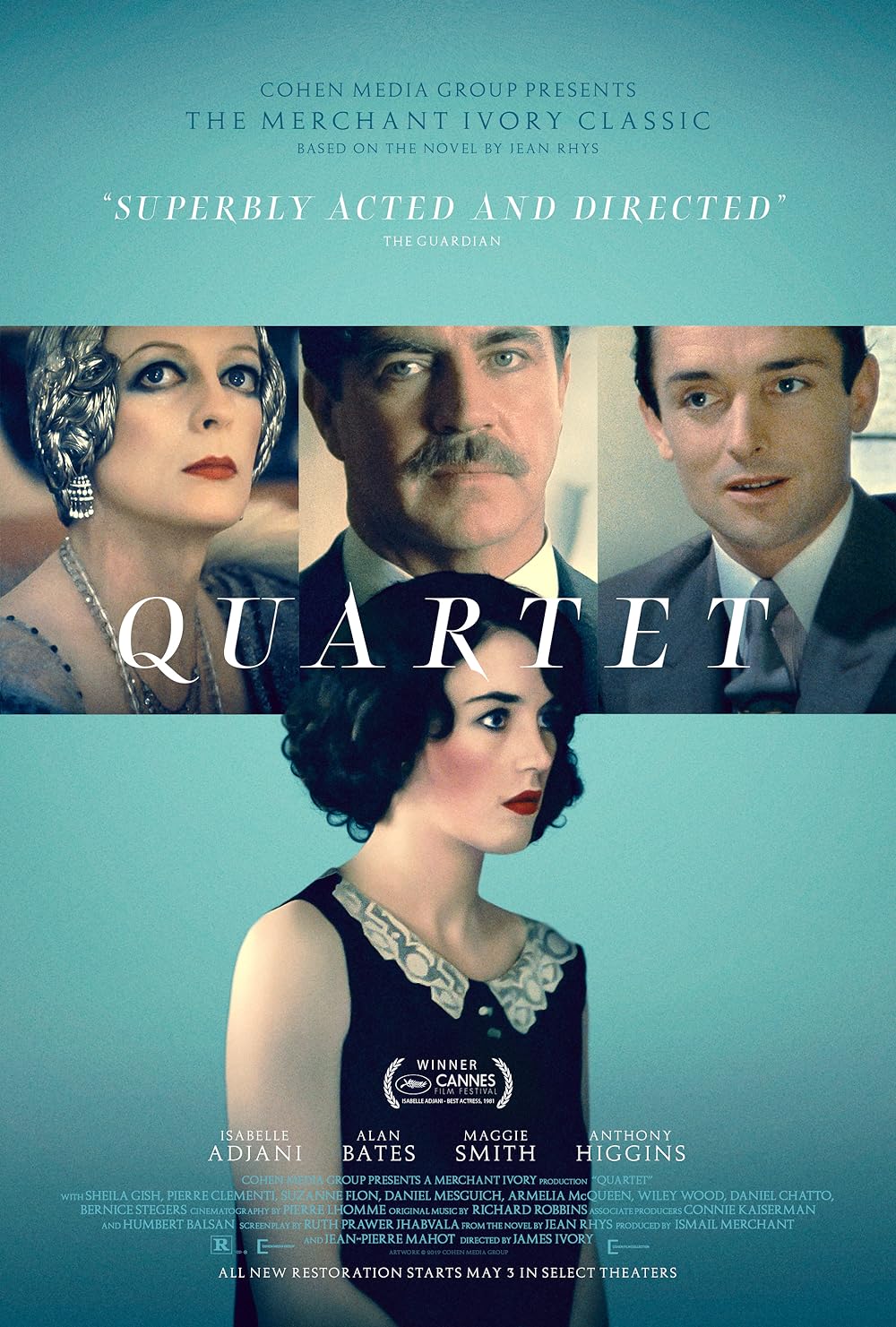
Marya Zelli se retrouve démunie après que son mari, Stephan, un marchand d'art, ait été reconnu coupable de vol. Marya accepte alors de se faire héberger par un couple étrange, H. J. et Lois Heidler, qui la laisse vivre dans leur maison.
Bande-annonce
Casting
James Ivory
Director
Isabelle Adjani
Marya Zelli
Suzanne Flon
Mme. Hautchamp
Sébastien Floche
Mr. Hautchamp
Anthony Higgins
Stephan Zelli
Maggie Smith
Lois Heidler
Sheila Gish
Anna
Daniel Chatto
Guy
Paulita Sedgwick
Esther
Alan Bates
H.J. Heidler
Bernice Stegers
Miss Nicholson
Isabelle Canto da Maya
Cri-Cri
François Viaur
Lefranc
Wiley Wood
Cairn
Dino Zanghi
Prison Guard
Michel Such
Prison Guard
Jean-Pierre Dravel
Prison Guard
Annie Noël
Maid
Maurice Ribot
Pianist
Jean Rhys
Writer
Ruth Prawer Jhabvala
Writer
Michel Maingois
Writer
James Ivory
Writer
Vous aimerez aussi
Sodom
Dream Boy
Postcards from London
Judas Kiss
Ma vie avec les Walter Boys
Heartstopper
Sanditon
Downton Abbey
Little Birds
Belgravia: The Next Chapter
Ackley Bridge
La chronique des Bridgerton
Hidden Love
Pursuit of Jade
If Loving You Is Wrong
Dian ran wo, wen nuan ni
There's no mention of a French release for The Rain in España. It seems like the show is only a
Meteor Garden
Gossip Girl
To My Shore
Xian ru re lian de wo men
Shuang cheng
Yi nian guan shan
Love and Crown
Commentaires
9 commentaires
source: Quartet
Quartet
Jean Rhys wrote this novel about her relationship with the then prominent writer Ford Madox Ford. While a young woman's husband is in prison, she is taken in by a writer and his wife, becoming the man's mistress. It was not a happy affair, but at least Rhys got her revenge with this story.
I was looking forward to see this movie. Finally I did and I was really disappointed. I'm positive about one thing: the script was weak and superficial. Ruth Prawer did not a good job this time. In an interview Ivory said that she was not fond of the idea of making a movie from that novel. Well, Ivory did convince her, but he was completely wrong. She botched the job, that's sure. Bates and Smith do a very good job, I'm not sure Adjani does. Anyway, I don't like to say these things about a movie director I admire so much, but truth before everything. I shall wipe my tears away watching Maurice and The remains of the day, truly the best of his movies.
The story opens in Paris, in the 1920s, where a wealthy, loveless couple (Maggie Smith, Alan Bates) goes from party to party and is still bored. He is disgusted with his older wife and she, in an effort to keep him happy, has a habit of procuring young women to live with them for his benefit. The acting by Smith and Bates (and Isabelle Adjani and Anthony Higgins, as the innocent young couple) is flawless, but the story is sordid, sad, and utterly depressing. It ends on a hopeless note, leaving me sorry I watched it. The glittery, jazzy, Parisian scene is convincing with beautiful sets and costumes, but they couldn't relieve the ugliness of it all. This Merchant-Ivory movie was made in 1981, and is unrelated to this year's, "Quartet," which also stars Maggie Smith. Recommended if you like character-driven movies and don't mind an overwhelmingly sad theme.
This movie was beautifully filmed, like all Merchant-Ivory productions, but was difficult to watch. The affair between Adjani's character and Bates' character was completely unbelievable. He was such a creep it was just stomach-turning when Adjani succumbs to his pressure to have sex with him. There was no discernible reason for her to fall in love with him, so it was hard to have sympathy for her character at all. Maggie Smith played her part very well, and was convincing, but again, not sympathetic. Alan Bates was just repugnant. The only sympathetic character was the Polish husband, who was in jail for most of the movie. Another puzzling thing about the movie is that, according to one of the reviewers on this page, there was some suspicion that the husband and Adjani were Bolshevists. While watching the movie, though, it seemed more likely that he was jailed for selling stolen property (the sword, which we saw early in the movie).
Few screenwriters have ever jumped the gap that Jhabvala traversed between THE EUROPEANS (1979) and QUARTET (1981). I know of no other film that captures as well the sense of European pre-WW2 'decadence' (compare CABARET for an object lesson in failure!), or that is directed and photographed with stronger integration of the settings, colours, sounds and behavior within the story being told. A remarkable achievement - the film that put filmmakers on notice about how well the remarkable Jhabvala/Ivory/Merchant trio present stories locked into their space and time.
That this was seen on a first visit to Paris at the Pathe Hautefeuille in the 6th may color the memory, but there it is. The sad Woolcott figure played by Bates is desperate (as is his Maggie Smith [BRILLIANT!] wife, a sad and cynical lady) and has an eye for new flesh. (This is pure Noel Harrison (Rex's boy) "new flesh to carve," as in his Young Girl cut.) The Woolcottioan figure is paunchy, unattractive, hungry, but with some social clout, and skincrawling. Maggie's character aids and abets. What's her line? One wonders if the satyr is in fact impotent. Cinematography, music, story line, cast...over reasonable expectations. Desperate story from a sad and deserate writer, Rhys, a suicide, I seem to recall. Ivory did this? Harder than the usual soft stuff the boyos do. Wondeful. Buy it.
In the tradition of some Merchant/Ivory films...this one deals with very profound social realities for a young woman (Isabelle Adjani)in Paris in the 1920s whose husband is a thief, is jailed. She is left penniless and without means of support (has no working papers). A rather strange English couple (Maggie Smith and Alan Bates) offer her refuge...but at the price of seduction by the husband, tolerated by the artist wife, who is inordinately tied to him emotionally. The young woman's emotional and psychological state is thrown into almost unbearable ambivalance...Love for her husband whom she visits weekly in jail and the need for survival. The film's visual beauty, the lighting, the intensity of color, the evocation of the "jazz age", the cabarets, the authentic costuming, in addition to the splended acting and direction make this a film deserving of far more attention than it's received, in my opinion. A truly cinematic experience of significance.