
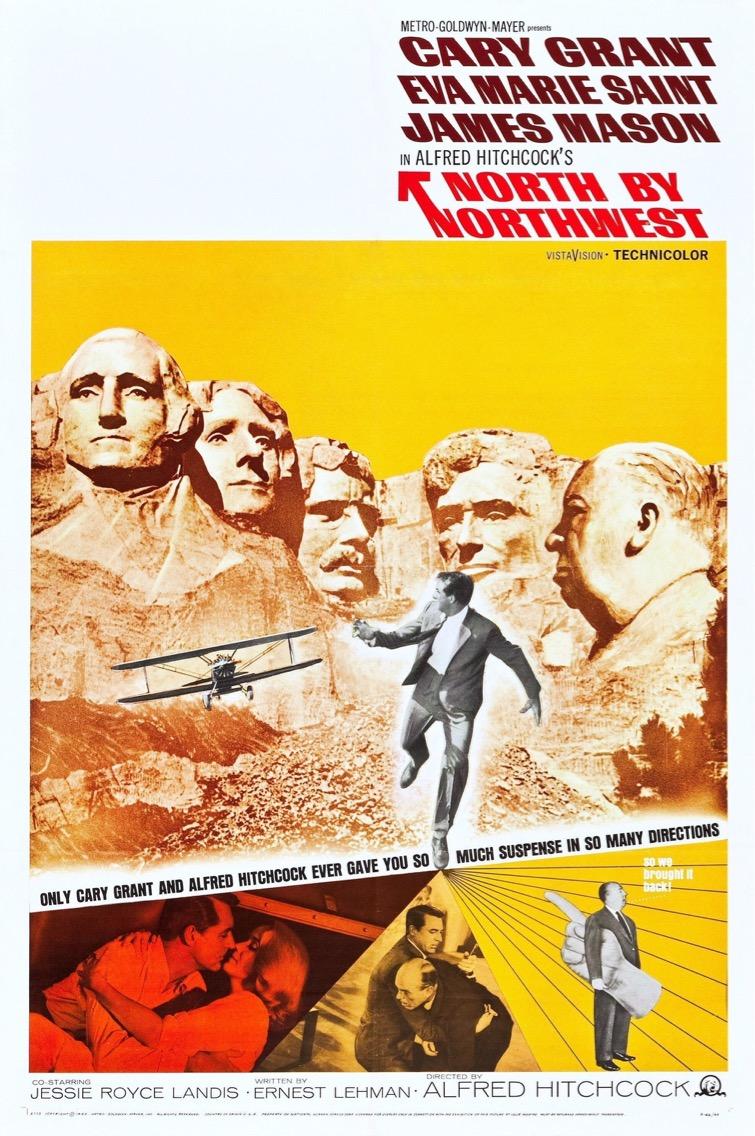
عندما يُخطئ المسؤول التنفيذي للإعلان روجر ثورنهيل في أنه وكيل حكومي، يتورط في مطاردة خطيرة عبر البلاد من قبل جواسيس أجانب والشرطة.
الإعلان الترويجي
طاقم العمل
Alfred Hitchcock
Director
Cary Grant
Roger Thornhill
Eva Marie Saint
Eve Kendall
James Mason
Phillip Vandamm
Jessie Royce Landis
Clara Thornhill
Leo G. Carroll
The Professor
Josephine Hutchinson
Mrs. Townsend
Philip Ober
Lester Townsend
Martin Landau
Leonard
Adam Williams
Valerian
Edward Platt
Victor Larrabee
Robert Ellenstein
Licht
Les Tremayne
Auctioneer
Philip Coolidge
Dr. Cross
Patrick McVey
Sergeant Flamm
Edward Binns
Captain Junket
Ken Lynch
Charley
Stanley Adams
Lieutenant Harding
David Ahdar
Auction Guest
Ernest Lehman
Writer
قد يعجبك أيضًا
Karnasubarner Guptodhon
A Love Story from the Streets
Missionary
Intimate Betrayals
12 قرد
Another Life
البراري
ذا لاند
Days of Our Lives: Beyond Salem
Dark Matter
Terra Nova
Archives: The Nanyang Mystery
The North Water
Treasure at Dawn
19th Floor
البحث عن الذهب
الرأس المحموم
The Stranded
بارايسو
النجوم
Blue Moment
The Five Star Weekend
The dawn of Olympus son of apollo
التعليقات
10 تعليق
source: North by Northwest
North by Northwest
The opening sequences are superb, but, for me, it all goes wrong after the scene in the UN lobby. Just when Hitch should have been tightening the screw, he inserts a scene where a committee of FBI agents reveal to us that they know our hero (Cary Grant) to be innocent. This robs much of what follows of any real tension. Just when the pace should be hotting up, Hitchcock slows things down with that long sequence on the train, which, surprisingly, lacks any sense of danger. As so often with Hitchcock in the 50s, he seemed more interested in glamour than with anything else. And glamour doesn't mix very easily with menace. The famous scene where Cary Grant is attacked by a plane is fine, but it isn't integrated with the rest of the plot. (If someone wanted to kill Cary Grant, why didn't they just hire a gunman instead of a plane?) The plotline is perfunctory: Cary Grant makes his way into the villain's house, and instantly discovers what one of the best FBI agents has failed to uncover in years. The scene at the auction and the final chase on Mount Rushmore are, once again, memorable. But overall, this film appears to confirm my view that while Hitchcock was superb with individual set pieces, he never gave much thought to the overall structure or pacing. Even at his best (e.g. "The 39 Steps" or "Rear Window") Hitchcock doesn't give an impression of having an artistic vision to impart, which makes his reputation as a great director rather puzzling. No doubt his admirers see more than I do.
Many feel this is Alfred Hitchcock's greatest American movie, and I agree! NORTH BY NORTHWEST is the Hitchcock film to end all Hitch films, with all his pet themes covered with maximum wit, panache, and suspense, as well as a romance between Cary Grant and a soignée Eva Marie Saint that's as tender as it is sexy. Grant has never been more engaging and dashing (literally and figuratively :-), though the smoothly villainous James Mason nearly out-suaves him. My husband and I have joked that if Mason had played Thornhill, the film would have been over in mere moments. With all due respect to Grant, if the imperious, unshakably confident Mason asked the Glen Cove police, "Do you honestly believe that this happened the way you think it did?" they would immediately reply, "No, sir, you must be right, you're free to go, sorry we bothered you." :-) Also boasts a great early performance by a reptilian young Martin Landau as Mason's possessive henchman, as well as one of Oscar nominee Ernest Lehman's best screenplays (in fact, he borrowed liberally from it for his script for the film version of THE PRIZE starring Paul Newman) and one of Bernard Herrmann's finest scores. Anybody who wants to write or direct a chase thriller should watch NORTH BY NORTHWEST first to see how it's done!
When I started collecting videos in earnest (by the thousands), I was excited to get this film. I had such fond remembrances of seeing it on the big screen when I was young teen. I remember being terrified when Cary Grant was being chased by the crop duster and then awed at the end with the climactic scene on Mount Rushmore. I saw it maybe a decade or so later on television and enjoyed it again. Well, seeing the film again five years ago on DVD as a 50-something-year-old turned out to be a major disappointment, mainly because the first hour was so boring. The beginning had scenes that looked too dated and worse, were drawn out too long, such as Grant's drunk scene and the romance between he and Eva Marie Saint. Once Grant goes on the run, the story improves noticeably and mixing in some comedy with the drama was a good move. From that point, it's still the fun film I had remembered but, overall, didn't have the suspense anymore and, to this day, I believe is an overrated Alfred Hitchcock film. The more I see of Hitch's old films, the more disappointed I am, with the exception of Psycho and Rear Window.
"North by Northwest" is my favorite of all Hitchcock films (a close shave with "Rear Window"), and it permanently occupies a slot in my Personal Top Ten Films of All Time. Grant is terrific--funny, sexy, angry, confused, exhausted, redeemed. It is a full-bodied performance. And speaking of bodies--Eva Marie Saint is *definitely* an asset here, not just for her looks (there's that cool, blond Hitch femme fatale again) but for showing off her acting chops as well. James Mason is a consumate actor, and Hitch gives him a vehicle to enter one of his finest performances. Martin Landau, too, is appropriately chilling. Favorite scenes? The crop-dusting sequence is certainly a classic. But I love the scenes with Roger and his mother, dickering over his "drunkenness." And the auction is Hitch in his element: the scene plays tense and terse but also funny. I can quibble with this film: The blue-screening looks a bit cheesy nowadays. And the movie opens with a huge plot hole (when the page is searching for George Kaplan and Thornhill grabs his ear for a quick question, Mason et.al. believe Thornhill to be their man, setting off the entire plot. However, shouldn't the page have continued searching the room, calling for Mr. Kaplan? And shouldn't the villains have heard him continue to page, knowing that Thornhill wasn't who they assumed he was? Ahh, but that would blow the whole movie!). This film also contains the best "naughty joke" Hitchcock ever devised. The final sequence is Eva Marie Saint and Grant pulling each other into bed. The jump cut is to a train entering a tunnel. You figure it out.
Despite Hitchcock's penchant for perfection on two occasions (Rear Window & Psycho), this is an absolutely imbecilic excursion. Plot holes fill the script and even Hitchcock's usual visual grandeur isn't present here. I'll trace this to where Spielberg's trait of "maximum suspension of disbelief" originates. More interesting works like 'Rope' and 'Birds' have daring elements that make them stronger. Cary Grant is a block of wood. Heck all the acting is simple by today's standards. The plot, too, is nothing remarkable since there have been so many other "running man/conspiracy" movies since this one. No doubt this work of Hitchcock has dated the worst. Tony Scott tried remaking this, he failed. Perhaps someone smarter like David Fincher or Robert Rodriguez will try again. Final Analysis = = Cinematic Dud
As it is clearly demonstrated even in this forum, many, many people love this movie. I just finished viewing it myself for the first time, and frankly, I can't say that I agree. Am I nuts? Maybe. All I know is I'd like to put my two cents in, for what it's worth. For an espionage tale like this, I would have preferred an approach more based on grim realism. Instead, the narrative seemed a bit too convenient and contrived, as if Old Hitch was trying to make the ends meet at the last minute. Somehow, I never felt the `taut' tension of his other films that I've immensely enjoyed (Dial M for Murder, Rear Window, Psycho, The Wrong Man, Vertigo, to name but a few). It certainly doesn't help that the film contains too many scenes that verge on the `fantastical' level. For example, there's a scene in which a gun goes off in the living room of a house. Eva Marie Saint comes out of her room and asks, `What was that noise,' to which James Mason replies, `We were just wondering about that.' Martin Landau just gives a little shrug and all is forgotten. I mean, come on! I'd say it's pretty hard to mistake a gunshot for, say, somebody dropping a glass on the floor. As I mentioned, there are many more scenes like this during the course of the movie, and every single one of them acts as a decelerator' of the narrative. Also, the overall performance of the cast struck me as rather underwhelming, especially when we're talking about some of the finest actors ever to grace the silver screen. James Mason, in particular, sleepwalks his way through, though I can't blame him, given the fact that his character was so painfully underwritten. The bit when Cary Grant acts like he's drunk was pretty difficult to sit through. Humor is fine when it works on, again, a believable level. I like the idea of having a normal Joe get tangled up in a case of mistaken identity/international espionage. Also, it does feature some memorable scenes, especially the famous crop field/airplane sequence (it really does deserve all the praise it has received) But again, it just proves to me that even a seemingly sure-fire combo like Ernest Lehman-Alfred Hitchcock can still come up short on the goods. The second 007 adventure, `From Russia with Love', received some hounding because people thought it was basically a rip-off of this movie (there are some obvious similarities), but in this madman's humble opinion, `From Russia with Love' is the one that achieves a better telling of a spy story.