
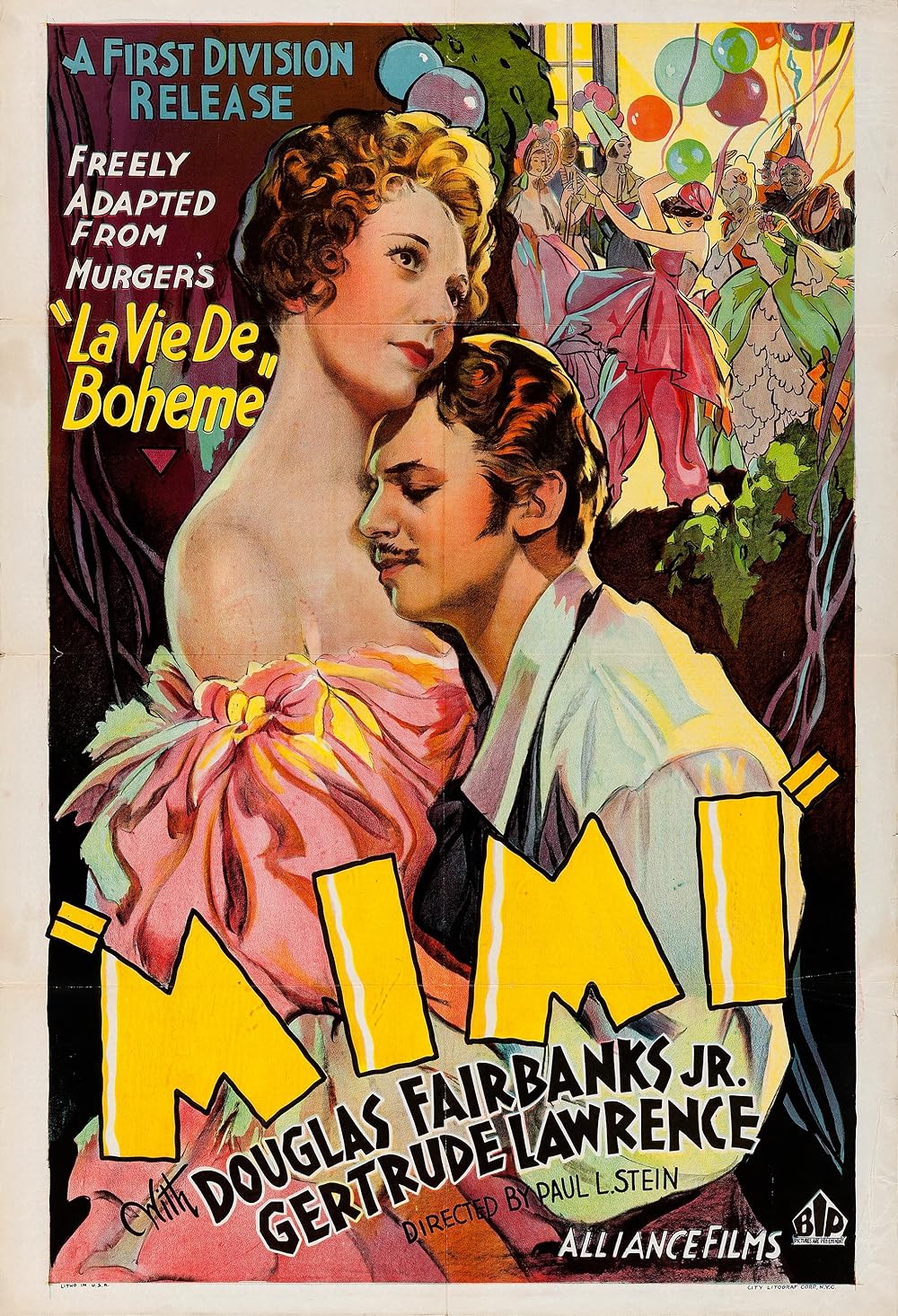
The story of a struggling playwright in 1850s Paris and his mate whose love furnishes him with the inspiration he has long sought.
Bande-annonce
Casting
Paul L. Stein
Director
Douglas Fairbanks Jr.
Rodolphe
Gertrude Lawrence
Mimi
Diana Napier
Mme. Sidonie
Harold Warrender
Marcel
Carol Goodner
Musette
Richard Bird
Colline
Martin Walker
Schaunard
Austin Trevor
Lamotte
Lawrence Hanray
Barbemouche
Paul Graetz
Durand
Jack Raine
Duke
Leonard Sharp
Waiter at Cafe Momus
Norma Varden
Madame Durand
Jack Davis Jr.
Writer
Clifford Grey
Writer
Paul Merzbach
Writer
Henri Murger
Writer
Denis Waldock
Writer
Vous aimerez aussi
Sodom
Dream Boy
Postcards from London
Judas Kiss
Ma vie avec les Walter Boys
Heartstopper
Poldark
Sanditon
Belgravia: The Next Chapter
Ackley Bridge
Pursuit of Jade
Dian ran wo, wen nuan ni
Au fil des années
Shuang cheng
Sunset Vibes
An ge li de mi mi
Kiseki: Dear to Me
The Sweetest Taboo
Kàn jiàn ài
Hanggang makita kang muli
Liu zhou ji
Monster Next Door
Love Story in the 1970s
Dazzling
Commentaires
8 commentaires
source: Mimi
Not really sure what drew me to watch this. Attractive poster perhaps and to see Gertrude Lawrence and Douglas Fairbanks JR as they were in 1935. Well, they were fine, she more impressive than he but both fine and everyone else was also fine. Fine as anyone could be on an Elstree stage telling the Parisian tale of La Boheme. I stayed awake, the ballroom sequence is impressive and to be fair it may have been the wondrous and sparkling Bu-ray picture that showed up the inadequacies of the stagey sets and at least the acting wasn't too stagey as well.
Mimi was one of a series of films that Douglas Fairbanks, Jr. did while visiting the United Kingdom from 1934 to 1936. It's a straight dramatic version of the Puccini opera, La Boheme. Though The Rise of Catherine the Great is probably the best known and best received of the Fairbanks English films from this period, Mimi was a special one. It's also one of the few films that Gertrude Lawrence did and she did it at a time when she and Fairbanks were romantically involved. In fact while making several films Fairbanks also appeared on the London stage in two different plays with Lawrence, Moonlight is Silver and The Winding Journey. Neither of those is first rank among the work of either Fairbanks or Lawrence. And sad to say, neither is Mimi. Unfortunately realizing that their source material is from grand opera, both Fairbanks and Lawrence perform in the manner of grand opera. They overact outrageously, maybe inspired by the Puccini music that is used in the background. Doug and Gertie sure got no directorial help in this one. Of course La Boheme served as the inspiration for the recent musical Rent and I'd suggest seeing that before watching Mimi. Unless you're a big fan of Doug and Gert.
source: Mimi
Mimi was one of a series of films that Douglas Fairbanks, Jr. did while visiting the United Kingdom from 1934 to 1936. It's a straight dramatic version of the Puccini opera, La Boheme. Though The Rise of Catherine the Great is probably the best known and best received of the Fairbanks English films from this period, Mimi was a special one. It's also one of the few films that Gertrude Lawrence did and she did it at a time when she and Fairbanks were romantically involved. In fact while making several films Fairbanks also appeared on the London stage in two different plays with Lawrence, Moonlight is Silver and The Winding Journey. Neither of those is first rank among the work of either Fairbanks or Lawrence. And sad to say, neither is Mimi. Unfortunately realizing that their source material is from grand opera, both Fairbanks and Lawrence perform in the manner of grand opera. They overact outrageously, maybe inspired by the Puccini music that is used in the background. Doug and Gertie sure got no directorial help in this one. Of course La Boheme served as the inspiration for the recent musical Rent and I'd suggest seeing that before watching Mimi. Unless you're a big fan of Doug and Gert.
Not really sure what drew me to watch this. Attractive poster perhaps and to see Gertrude Lawrence and Douglas Fairbanks JR as they were in 1935. Well, they were fine, she more impressive than he but both fine and everyone else was also fine. Fine as anyone could be on an Elstree stage telling the Parisian tale of La Boheme. I stayed awake, the ballroom sequence is impressive and to be fair it may have been the wondrous and sparkling Bu-ray picture that showed up the inadequacies of the stagey sets and at least the acting wasn't too stagey as well.
This film was made during the production regime of Walter Mycroft at Associated British.He was a former film critic so you would have though that he would have known better than to put this dreary mess into production.Maybe since the cast knew it was so bad they went very much over the top.The film is far too much like a theatrical production,with actors trying to project themselves to the back of the theatre.Probably the only point of note is the appearance of Gertrude Lawrence in one of her very few films.However it is difficult to understand the reason British producers to make films like this when the nation was in the grip of depression and seeking to be entertained.
Mimi