
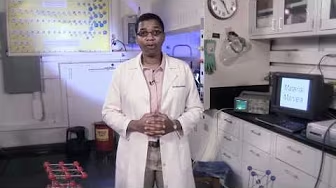
Material Marvels explores some amazing technology in engineering with Associate Professor, Ainissa Ramirez.
قد يعجبك أيضًا
CoComelon #shorts
CoComelon
SS 1 Biology
SS 1 Physics
Numberblocks Mission HQ!
Charlie and Lola - Season 1
Numberblocks Season 1 - Full Episodes
Emanuella And Success Comedy
Test Your English with TV Series and Movies
Go Figure
Kids Songs by CoComelon
Learn Colors with CoComelon!
Alphabet (ABC) Songs by CoComelon
CocoMelon | Little Baby Bum | Blippi - Nursery Rhymes & Kids TV Shows
CoComelon - Happy Holidays
BabyBus | Learning Vehicles Song | Car Songs | Cars for Kids | Nursery Rhymes | Baby Cartoon
Learn English With Disney Movies
All New Akili & Me
Educational Cartoons for Kids | Learn with Sheriff Labrador
Sheriff Labrador New Episodes
Learn about Safety Tips for Kids!
🏝️🗺️ Talking Hank’s Adventure Guide | Explore & Learn
Learn ABC English Alphabet with Sheriff Labrador
Let's Make African Dishes!
التعليقات
6 تعليق
As millions of viewers settle in to watch the Super Bowl, Yale scientist Ainissa Ramirez describes the physics behind the game and what gives a football its speed, drag and spin. Tune in now to this special Super Bowl edition of Science Xplained.
Associate Professor of Mechanical Engineering & Materials Science at Yale, Dr. Ainissa Ramirez, discusses how a layer of carbon that is one atom thick, called graphene, will revolutionize our lives. Discovered by scientists that won the Nobel prize, graphene can be found in everyday pencils, is incredibly strong and super-conductive and will make blazingly fast computers and video games a reality.
Associate Professor of Mechanical Engineering & Materials Science at Yale, Dr. Ainissa Ramirez (@blkgrlphd), talks about shape memory alloys. These "metals with a memory" are used in space, in robots and even in your mouth!
Associate Professor of Mechanical Engineering & Materials Science at Yale, Dr. Ainissa Ramirez, demonstrates the heat absorption properties of the space shuttle's ceramic tiles.
In this short video, Yale engineer, Dr. Ainissa Ramirez, shows how sandwiches of silicon (in solar cells) can create energy from sunlight and help curb our dependence on oil.
The Nobel Prize in Chemistry went to quasicrystals. But what are they? Dr. Ainissa Ramirez guides us into the strange world where atoms arrange themselves in forbidden ways and create materials with weird properties.