
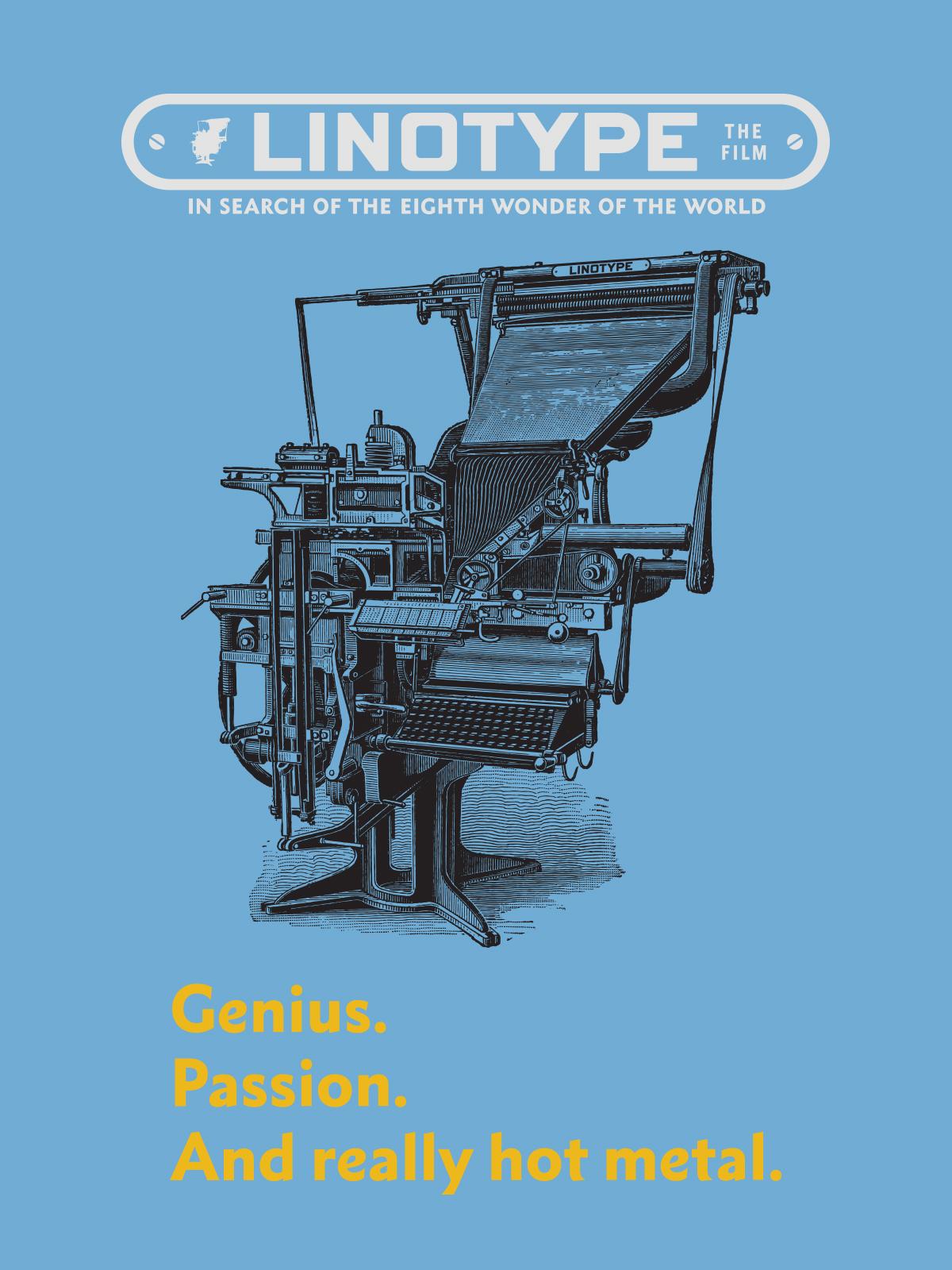
Called the "Eighth Wonder of the World" by Thomas Edison, the Linotype revolutionized printing and society. The film tells the surprisingly emotional story of the people connected to the Linotype and how it impacted the world.
Trailer
Cast
Douglas Wilson
Director
Matthew Carter
Self
Ray DesChamps
Self
Elln Hagney
Self
Allan Haley
Self
Ray Loomis
Self
Eldon Meeks
Self
Frank Romano
Self
Carl Schlesinger
Self
Dave Seat
Self
Guy Trower
Self
Tim Trower
Self
Maaari Mo Ring Magustuhan
Linotype: The Film
Shakedown
Hollywood, No Sex Please!
Sex in the Soviet Union
Pride
Surviving Black Hawk Down
The Dinosaurs
World War II with Tom Hanks
Vikings: The Rise and Fall
Inside the Factory
The Chi
Ambitions
The Five Star Weekend
the rise of lycan queen
Arena zero
Poppy the Little Witch
knight of the lost heirs
Sweet Temptation
Avatar: The Last Airbender
The Rookie
The Witcher
Legacies
My Demon
Siren
Mga Komento
10 Mga Komento
source: Linotype: The Film
As someone who's had a long career involved with the publishing world, I found Linotype: The Film a very welcome tribute to the amazing machine that really made print accessible to the masses. The documentary does an excellent job of presenting the allure of a mechanical behemoth that sold in huge numbers and ruled the world of print for almost 100 years. It also pays suitable tribute to the last generation of skilled operators who ran Linotype machines, and witnessed the end of an era as the machines were phased out and junked, made obsolete by the advent of cheap digital typesetting solutions. I particularly appreciated the explanation of how the Linotype machine actually worked. As one person says, it was almost a Rube Goldberg contraption, employing complex cams, belts and chutes, delivering a * of hot molten metal to create each line of type. Quite amazing. That said, I wished the movie had taken just a bit more time on the denouement of this tale. The various optical and electronic successors to the mechanical Linotype machine are mentioned, but it would have been interesting to hear how they took the world of print forward - and about what may have been lost along the way. For example, metal type being an analog process, it provides near-infinite 'resolution' - razor-sharp lettering that does have a certain unique quality. On the other hand, digital technology did bring typesetting literally to any desktop. One consequence has been that terms like 'font' and 'typeface' became commonplace (even if often misused). The movie does touch briefly on the evolution in typefaces that the Linotype enabled. But, again, it could have gone just a bit further in talking about how that accumulated art has been evolved and popularized by the transition to digital. Nonetheless, Linotype: The Film does well at dramatizing the story of the Linotype machine, and capturing the enthusiasm of the people still working today to keep its legacy alive. It's a lively, entertaining documentary, highly recommended for anyone with an interest in print or media in general, or with a love of clever mechanical devices for their own sake.
The machines are old and the operators are old giving me pause to slow down and listen. Its hard to imagine what our modern world would look like if the Linotype did not exist. Would we have even have computers, smartphones or any level of modern comfort without it? This is one of the greatest inventions that effected the exponential growth of all human knowledge. These humble machines are doomed for scrape metal. They were made obsolete by their own success. We all owe the Linotype machine a thank you for everyday conveniences we just take for granted. I enjoyed watching the operators keying in the lines and just listening to the whirring, clicks, clanks and clinks of the machine. Its puts me into some kind of state like I'm in a trance.
This film is a great introduction to a very complicated machine called the Linotype, which was used for typesetting from the late 19th century to the 1960s and 70s. It is most informative and by the end of the film, you have a very good idea of how the machine works. What is even more fascinating is how the Linotype changed the history of communication. Because of the invention of this machine literacy rates climbed, simply because there was more to read and it was less expensive than it had been in the past. The history is covered on many levels by former Linotype operators and their descriptions of the working conditions, the unique stories, and the sorrow they felt when the machine was replaced by more modern methods. Intertwined in the film are some of the remaining operators that still use fully functional machines. As an aside, I would like to note that I encountered a Linotype during my first job out of college, at a typesetting shop in 1981. The machine was being kept because the company was finishing up a dictionary and it was the only way they could match the font. When the people in this film mention that it was a beast they are not kidding! The sound it made was incredibly loud and the moving parts resembled some kind of weird kinetic sculpture you might see at Burning Man. I never quite understood how the machine worked because I was terrified to get near it, but this film has given me a good understanding of this fascinating, history changing machine. This is truly a excellent film that covers many aspects of the Linotype machine and presents some very interesting characters in the process, most of whom are quite charming in their individual ways. Definitely worth a look whether you have an interest in printing or not.
As someone who's had a long career involved with the publishing world, I found Linotype: The Film a very welcome tribute to the amazing machine that really made print accessible to the masses. The documentary does an excellent job of presenting the allure of a mechanical behemoth that sold in huge numbers and ruled the world of print for almost 100 years. It also pays suitable tribute to the last generation of skilled operators who ran Linotype machines, and witnessed the end of an era as the machines were phased out and junked, made obsolete by the advent of cheap digital typesetting solutions. I particularly appreciated the explanation of how the Linotype machine actually worked. As one person says, it was almost a Rube Goldberg contraption, employing complex cams, belts and chutes, delivering a * of hot molten metal to create each line of type. Quite amazing. That said, I wished the movie had taken just a bit more time on the denouement of this tale. The various optical and electronic successors to the mechanical Linotype machine are mentioned, but it would have been interesting to hear how they took the world of print forward - and about what may have been lost along the way. For example, metal type being an analog process, it provides near-infinite 'resolution' - razor-sharp lettering that does have a certain unique quality. On the other hand, digital technology did bring typesetting literally to any desktop. One consequence has been that terms like 'font' and 'typeface' became commonplace (even if often misused). The movie does touch briefly on the evolution in typefaces that the Linotype enabled. But, again, it could have gone just a bit further in talking about how that accumulated art has been evolved and popularized by the transition to digital. Nonetheless, Linotype: The Film does well at dramatizing the story of the Linotype machine, and capturing the enthusiasm of the people still working today to keep its legacy alive. It's a lively, entertaining documentary, highly recommended for anyone with an interest in print or media in general, or with a love of clever mechanical devices for their own sake.
The machines are old and the operators are old giving me pause to slow down and listen. Its hard to imagine what our modern world would look like if the Linotype did not exist. Would we have even have computers, smartphones or any level of modern comfort without it? This is one of the greatest inventions that effected the exponential growth of all human knowledge. These humble machines are doomed for scrape metal. They were made obsolete by their own success. We all owe the Linotype machine a thank you for everyday conveniences we just take for granted. I enjoyed watching the operators keying in the lines and just listening to the whirring, clicks, clanks and clinks of the machine. Its puts me into some kind of state like I'm in a trance.
source: Linotype: The Film
This film is a great introduction to a very complicated machine called the Linotype, which was used for typesetting from the late 19th century to the 1960s and 70s. It is most informative and by the end of the film, you have a very good idea of how the machine works. What is even more fascinating is how the Linotype changed the history of communication. Because of the invention of this machine literacy rates climbed, simply because there was more to read and it was less expensive than it had been in the past. The history is covered on many levels by former Linotype operators and their descriptions of the working conditions, the unique stories, and the sorrow they felt when the machine was replaced by more modern methods. Intertwined in the film are some of the remaining operators that still use fully functional machines. As an aside, I would like to note that I encountered a Linotype during my first job out of college, at a typesetting shop in 1981. The machine was being kept because the company was finishing up a dictionary and it was the only way they could match the font. When the people in this film mention that it was a beast they are not kidding! The sound it made was incredibly loud and the moving parts resembled some kind of weird kinetic sculpture you might see at Burning Man. I never quite understood how the machine worked because I was terrified to get near it, but this film has given me a good understanding of this fascinating, history changing machine. This is truly a excellent film that covers many aspects of the Linotype machine and presents some very interesting characters in the process, most of whom are quite charming in their individual ways. Definitely worth a look whether you have an interest in printing or not.
Linotype: The Film