
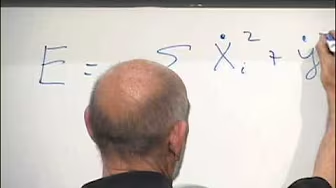
String theory (with its close relative, M-theory) is the basis for the most ambitious theories of the physical world. It has profoundly influenced our understanding of gravity, cosmology, and particle physics. In this course we will develop the basic theoretical and mathematical ideas, including the string-theoretic origin of gravity, the theory of extra dimensions of space, the connection between strings and black holes, the "landscape" of string theory, and the holographic principle.
Mungkin Anda Juga Suka
Kids Songs by CoComelon
CoComelon
Primary 1 English
Alphabet (ABC) Songs by CoComelon
CocoMelon | Little Baby Bum | Blippi - Nursery Rhymes & Kids TV Shows
Learn English With Disney Movies
CoComelon - Happy Holidays
BabyBus | Learning Vehicles Song | Car Songs | Cars for Kids | Nursery Rhymes | Baby Cartoon
The Original CoComelon Alphabet Series
CoComelon For Journeys
Masha and the Bear 📱 Shorts!
ABC Songs for Kids - CoComelon Nursery Rhymes
CoComelon Dance Party | Dance Along & Kids Songs
English lessons for kids - My English teacher
Primary 2 English
Nursery Rhymes by CoComelon
CoComelon Dance Party - Mix
Primary 2 Mathematics
English Fairy Tales @EnglishFairyTales
Baby Learning with CoComelon - Colors, Shapes and Numbers!
SS 1 English
BabyBus | Super Panda Rescue Team | Cartoon for Kids | Kids Animation
JJ & Friends by CoComelon
Animation & Kids Songs collections For Babies | BabyBus
Komentar
10 Komentar
(November 30, 2010) Professor Leonard Susskind continues his discussion on T-Duality; explains the theory of D-Branes; models QFT and QCD; and introduces the application of electromagnetism. String theory (with its close relative, M-theory) is the basis for the most ambitious theories of the physical world. It has profoundly influenced our understanding of gravity, cosmology, and particle physics. In this course we will develop the basic theoretical and mathematical ideas, including the string-theoretic origin of gravity, the theory of extra dimensions of space, the connection between strings and black holes, the "landscape" of string theory, and the holographic principle. This course was originally presented in Stanford's Continuing Studies program. Stanford University: Stanford Continuing Studies Program: Stanford University Channel on YouTube: /stanford
(November 23, 2010) Leonard Susskind gives a lecture on the constraints of string theory and gives a few examples that show how these work. String theory (with its close relative, M-theory) is the basis for the most ambitious theories of the physical world. It has profoundly influenced our understanding of gravity, cosmology, and particle physics. In this course we will develop the basic theoretical and mathematical ideas, including the string-theoretic origin of gravity, the theory of extra dimensions of space, the connection between strings and black holes, the "landscape" of string theory, and the holographic principle. This course was originally presented in Stanford's Continuing Studies program. Stanford University: Stanford Continuing Studies Program: Stanford University Channel on YouTube: /stanford
(November 8, 2010) Professor Leonard Susskind covers the history of path/surface integrals; conformal mapping; application of conformal mapping in string scattering. String theory (with its close relative, M-theory) is the basis for the most ambitious theories of the physical world. It has profoundly influenced our understanding of gravity, cosmology, and particle physics. In this course we will develop the basic theoretical and mathematical ideas, including the string-theoretic origin of gravity, the theory of extra dimensions of space, the connection between strings and black holes, the "landscape" of string theory, and the holographic principle. This course was originally presented in Stanford's Continuing Studies program. Stanford University: Stanford Continuing Studies Program: Stanford University Channel on YouTube: /stanford
(November 1, 2010) Leonard Susskind discusses the specifics of strings including Feynman diagrams and mapping particles. String theory (with its close relative, M-theory) is the basis for the most ambitious theories of the physical world. It has profoundly influenced our understanding of gravity, cosmology, and particle physics. In this course we will develop the basic theoretical and mathematical ideas, including the string-theoretic origin of gravity, the theory of extra dimensions of space, the connection between strings and black holes, the "landscape" of string theory, and the holographic principle. This course was originally presented in Stanford's Continuing Studies program. Stanford University: Stanford Continuing Studies Program: Stanford University Channel on YouTube: /stanford
(October 25, 2010) Leonard Susskind focuses on the different dimensions of string theory and the effect it has on the theory. String theory (with its close relative, M-theory) is the basis for the most ambitious theories of the physical world. It has profoundly influenced our understanding of gravity, cosmology, and particle physics. In this course we will develop the basic theoretical and mathematical ideas, including the string-theoretic origin of gravity, the theory of extra dimensions of space, the connection between strings and black holes, the "landscape" of string theory, and the holographic principle. This course was originally presented in Stanford's Continuing Studies program. Stanford University: Stanford Continuing Studies Program: Stanford University Channel on YouTube: /stanford
(October 18, 2010) Professor Leonard Susskind delivers a lecture concerning plonck variables and how they relate to string theory in the context of modern physics. String theory (with its close relative, M-theory) is the basis for the most ambitious theories of the physical world. It has profoundly influenced our understanding of gravity, cosmology, and particle physics. In this course we will develop the basic theoretical and mathematical ideas, including the string-theoretic origin of gravity, the theory of extra dimensions of space, the connection between strings and black holes, the "landscape" of string theory, and the holographic principle. This course was originally presented in Stanford's Continuing Studies program. Stanford University: Stanford Continuing Studies Program: Stanford University Channel on YouTube: /stanford
(October 11, 2010) Leonard Susskind gives a lecture on the string theory and particle physics. During this lecture he focuses on closed string theory as opposed to open string theory. String theory (with its close relative, M-theory) is the basis for the most ambitious theories of the physical world. It has profoundly influenced our understanding of gravity, cosmology, and particle physics. In this course we will develop the basic theoretical and mathematical ideas, including the string-theoretic origin of gravity, the theory of extra dimensions of space, the connection between strings and black holes, the "landscape" of string theory, and the holographic principle. This course was originally presented in Stanford's Continuing Studies program. Stanford University: Stanford Continuing Studies Program: Stanford University Channel on YouTube: /stanford
(October 4, 2010) Professor Leonard Susskind reviews harmonic oscillators, the spin of massless particles (photons and gravitons), the low lying spectrum of strings, the tachyon problem, and the basics of string interactions. String theory (with its close relative, M-theory) is the basis for the most ambitious theories of the physical world. It has profoundly influenced our understanding of gravity, cosmology, and particle physics. In this course we will develop the basic theoretical and mathematical ideas, including the string-theoretic origin of gravity, the theory of extra dimensions of space, the connection between strings and black holes, the "landscape" of string theory, and the holographic principle. This course was originally presented in Stanford's Continuing Studies program. Stanford University: Stanford Continuing Studies Program: Stanford University Channel on YouTube: /stanford
(September 27, 2010) Professor Leonard Susskind discusses how the forces that act upon strings can affect the quantum mechanics. He also reviews many of the theories of relativity that contributed to string theory today. String theory (with its close relative, M-theory) is the basis for the most ambitious theories of the physical world. It has profoundly influenced our understanding of gravity, cosmology, and particle physics. In this course we will develop the basic theoretical and mathematical ideas, including the string-theoretic origin of gravity, the theory of extra dimensions of space, the connection between strings and black holes, the "landscape" of string theory, and the holographic principle. This course was originally presented in Stanford's Continuing Studies program. Stanford University: Stanford Continuing Studies Program: Stanford University Channel on YouTube: /stanford
Help us caption and translate this video on Amara.org: (September 20, 2010) Leonard Susskind gives a lecture on the string theory and particle physics. He is a world renown theoretical physicist and uses graphs to help demonstrate the theories he is presenting. String theory (with its close relative, M-theory) is the basis for the most ambitious theories of the physical world. It has profoundly influenced our understanding of gravity, cosmology, and particle physics. In this course we will develop the basic theoretical and mathematical ideas, including the string-theoretic origin of gravity, the theory of extra dimensions of space, the connection between strings and black holes, the "landscape" of string theory, and the holographic principle. This course was originally presented in Stanford's Continuing Studies program. Stanford University: Stanford Continuing Studies Program: Stanford University Channel on YouTube: /stanford