
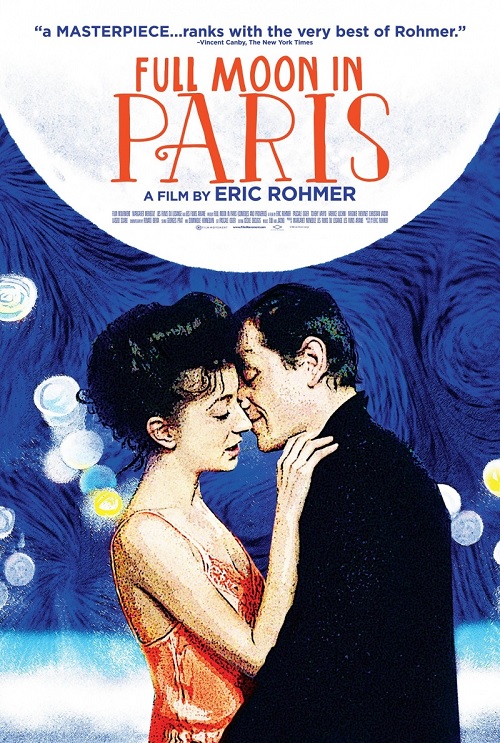
Feeling suffocated by a possessive boyfriend, work and suburban life, a young woman starts spending the weekends in her Paris apartment in order to reclaim some of her lost freedom.
Pemeran
Pascale Ogier
Louise
Tchéky Karyo
Remi
Fabrice Luchini
Octave
Virginie Thévenet
Camille
Christian Vadim
Bastien
László Szabó
Painter at cafe
Lisa Garneri
Tina the babysitter
Mathieu Schiffman
Louise's decorator friend
Anne-Séverine Liotard
Marianne
Hervé Grandsart
Remi's friend Bertrand
Noël Coffman
Stanislas
Elli Medeiros
Danseuse soirée
Mungkin Anda Juga Suka
30 Beats
Missions of Love
Sex First Love Second
A Royal Christmas Match
Greek Salad
Sex/Life
He's Into Her
Love is Sweet
Insecure
Everyone Loves Me
Cute Programmer
One Day
Begin Again
Gemerlap Cinta
Love & Anarchy
Cinta yang Begitu Indah
Sweet Combat
My Safe Zone
Feel Good
Skate Into Love
Oh My Boss
The Miniature Wife
Kembalilah Kasih
The Bisexual
Komentar
10 Komentar
I'm afraid I fell asleep half way through. My understanding is, the film featured a narcissistic young woman talking endlessly about what she wanted, in a stilted artificial monologue. There were others present but no convincing dialogue. She was cold heartedly two timing the boyfriend she was living with. I could not relate to her as a sympathetic character. She was entirely unlikeable. I'm surprised a film maker would expect an audience to sit through such drivel. It is meant to be existential yet no important issues are dealt with, about the meaning or purpose of existence. There was no real human drama. I found the film completely without meaning or interest, except for some interesting the French interior shots.
"But Louise cannot have her cake and eat it too, she is over-confident in rationalizing her and Remi's situation, openly suggesting that their relationship can be terminated if they find someone else whom they love more, only to be hoisted by her own petard, after finally bringing a random guy to her pied-à-terre, Louise has a rude awakening on this night of full moon, that she has finally gotten over with meaningless sex, and it is Remy, their home in the banlieue beckon her, however, Rohmer makes it clear that it is not just she who has the say-so in this precarious relationship, but at the very least, she has some place to return to when her entire world crumbles down." read my full review on my blog: cinema omnivore, thanks
Expecting to find all the extras in the Blu-Ray/ DVD box set to be placed in the final,I was surprised to find a bonus DVD inside the case for the 4th title in Éric Rohmer's loose series,which led to me looking up at the moon in Paris. View on the film: Spending most of the movie in flats, (with the odd breakout of dancing at parties in the outside world) writer/director Éric Rohmer and cinematographer Renato Berta sterilise Louise's rooms,which are breached out in saturated whites and dour blacks. Leaving Louise on her own,Rohmer boils up a minimalist atmosphere that cuts any music from the soundtrack and leaves Louise's hollow footsteps as the lone sound. Spanning a number of months,the screenplay by Rohmer captures Louise's belief of everything remaining still,whilst she takes her own sidetracks. Whilst this does catch some of Louise "in the moment" thinking,it also leads to an emotional depth between Louise and Remi never fully being explored. For his major auteur focus on the bourgeoisie,Rohmer gives Louise's relationships a bitter after taste,but disappointingly keeps the focus on the incredibly dry surface of Louise's life,as a full moon appears in Paris.
If I had only one director's films to live with I would choose Rohmer. If I had to reduce his output to ten I would choose all of the six that make up the ' Comedies and Proverbs ' series, plus a couple from his ' Four Seasons ' and a couple from his ' Moral Tales. ' Les nuits de la pleine lune ' the fourth in his ' Comedies and Proverbs ' is his most tragic, and bears endless watching. It shows how an emotional house cannot be a divided one. As simple and as complex as that. Pascale Ogier is excellent in the role of a young woman who must live quite literally in two places; one with her partner in the suburbs, the other in Paris. She wants freedom and she wants to be attached and during the night of a full moon this situation comes to a climax. It is tragic because the outcome is not her choice, and I for one feel that this will be repeated again and again. She loves to be admired and wanted, and yet she is not at all promiscuous. I was struck too by the decors of both places and Rohmer's use of colour. Blue predominates. In her place in Paris she decorates it herself, and in her partner's place she seems to have only a small amount of choice. I could try to interpret the meaning of this, and also the meaning of the full moon which seems as meaningful as the sun in ' Le Rayon Vert ' also in the same series, but I will not indulge in analysis. I will only mention one observation; the moon is a sort of cold madness, while the sun in ' Le Rayon Vert ' and the experience of witnessing the elusive Green Ray before the sun sets promises the warmth of love. As usual Rohmer's choice of actors is perfect and that his dialogue is rich and clear. Why is he my favourite director ? That too is a mystery to me. I want to keep it that way because if I explained it to myself I might lose the magic of his films.
I went to Paris for the first time a couple of years after this film was made. It was my very first trip to Europe, and I stayed for three months. Many memories have been rehydrated by this film. But I've noticed that just about every film made in the 1980s looks dated (and this one is no exception) because of the extreme adherence to the bizarre dictates of fashion of that decade: big hair, disco-dancing, high-waisted jeans and big shoulders. Everyone smacks vaguely of Madonna from that era. You cannot really mistake the images for any other decade. As far as content, the film itself offers a great deal of philosophizing on relationships. Based on a couple of examples, I would say, in fact, that Roemer is probably more of a philosopher than a film maker. Not that this film is bad, but its focus is on ideas, not so much visuals. Throughout this lengthy examination of relationships, I found myself wondering why anyone would find Louise attractive given her rather annoying demeanor. So I suppose that the ending was predictable. And everyone knows what happens after the curtain comes down: Octave loses all interest in Louise the moment she becomes receptive to him.
I enjoy this film very much. Rohmer as a way to describe feelings, to describe how those feelings can get all twisted sometimes. Love and the numerous questions it brings is well put to light. Books, smart funny talks and more... Pascale Ogier is superb. As for Fabrice Luchini, he's one of my favorite actor. He performs so well in this kind of role. And the name "Octave" fits him like a glove! Out of 100, I gave it 81. That's good for *** out of ****. Seen at home, in Toronto, on January 14, 2003.
One of the things Rohmer does which I have not seen with any other director is to take a location, seemingly dull, far from beautiful and somehow he renders it of utmost important to his story. In 'La femme d'aviateur' it's the interiors of Paris apartments and a moderate park in Paris called Le Parc de Buttes Chaumont. In 'Pauline a la plage' and 'Le Rayon Vert' there is an emphasis on the changes in people when you take them out of their daily routine and normal environment, specifically when they are on vacation, a very important part of French life. In this film 'Les nuits de la pleine lune' (Full Moon in Paris) and L'ami de mon amie', he films relatively new suburbs of Paris with new ideas on architecture, new ideas on living and with young successful people. Most directors would never bother to even visit these grotesque modern suburbs, let alone film a film there. However it works with this film and L'ami de mon amie'. Why I don't know, but we know that it is a crucial element to the emotional journey of the main character in this film - her displacement between Paris and the suburbs. She prefers the chaos of Paris to the straight lines and cubism of her suburban apartment. I thought Pascale Ogier was fantastic as the lead in this film. I think Rohmer has a fantastic knack for choosing lead woman, with only one exception in my mind to this rule. They are usually petite, fragile, mystically beautiful.....What I thought of when watching Pascale Ogier as Louise was a cat. Her slinky movements, her lazy eyes, her calmness, her desire for space - not your average women. I read just one year after making the film she died of a heart attack at the age of 26. All in all an average or above average Rohmer film (which it not a bad thing). It sweeps over you with it's subtle charms and before you know it you will be under the film's spell.
For the last few years I have started to collect VHS of masterpieces of cinema my reasons being that the sound is at least six or seven times better than anything digital and also the image although it has lower definition than later digital issues the depth of field the 3-D quality of the picture you feel you can reach inside the screen something which never is available on the flat/fused digital types of media; so for me a no-brainer VHS whenever possible .... Anyway back to our onions here which is basically yet another semi-masterpiece by Éric Rohmer Here we have Pascale Ogier the daughter of Bulle Ogier who sadly passed away a couple of months after the film was released aged only 25 probably from a drug overdose although heart issues were mentioned too ... Anyway the story here is really a case of can you have your cake and eat it and the resounding philosophical outcome of this reflection is that no you cannot. If you wanted to be harsh you could say at the end of this tale because with Rohmer it is always a tale If you watch this in English you could say «she had it coming» if you thought in French you could say even more cruelly «bien fait pour sa gueule» That would be extremely unchristian but in a way this is really what the story is about ... A 20-something couple and then she subconsciously decides that he is not quite the full ticket and she wants a lot of space to herself; he himself does not want to have a sort of loose arrangement he wants to live and die in the same space type relationship. In many ways in 2023 she would be way more acceptable in her stance; relationships have evolved a lot since the 1980s in many ways she could be described as a very modern woman does not want to be tied too tightly to a male partner she wants room to move in and evolve at her own pace she tells him she loves him but she needs breathing space; nowadays totally acceptable people would totally hear this; he would probably hear this Anyway the short of it is she manages to have her own little pied-à-terre In Paris away from the soulless "nouvelle ville" (new suburban satellite town) her male partner has a job in and also an aseptic flat The acting is very high quality with Pascale Ogier , Tchéky Karyo and Bulle Ogier truly excellent. There is also Fabrice Luchini also very competent too; personally I find him a natural irritant and a tad creepy whether acting or not; but that is my personal hangup; he is highly revered by most In a typical Rohmer way and often seen in his films the picky female character ends up left at the altar so to speak; her male partner finds somebody in the meantime he can relate to better and decides to leave her and take up with his new woman Ironically he met her at a party she insisted in going to and that he only went to reluctantly; so again a Rohmerian twist which is bittersweet and comical This film is by no means one of Rohmer's best films but it is still quite impactful as usual he uses locales which are so dull that one would never think of using them as settings for a film and bit by bit those places become integral part of the storyline and totally undissociable from it An absolute must for Rohmerophiles everywhere. Would surrender Godard to him if if were a case of you can only have one :) for me he is the Godfather of the Nouvelle Vague and then some ...
Sure, other artists, countless others, have spent their lives depicting the interrelationships of men and women. But I don't know of anyone who so consistently seems to understand human relationships than Eric Rohmer. So few can build as believable characters, such believable situations. Full Moon in Paris concerns a young woman, Louise (Pascale Ogier), who has arrived at a point of extreme confusion: she loves her long-time boyfriend, Rémi (Tchéky Karyo), but she desperately wants to be alone for once in her life. Rémi likes his life the way he has it, living in the suburbs, doing his job, coming home to Louise. But it's all too stifling for her. She rents an apartment in Paris, but that only partly steadies her mind. Louise also has another, more ambiguous boyfriend, Octave (Fabrice Luchini, who appears in several Rohmer films and stars in my very favorite, Perceval le Gallois). Their relationship is definitely on the romantic side, but both seem to be in it, at least most of the time, for each other's company. They can talk, where Rémi isn't an especially gifted conversationalist (not a good character trait if you're in a Rohmer film!). The film moves along as well as any Rohmer film, but for a long time I was pretty sure that Rohmer wouldn't be able to end it in any significant way, that it would end up being a great film (like I say, I couldn't find one of his films any less), but not one of his best. Fortunately, Rohmer really does find the perfect ending, which ends up lifting the film up and making it one of the director's best. The film really benefits from its perfectly written characters and amazing acting, as well. Ogier gives one of the strongest central performances in Rohmer's canon. Fabrice Luchini, man, I love this actor! He stars in my favorite Rohmer film and has a small roll in my second favorite (the vastly underrated 4 Adventures of Reinette and Mirabelle from 1987). Luchini is so perfect here, so subtly hilarious that most will not notice it. During one of Octave's many conversations with Louise, he rattles off a really good line and has to stop to write it down. Louise understandingly excuses herself to the restroom to give him time to get his quip recorded. 9/10.
"Les Nuits de la Pleine Lune" is by far one of the best movies I have seen. Rohmer manages to capture the full complexity of a relationship that is on the rocks. Fabrice Lucini as Octave is very believable, even during his pensive rants in front of the camera for an extended period of time. Pascale Ogier as Louise gives a very good performance, showing us how a woman like Louise acts when caught in the middle of trying to decide between two men and resisting another. She is sometimes seducing, sometimes a devoted girlfriend, and sometimes just acts like she wants to run away from it all. Tchéky Karyo is perfect in his ability to show Remi's awkwardness in social situations. Overall, an excellent movie. --Céline. Contact me at Niancul@aol.com