
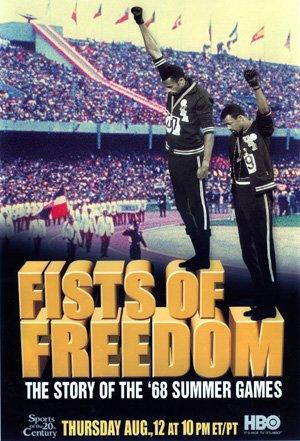
Fists of Freedom: The Story of the '68 Summer Games
Documentary leading up to, during and after the 1968 Summer Olympic Games in Mexico City. Features interviews with athletes, including John Carlos, Tommie Smith and George Foreman, activist Dr. Harry Edwards, journalists and archival footage of the Games and the fallout after the raised fisted gloves by Carlos and Smith.
Trailer
Cast
George Roy
Director
Neil Amdur
Self
Bob Beamon
Self
Ralph Boston
Self
Avery Brundage
Self
John Carlos
Self
John Coatsworth
Self
Hal Connolly
Self
Willie Davenport
Self
Michael Eric Dyson
Self
Harry Edwards
Self
Lee Evans
Self
George Foreman
Self
Dick Fosbury
Self
Bud Greenspan
Self
Allen Guttman
Self
Erv Hall
Self
Bob Hayes
Self
Jim Hines
Self
Steven Stern
Writer
Maaari Mo Ring Magustuhan
Shakedown
Hollywood, No Sex Please!
Sex in the Soviet Union
Suffocated
The Family Business: Trump and Taxes
Secrets of the Asylum
Charlie Hustle & the Matter of Pete Rose
Giuliani: What Happened to America's Mayor?
The Dinosaurs
World War II with Tom Hanks
Legacy: The True Story of the LA Lakers
The Food That Built America
Fever Pitch! The Rise of the Premier League
The Bible
Queen Cleopatra
Lost Treasures of Egypt
Lost Cities of the Bible
The Chi
my vampire system
The Five Star Weekend
The Last Teal Dragon
knight of the lost heirs
Sweet Temptation
The Republic of Sarah
Mga Komento
10 Mga Komento
source: Fists of Freedom: The Story of the '68 Summer Games
Fists of Freedom is an important film that chronicles the Black Boycott movement and touches on the lives of several American athletes involved in the 1968 Summer Olympic Games. It is a must see for anyone interested in the history of racism in sports. It is a beautiful tribute to the eloquence of John Carlos's and Tommie Smith's courageous stand. At the same time, it is deeply flawed for reasons other than its omission of contemporary interview footage with John Carlos, though this is its most glaring fault. The film also perpetuates some racially problematic characterizations of black athletes and activists. If you would like to know more about the limitations of the film, check out the doctoral dissertation (UMI Proquest) titled "The Presence of the Past: Rhetorical History and Cultural Memory of the 1968 Summer Olympic Games." If you just want to be moved by a well-narrated montage of archival and interview footage, sit back and prepare to be delighted. The coverage of Bob Beamon's record setting long jump and the massacre of student protesters in Tlatelolco are other highlights worth appreciating.
"Fists of Freedom: The Story of the '68 Summer Games" (originally released in 1999; 60 min.) is a documentary bout the events that led to Tommie Smith and John Carlos raising their gloved fists at a medal ceremony during the 1968 Olympic Games in Mexico City. As the documentary opens, we are reminded of the major political and social upheaval taking place in the US. We then are introduced to Tommie Smith, Lee Evans and John Carlos, who all end up at San Jose State in the mid-60s, in an overtly racist environment. As the '68 Summer Olympics loom, they, and other black athletes, ponder their options... At this point we are 10 min. Into the documentary. Couple of comments: this is directed by George Roy. Who has made dozens of these TV sports documentaries, but this one stand out for its importance. Please note that to suggest this is "the story of the '68 Summer Games" is flat-out wrong and in fact the Olympic Games are dealt with in about 10 min (if that much). Indeed the film looks primarily at what led to the events, and the fallout from the events. Smith, Evans and many others are interviewed and give their perspectives, with the benefit of 30+ years of hindsight. Whether you agree with what these athletes did or not, the fact remains that the image of two black athletes, raising their gloved fists as the national anthem plays, is one of the more powerful images ever to emerge from that era. As Smith notes: "this was not a sign of hate for this country; it was a cry for help, a cry for freedom." This film was originally released on HBO in 1999 and then a new introduction and post-script were added in 2018, for the 50th anniversary of these events. It can now be seen on HBO ON Demand (where I caught it the other day), Amazon Instant Video, and other streaming services. It absolutely blows the mind how, now 50+ years later, so much more needs to be done to address the systemic and institutionalized racism that continues to exist in this country. If you have any interest in civil rights and social justice issues, I'd readily suggest you check this out, and draw your own conclusion.
Being a huge fan of the Olympics, I couldn't pass up the opportunity to watch a documentary on one of the most Olympics in history. This film not only captures the mood that surrounded the 1968 games, but it also does a good job of showing the events that lead up to probably one of the most enduring symbols of the civil rights movement. I also loved the fact that the producers interviewed Peter Norman, the Australian who finished second in the 200 meters. Norman explained how he supported Carlos and Smith and how he even wore the three of them wore civil rights badges on the medal stand. The film also talks about the massacre of several hundred Mexican students on the eve of the games. This is one great film that I think should be shown not only on H.B.O. but in classrooms all over America.
This is a solid, well-made documentary about the 1968 Summer Olympics in Mexico City. Most of the action focuses on Tommie Smith and John Carlos, the two track stars whose raised fists on the victory stand created a huge scandal and a storm of misunderstanding. The film tells its story well, but is hurt by the fact that John Carlos for some reason did not sit down for an interview with the filmmakers. Instead, the film treats runner Lee Evans as the second-most dramatic figure after Tommie Smith. Evans is good on camera, and an appealing character, but he simply doesn't end up being that important. It's unfortunate that the makers couldn't get Carlos as an interview subject--it diminishes an otherwise fine film.
source: Fists of Freedom: The Story of the '68 Summer Games
"Fists of Freedom: The Story of the '68 Summer Games" (originally released in 1999; 60 min.) is a documentary bout the events that led to Tommie Smith and John Carlos raising their gloved fists at a medal ceremony during the 1968 Olympic Games in Mexico City. As the documentary opens, we are reminded of the major political and social upheaval taking place in the US. We then are introduced to Tommie Smith, Lee Evans and John Carlos, who all end up at San Jose State in the mid-60s, in an overtly racist environment. As the '68 Summer Olympics loom, they, and other black athletes, ponder their options... At this point we are 10 min. Into the documentary. Couple of comments: this is directed by George Roy. Who has made dozens of these TV sports documentaries, but this one stand out for its importance. Please note that to suggest this is "the story of the '68 Summer Games" is flat-out wrong and in fact the Olympic Games are dealt with in about 10 min (if that much). Indeed the film looks primarily at what led to the events, and the fallout from the events. Smith, Evans and many others are interviewed and give their perspectives, with the benefit of 30+ years of hindsight. Whether you agree with what these athletes did or not, the fact remains that the image of two black athletes, raising their gloved fists as the national anthem plays, is one of the more powerful images ever to emerge from that era. As Smith notes: "this was not a sign of hate for this country; it was a cry for help, a cry for freedom." This film was originally released on HBO in 1999 and then a new introduction and post-script were added in 2018, for the 50th anniversary of these events. It can now be seen on HBO ON Demand (where I caught it the other day), Amazon Instant Video, and other streaming services. It absolutely blows the mind how, now 50+ years later, so much more needs to be done to address the systemic and institutionalized racism that continues to exist in this country. If you have any interest in civil rights and social justice issues, I'd readily suggest you check this out, and draw your own conclusion.
Being a huge fan of the Olympics, I couldn't pass up the opportunity to watch a documentary on one of the most Olympics in history. This film not only captures the mood that surrounded the 1968 games, but it also does a good job of showing the events that lead up to probably one of the most enduring symbols of the civil rights movement. I also loved the fact that the producers interviewed Peter Norman, the Australian who finished second in the 200 meters. Norman explained how he supported Carlos and Smith and how he even wore the three of them wore civil rights badges on the medal stand. The film also talks about the massacre of several hundred Mexican students on the eve of the games. This is one great film that I think should be shown not only on H.B.O. but in classrooms all over America.
Fists of Freedom is an important film that chronicles the Black Boycott movement and touches on the lives of several American athletes involved in the 1968 Summer Olympic Games. It is a must see for anyone interested in the history of racism in sports. It is a beautiful tribute to the eloquence of John Carlos's and Tommie Smith's courageous stand. At the same time, it is deeply flawed for reasons other than its omission of contemporary interview footage with John Carlos, though this is its most glaring fault. The film also perpetuates some racially problematic characterizations of black athletes and activists. If you would like to know more about the limitations of the film, check out the doctoral dissertation (UMI Proquest) titled "The Presence of the Past: Rhetorical History and Cultural Memory of the 1968 Summer Olympic Games." If you just want to be moved by a well-narrated montage of archival and interview footage, sit back and prepare to be delighted. The coverage of Bob Beamon's record setting long jump and the massacre of student protesters in Tlatelolco are other highlights worth appreciating.
This is a solid, well-made documentary about the 1968 Summer Olympics in Mexico City. Most of the action focuses on Tommie Smith and John Carlos, the two track stars whose raised fists on the victory stand created a huge scandal and a storm of misunderstanding. The film tells its story well, but is hurt by the fact that John Carlos for some reason did not sit down for an interview with the filmmakers. Instead, the film treats runner Lee Evans as the second-most dramatic figure after Tommie Smith. Evans is good on camera, and an appealing character, but he simply doesn't end up being that important. It's unfortunate that the makers couldn't get Carlos as an interview subject--it diminishes an otherwise fine film.