
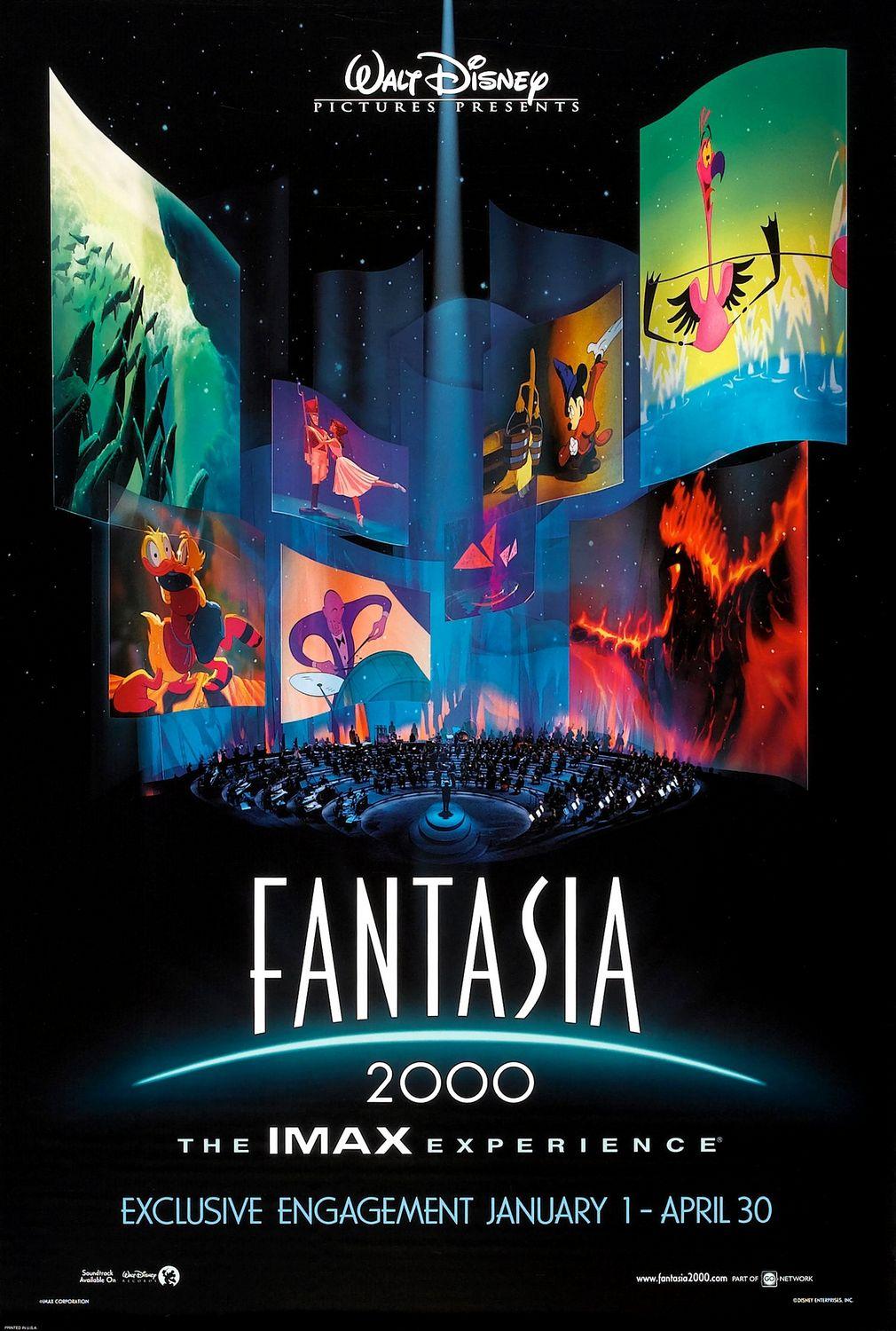
An update of the original film with new interpretations of great works of classical music.
Trailer
Pemeran
James Algar
Director
Gaëtan Brizzi
Director
Paul Brizzi
Director
Hendel Butoy
Director
Francis Glebas
Director
Eric Goldberg
Director
Don Hahn
Director
Pixote Hunt
Director
Steve Martin
Self - Introductory Host
Itzhak Perlman
Self - Host
Quincy Jones
Self - Host
Bette Midler
Self - Host
James Earl Jones
Self - Host
Penn Jillette
Self - Host
Teller
Self - Host
James Levine
Self - Host , Conductor (Chicago Symphony Orchestra)
Wayne Allwine
Mickey Mouse
Angela Lansbury
Self - Host
Dennis Quaid
Self - Co-Host
Tony Anselmo
Donald Duck
Russi Taylor
Daisy Duck
Chicago Symphony Orchestra
Themselves
Kathleen Battle
Self - Featured Soprano
Gaëtan Brizzi
Self - Animator
Paul Brizzi
Self - Animator
Yefim Bronfman
Self - Pianist
Eric Goldberg
Writer
James Fujii
Writer
Joe Grant
Writer
Perce Pearce
Writer
Carl Fallberg
Writer
Gaëtan Brizzi
Writer
Paul Brizzi
Writer
Don Hahn
Writer
David Reynolds
Writer
Irene Mecchi
Writer
Brenda Chapman
Writer
Elena Driskill
Writer
Mel Shaw
Writer
Hans Christian Andersen
Writer
Mungkin Anda Juga Suka
Barbie: Princess Charm School
Barbie: The Pearl Princess
The Big Wish
The Wishmas Tree
Doc McStuffins
Teletubbies
Stillwater
The Sisters Grimm
Daniel Tiger's Neighborhood
Wolf King
Hero Inside
Unicorn Academy: Secrets Revealed
Kill Blue
Onyx Equinox
Dragon Striker
Tomb Raider King
Tombs of Fallen Immortals
Metal Family
My Two Cents
Don't Hug Me I'm Scared
Karna the Guardian
The Legend of Karna
Kung Fu Panda: The Dragon Knight
Unicorn Academy
Komentar
10 Komentar
source: Fantasia 2000
Uncle Walt would have hated this updated version of his Classic. I found it to be a total bore. It was nice to see Bette Midler, but Angela Lansbury ... not so much. I fear Ms. Lansbury lost a few fans when she decided to do an episode of Law & Order: SVU. One thing that was very good about the old studio system was that they would have never allowed her to play a part so negative to her career. Even in The Harvey Girls she came out smelling as a rose! Back to Fantasia 2000 ... a waste of money. It is true that when the original first came out it was bomb ... people hated it. However, it gained popularity in the 1960's ... considered to be one righteous trip, with or without mushrooms! I knew a guy that saw it on acid, he was never the same after that. No, I am not into that stuff ... bit it does show why Fantasia became a hit in the 1960s. Seeing Mickey as The Sorcerer's Apprentise was pretty cool, mainly because he didn't say anything ... always hated Mickey's voice! Creeps me out! All in all, stick with the original ... and leave this one to the spider webs and dust.
A highly belated sequel to the 1940 original, this is a film that makes me wonder who it was created for. Music lovers? For the most part, the music is butchered in order to fit into the film's format. The opening sequence based on the first movement of Beethoven's Fifth Symphony is about 1/3 the length of that work. The exposition here goes directly into the coda bypassing the development and recap which, as we know, don't count. Now we all know that Beethoven hadn't a clue as to what he was doing, he was only a composer, and the Walts had every right to "improve" him! The Pines of Rome? Though Ottorino Respighi may have thought he was describing Rome, the Disneys knew better realizing that he was really describing a school of humpback whales. Of course! Why didn't I think of this? And, of course, "The Pines near a Catacomb" would have made it all too long so "The Pines of the Villa Borghese" goes directly into "The Pines of the Janiculum" minus the nightingale which had to go because it's about whales. and not birds! But I thought the low point of this film was the Pomp and Circumstances segment. Based on the Marches 1-4 (the fifth is still under copyright and the Elgar estate probably put its collective foot down on its use.) this P and C "fantasia" was cut and pasted as needed to the feeble story starring a lachrymose Donald and Daisy in Noah's Ark with an added piccolo in order to represent the birds (payback to their being cut from "The Pines"?). In the scene where all the animals march on the ark to the strains of "Land of Hope and Glory" the wordless chorus (as well as Kathleen Battle!) comes in, creating a ghastly grandiose effect (comparable to the pseudo-religious, church-belled, Schubert Ave Maria ending of "A Night on Bald Mountain" in the original Fantasia.) The Al Hirschfeld-based segment of Gershwin's "Rhapsody in Blue" was, by far, the best of all with an inventive use of the caricaturist's work and milieu. Since Mr. Hirschfeld, near the end of his long life, was a consultant on this segment, his work was used appropriately in the 1930s depression-era story. I easily recognized his caricatures of Gershwin himself as well as Alexander Woolcott, the writer and friend of Harpo. (Though it is a stretch to imagine him as a henpecked husband or any husband at all for that matter!) The introductions by Perlman, Steve Martin, Levine, Penn and Teller, Midler etc. were quite useless and I was especially annoyed with the pains they took to disguise Itzhak Perlman's handicap, something Perlman himself never does. (Due to an early childhood bout with polio, he uses crutches on-stage and a wheelchair off.) Of course, Mickey has his interaction scene with Jimmy Levine as he did with Stokowski in the original Fantasia. Despite the Disney Organization's occasional fine work, Fantasia 2000, as a whole shows their typical crassness. "Creativity" my foot!
1. This movie is NOT 75 or even 70 minutes long. It is about one hour long including the trailers that precede the film, which are not related to it, and the end titles. 2. The quality of the animation is inferior to most recent works of animation (including ALL recent Disney films) in terms of the complexity of the stories and characters, the movement and the action. The drawings are elementary and roughshod and, in the case of the Hirschfeld-inspired "Rhapsody in Blue" segment, so minimalistic you wonder how very little it must have taken to produce the whole segment. 3. The whole picture seems to have been made quickly and inexpensively, certainly a minor effort compared to the first "Fantasia," of which in all fairness I have never been much of a fan anyway. In the age of spectacular, elaborate animation such as "The Lion King", "Prince of Egypt" and the "Toy Story" films, this is an insult to an audience that paid, in some cases, up to 20 dollars to see this film. (NOTE: purists who defend the film's attempt to recreate the original's hand-drawn qualities should be quieted down by the fact that the film does use a significant amount of computer animation, therefore nullifying the purist argument.) 4. The "Sorcerer's Apprentice" segment tries to be an hommage to the first "Fantasia" but, given the skimpiness of this effort, you wonder if it was just thrown in there as a last-minute resort to fatten what was clearly very skinny movie. 5. The live-action sections between the animated portions, hosted in Academy Awards-presenter fashion by a number of Hollywood celebrities, seem unnecessary and perhaps more appropriate for a "Making of..." documentary than for the film itself. 6. The especially constructed, Disney-owned IMAX Theater in Los Angeles charges 12 dollars for general adult admissions and 20 dollars for "VIP seating". You may wonder what VIP seating is. VIP seating are the seats at the center of the theater ideal for an IMAX film ("general admission" at this venue refers to the peripheral seats). This is a scam. "Fantasia 2000" plays at non Disney-operated IMAX theaters at a single adult admission price, including the center seats. 7. The spectacle of this film comes not from the film itself but mostly from the IMAX format, which renders a spectacularly clear and steady picture along with crisp multi-channel sound. Actually, the gargantuan IMAX screen amplifies a film's visual flaws. In the case of "Fantasia 2000", this is most obvious in the graininess of the "Sorcerer's Apprentice" blow-up (Mickey sports grain four-feet wide across his face) and the live-action images. It is important, however, not to confuse the quality of a movie with that of the process it is presented in. 8. Wait for it to be on the Disney Channel.
When my friends hear that I didn't like "Fantasia", they assume I am a stupid Neanderthal. This might be true, but I never have been a fan of this Disney film. Why? Because although the music and animation are great, so much of the film is tremendously boring and stuffy. I still remember back when I was a child, as the only part of the film I liked was "The Sorcerer's Apprentice" portion...the rest didn't do much for me. Because of this, I wasn't surprised that I enjoyed "Fantasia 2000" much more--because it seemed to have a lighter and less stuffy air about it. And, at times, it was quite fun...plus, they included the original "Sorcerer's Apprentice" section! As for the film, unlike the original, it was pieced together over a five year period. In other words, when the artists were between feature-length films, Disney had them work on these various segments--and then finally assembled them into the feature. So why do I give the film a 7? Well, most of the positives I mentioned above. But, on the negative side, the film suffers a bit when it comes to the animation. I am pretty sure that the staff at Disney used this film to learn to use CGI--but several times the quality of the CGI looked old and unrealistic--particularly the first segment set to Beethoven's Fifth Symphony. Additionally, while the film had some funny moments, it could have used a few more--mostly because I STILL think most kids would not enjoy the film.
Some random jottings, as my impressions and memories serve me: "Pines of Rome"--I always considered this particular piece of music as garish, overblown trash. But the Disney artists have done a very nice underwater story here that throws a refreshing new angle on the music. Even though I've always considered their mixing of computer animation and conventional cel animation uncomfortable at best, I came away liking this piece more than I did before. Quite possibly this film's best portion. "Pomp & Circumstance"--now you KNOW no one's going to smother memories of this, The Graduation March. Whoever gave Disney's artists the idea to do a Noah's-Ark story with Donald & Daisy in the "human" leads (I just don't accept the premise) should be tossed out on his/her can. "Carnival of the Animals"--an unimaginative choice, much like "Peter & the Wolf" was nearly 60 years before. These are both abstract pieces of music, a "theatre-of-the-mind" type of experience. And the use of only one short movement--from the tail end of the piece--is inexplicable. There IS a somewhat engaging quality to the picture of five flamingos in their ballet bit, but it reinforces an overriding impression I got from this whole film--that this was just a lark for the animators, a sideline project while they devoted their full passion to the regular story-oriented features. "Rhapsody in Blue"--Very nice use of Al Hirschfeld-style characters; the lead players (i.e., the ones who end up jamming at night) are all endearing. This piece has been with me since childhood, and nothing could ever efface the purely abstract experience of simply hearing it, but it's very entertaining. "The Steadfast Tin Soldier"--a hackneyed, Saturday-morning type of story, one which alters the original tragic ending, one which does nothing to leave me with a better impression of the music (which I'm unfamiliar with), and its computer graphics once again show how ill-at-ease the Disney artists could be with this. Beethoven's "Fifth"--c'mon, are you kidding? This is as old hat as "Pomp & Circumstance"--it's been hammered into umpteen-many schoolkids in umpteen-many music appreciation classes that the music depicts death knocking at the door. All in all, an off-putting experience. Let's all blame it on Michael Eisner and company, shall we? Better yet, let's abandon all plans for future additions to the original masterpiece of 60 years ago (Disney's own original plan). The original film's been critiqued and torn apart over the years, but many easily forget the blood, sweat and tears that went into it (read John Canemaker's book to know all about that). And even though the Deems Taylor narrated sequences in the original are now laughed at, one can't help wondering how the obnoxious live-action contributions of Steve Martin, Bette Midler, Penn & Teller & co. will look 60 years from now.
I've written before. Since then I've seen the movie again and my opinion hasn't changed. It's a miserable flop. But the first time I wrote I failed to mention Eric Goldberg (among his previous credits: lead animator of the genie in "Aladdin"), the only director on the team who managed, or at least tried, to keep the spirit of the magnificent original "Fantasia" alive. His work contain all that is good in "Fantasia/2000" (except for the Sorcerer's Apprentice segment, of course, which still puts the rest of the movie to shame). He's responsible for "Rhapsody in Blue" and the small snippet of "Carnival of the Animals". The latter piece is, undeniably, too short, like the movie as a whole - but unlike the movie as a whole, that's all that's wrong with it. The original "Fantasia" was groundbreaking. Not that being groundbreaking is a virtue in itself, but it was, in this case, an indication of the sheer creative force behind the production. The Beethoven is influenced by both deco and classical art, and it looks like nothing before or since - as stylised as UPA cartoons would be ten years later, but rounder. The Tchaikovsky brings Edwardian fairy art to life. The Stravinsky contains convincing dinosaur animation. The Mussorgsky looks like Kay Nielsen (whom Disney hired to provide conceptual art). The Ponchielli creates a new world; the Bach flirts with non-representational shapes and lines. The fact that all these pieces appear to belong together is something of a miracle. Of the new segments in the sequel, only Godlberg's ("Rhapsody in Blue" obviously so, "Carnival of the Animals" less obviously so) exhibit anything like this sense of freedom. More importantly, only Goldberg's images MATCH the music half so well as the images in the original did (unfortunately, it IS only half so well - Goldberg can't synchronise the narrative climaxes with the musical climaxes with quite the same invisible finesse of his predecessors, although he probably wasn't given much chance - but half so well is more than enough). Everything not directed by Goldberg is a shotgun marriage. Mostly the animation uses the music as a handy soundtrack on which to hang a cartoon which is neither apt nor particularly inapt, as in the forced Shostakovich/Andersen collaboration, or Stravinsky's "Firebird". But in one instance the director (Hendel Butoy) manages to come up with images that are as precisely wrong as it is possible to get. He takes Respighi's "Pines of Rome", a sunlit work if ever there was one, and sets it in the arctic winter; he takes the bustle of the opening movement and shows us the stately motion of a handful of whales; he takes sharp, tangy, colourfully orchestrated music and illustrates it in various shades of blue; he takes the closing movement, which is a MARCH, and shows us his whales soaring through the air, to no particular rhythm, like so many blimps. (He also takes the third movement and throws it away altogether, which is a crime in itself.) It takes a special kind of genius to be so clueless. But he didn't work alone. Why was nobody prepared to say, "The whales are a stupid idea - get rid of them"?