
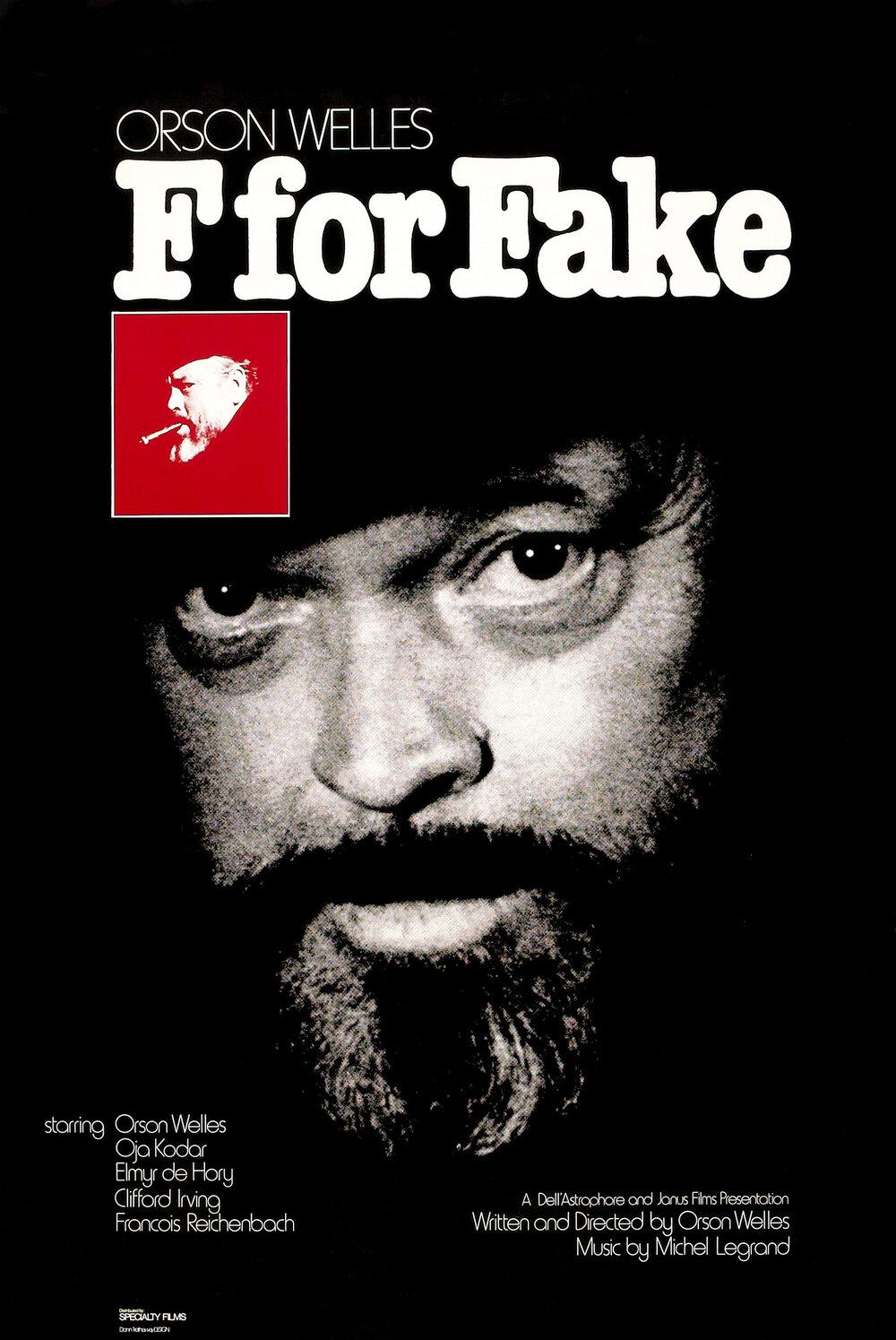
A documentary about fraud and fakery.
ٹریلر
کاسٹ
Orson Welles
Director
Gary Graver
Director
Oja Kodar
Director
François Reichenbach
Director
Orson Welles
Self - Narrator
Oja Kodar
Self - The Girl
François Reichenbach
Self - Special Participant
Elmyr de Hory
Self
Clifford Irving
Self
Laurence Harvey
Self
Edith Irving
Self
David Walsh
Self
Paul Stewart
Self - Special Participant
Richard Wilson
Self - Special Participant
Joseph Cotten
Self - Special Participant
Howard Hughes
Self
Richard Drewett
Self - Associate Producer
Alexander 'Sasha' Welles
Self
Gary Graver
Self - Special Participant
Andrés Vicente Gómez
Self - Special Participant
Julio Palinkas
Self - Special Participant
Christian Odasso
Self - Special Participant
Orson Welles
Writer
Oja Kodar
Writer
آپ کو یہ بھی پسند آ سکتا ہے
Sexology
Bigay hilig: Sexual Fetish
Addicted to Sexting
VMX Kama Sutra
Breaking the bank: One trader, 50 billion
Sex, Explained
Life on Our Planet
How to Get Rich
Good Girl's Guide to Kinky Sex
Toughest Forces on Earth
Ashley Madison: Sex, Lies & Scandal
America's Sweethearts: Dallas Cowboys Cheerleaders
Animal
Marvel Studios: Assembled
Porn Laid Bare
Serengeti
I, Hostage
Money Heist: From Tokyo to Berlin
Africa
Trust Me: The False Prophet
Michael Jackson: The Verdict
Cosmos: A Spacetime Odyssey
Paranormal Caught on Camera
Should I Marry a Murderer?
تبصرے
10 تبصرے
source: F for Fake
that Welles said was that he's been in decline his whole career. There was an interesting story here. Unfortunately, Welles seemed completely incapable of telling it. Instead, he was trying to tell a bunch of different stories, about Elmyr, about Clifford Irving, about his pompous view of critics and experts, oh, yeah, and trying to jump start his current girlfriend's career by giving her unneeded screen time. (Oja, honey, when they told you to sleep with the director, they didn't mean one washed up like a whale on a beach!) Welles was probably trying to cash in with a bunch of footage of Clifford Irving as Irving was becoming a household name with his role in the faked auto-biography of Howard Hughes. Unfortunately, it means the subject of his film, Elmyr, didn't get the time he deserved and he was probably the more interesting story. The great tragedy of Orson Welles was that he peaked early, and then spent the rest of his career sputtering, finally doing wine commercials and awful documentaries...
A dissertation on liars, cheats, counterfeiters and forgers by Orson Welles that never settles on a subject, shooting style, genre or personality. Is it a documentary, a fantasy, a historical drama or an art film? Welles employs a crazed guerrilla documentary style, splicing half-conversations with notorious scammers on top of one another while concentrating on awkward close-ups, unflattering angles and incomplete thoughts. Orson handles most of the narration himself from a seat at the editing table, apparently in the process of chaotically piecing the final product together. It's a manic blend of jumbled thoughts that seems like something thrown together on a whim after filming every instant of a lavish European vacation, then poring over the resultant footage for its most quizzical moments. For what it's worth, I could watch Orson carry on conversation with nobodies for hours at a time, and on the few occasions the film delivers just that, it reaches a certain peak. If Welles could've let this story tell itself without overproducing every instant and later forcing himself into unnecessary dramatizations, it would have had my rapt attention. Instead, the second half nearly put me to sleep. A solid concept that's been overcomplicated and spoiled.
Of the Orson Welles films I have seen, this has to be the most fun to watch. "F for Fake" is about an art forgerer and his biographer who was a forgerer himself. (He faked a biography about Howard Hughes.) What's great about the film is that Welles constantly keeps you guessing at what's real and what's fake and why at all that might be important. I also give Welles credit for pulling the greatest plot twist I have ever not seen coming. And this is a documentary! There's not supposed to be a plot, is there? (wink, wink) Giving the surprise away would ruin all of the fun. What I can say is that you should find this somewhat rare film and watch it with a clock close by.
Excellent pseudo-documentary about the art of fakery. Elmyr D'Hory the art forger and Clifford Irving, his biographer are profiled, as well as Welles' own career as a faker. Irving apparently perpetrated a scam to collect money for a check written, supposedly, by Howard Hughes as a deposit on a biography they would write together. I've listened carefully and I believe it really IS Hughes' voice on the telephone saying that Irving is a faker and that he had never heard of him before. Anyway, 100% editing genius makes a fake movie out of a TV special (made for French public Tv, as I understand it) by tacking on 40 minutes of inspired nonsense by Welles himself, proving that he truly is a magician for the masses.
"F for fake" stands for the last movie Orson Welles really directed and, as for many artistic legacies it's the final demonstration of the genius of the artist, becoming some kind of briefing of his entire career. It's hard to explain this movie and why I really enjoyed because, as many other Welles's movies, it's full of surprises and twists. Filmed as a Documentary, this film introduces us the personae of Elmyr, a painter who lives out of painting copies of famous pictures of Van Gogh, Picasso, Vlaminck and many others and making them look like they're the original one. Welles also introduces to us two more people; an actress and a biographer. With many resemblances to Welles's own life, the director of such wonderful pieces as "Citizen Kane" and "Touch of Evil" plays with the audience some sort of magical trickery. What is real and what is not? If Elmyr is able to paint a perfect copy of a famous picture and fool the world greatest experts, is he as good artist as the originals he's copying? Working as a perfect metaphore of Welles own experiences in art (he's not only been movie director but radio speaker and even painter) "F for Fake" remains as a perfect legacy of the ideas of one of the greatest and most gifted cinema artists. Don't miss it!
The magnificent Orson takes us on a whimsical tour of fakery that involves some real fakery, some fake fakery, some fake reality, and... You get the idea. The point seems to be that all of life is an illusion. The question becomes how much illusion can we buy and how much becomes offensive. We see what we want to see. We ignore the rest. Orson is in classic form here, reciting poetry with dramatic flare, theatrically roaming about Europe in a wide-brimmed black hat, black cape, and surrounded by a clowd of cigar smoke. Do we get an insight into the real Orson? Is there a real Orson? Is there any point asking? Orson tilts his head at a humorous angle and looks at us out of the corner of his eyes -- and we are his willing victims in a delightful hoax. Or is it real?
F for Fake (1973) ** 1/2 (out of 4) Orson Welles' final major picture started off as a documentary on art forger Elmyr de Hory but when that project led to an interview with Clifford Irving, the man who wrote the fake Howard Hughes biography, the documentary took a new turn and decided to look at fakes all around. This really isn't your typical documentary and many critics of the film will say it makes very little sense and all in all is nothing more than an incoherent mess. I wouldn't go that far but I think F FOR FAKE is certainly more style than actual substance. I say that because Welles visual style here is something that you didn't see in documentaries at the time and I'd say that nothing that followed really looked the same. The documentary has an avant garde feel to it and most of them comes from the editing. The editing goes all over the place with all sorts of weird edits, different styles of cameras being used and the editing usually takes the story and tells it in a different time frame and I think this is where people get lost. The look of the film is certainly something impressive and you really can turn the volume down and be entertained just by the look that Welles made. However, this "style" is so good that it really takes away from the stories being told and I think it really kills most of the interest in the subjects. I think the way the story goes back and forth does make the film incoherent but this is also due to the fact that the material just isn't worth following. I think had Welles made a more traditional documentary then the story would have been more entertaining. As is, the story just gets lost in the style and in the end you really don't learn anything about either man. We even get a quick clip about The War of the World hoax that landed Welles not in jail but in Hollywood. What actually keeps the film entertaining is the performance of Welles being himself and hosting. He comes off so good and charming that it at least keeps you awake even when the story itself goes under. F FOR FAKE is considered by some to be horrid while others see it as another Welles masterpiece. I'm in the middle thinking it shows some signs of greatness but in the end it's just too rough around the edges to really work.
Never have I witnessed such pretentious comments, but one expects little else when discussing Welles. Self-indulgent and often muddled, "Fake" is definitely for specific tastes. Having gone through USC's School of Cinema Studies, I certainly had plenty of exposure to Welles, but somehow I missed this mockumentary, or whatever you want to call it. The editing is incredibly annoying and dated - "Kane" still works today, feeling contemporary in almost all aspects, but "Fake" comes across as a mod-70s ego trip. Welles didn't die until 1985 (I remember my film theory professor practically throwing herself on the floor at the news), so this came out ten years prior. Welles had an ego, certainly, and this oddity is proof-positive.
Boy oh boy, I see a lot good reviews for this here. Okay, I love "Citizen Kane" and "Touch Evil" as much as the next guy, and Orson Welles was treated poorly by Hollywood, but that doesn't give him a free pass. Peter Bogdanovich was an early champion of this, right about the time Bogdanovich forgot how to make good movies. Coincidence? This is a sloppy, er..um.. nonlinear documentary about con men. It starts to tell its story about an art forger, but then it backtracks to his homeland of Hungary, then Welles tells a Hungarian joke, then it gets back to the main story, then Welles does a magic trick, then the camera oogles a hot chick for 10 minutes, then Welles waxes on about the wonderful Mr. Welles, etc., ad nauseum. Genius editing? Come on now this is a mess. I think that Mr. Welles had a lot of haphazard footage that really didn't add up to much, and this is the result. He was able to piece together something not entirely incoherent and the subject is sort of interesting - hence two stars instead of one - but I certainly didn't witness a "deep" exploration of art and fakery with "masterful editing". I suspect that if Welles had passed gas into the camera for 90 minutes his followers would have raved: "Neglected genius Orson Welles has done it once again, filming a gastrointestinal masterpiece years ahead of the Tom Greenesque oeuvre, perfectly capturing the flatulence of modern society! 'F for Fart' sublimely cuts-the-cheese to a passionless universe!" Well, I say the Emperor has no clothes, this is crap and for Wellesian cultists only.