
Work in Experimental Psychology at Oxford. Looking for our undergraduate course in Experimental Psychology? Take a look here:
Vous aimerez aussi
CoComelon
Primary 1 English
Alphabet (ABC) Songs by CoComelon
CocoMelon | Little Baby Bum | Blippi - Nursery Rhymes & Kids TV Shows
Learn English With Disney Movies
CoComelon - Happy Holidays
BabyBus | Learning Vehicles Song | Car Songs | Cars for Kids | Nursery Rhymes | Baby Cartoon
The Original CoComelon Alphabet Series
CoComelon For Journeys
Masha and the Bear 📱 Shorts!
ABC Songs for Kids - CoComelon Nursery Rhymes
CoComelon Dance Party | Dance Along & Kids Songs
English lessons for kids - My English teacher
Primary 2 English
Nursery Rhymes by CoComelon
CoComelon Dance Party - Mix
Primary 2 Mathematics
English Fairy Tales @EnglishFairyTales
Baby Learning with CoComelon - Colors, Shapes and Numbers!
Learn Colors with CoComelon!
JJ & Friends by CoComelon
Animation & Kids Songs collections For Babies | BabyBus
Year1 English
CoComelon & Friends Holiday and Christmas Videos for Kids | Little Baby Bum | Go Buster and More!
Commentaires
10 commentaires
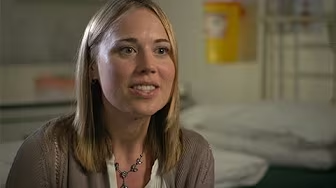
Kate Nation, Oxford University, outlines some of the early findings from ReadOxford's research using the Oxford Corpus.
Kate Nation, Oxford University, talks about how ReadOxford are using the Oxford Corpus in their research into children's literacy development.
Vineeta Gupta, Oxford University Press, describes the creation of the Oxford Corpus and the BBC Radio 2 500 Words story writing competition which provides the words for the written subcorpus.
Kate Nation, Oxford University, describes how ReadOxford are using eyetracking to understand what happens when children read.
Kate Nation, Oxford University, introduces some of the problems children might face with reading comprehension- a vital aspect of reading.
Kate Nation, Oxford University, describes the early stages of reading development.
Early research suggests that using electrical currents to stimulate your brain could improve your attention and maths ability. But now some companies are selling such devices online, leading to calls to regulate the technology. Melissa Hogenboom reports.
Please click on the cog icon below the screen and select 1080p HD for the best viewing experience CHA Cognitive Health in Ageing studies In a population in which the number of individuals experiencing the devastating effects of dementia is increasing, it is vital we understand why and how brain function declines with age so that effective treatments can be developed. We are conducting a series of studies at the University of Oxford to investigate whether increasing physical and mental activity can improve cognitive health and prevent cognitive decline in healthy older people and in people with mild cognitive impairment. We are using brain scanning techniques, such as magnetic resonance imaging (MRI) and magnetoencephalography (MEG), to investigate the effect these interventions have on the functioning of the brain. These techniques provide us with images of the brain and allow us to measure brain function. We are recruiting people over 60 years of age to take part in either our exercis
Award-winning professor of social psychology at Oxford University, Miles Hewstone visits the RSA to show how 'intergroup contact' can play a fundamental role in creating peace and cohesion within our increasingly diverse societies. Listen to the podcast of the full event including audience Q&A: Follow the RSA on Twitter: /thersaorg Like the RSA on Facebook: /thersaorg Our events are made possible with the support of our Fellowship. Support us by donating or applying to become a Fellow. Donate: Become a Fellow:
Can a change in environment really change the experience of food and drink? World-first scientific experiment reveals changes in environment affects smell, taste and flavour of single malt whisky. But what does this mean for our dining experience in general? Can a change in lighting or music really affect how we experience food and drink? Change the room, change the taste of your whisky A Professor from the University of Oxford has conducted a world first scientific experiment and claims to have proven scientifically that a change of environment can enhance the sensory experience of whisky by up to 20%. Professor Charles Spence, Head of Crossmodal Research in the Department of Experimental Science at Oxford University, found that the participants in his multi-sensory tests would vary ratings of the smell, taste and flavour of the whisky by 10- 20% when tasting exactly the same single malt whisky in different atmospheres. The study's findings go some way to explaining why a drink tasted