
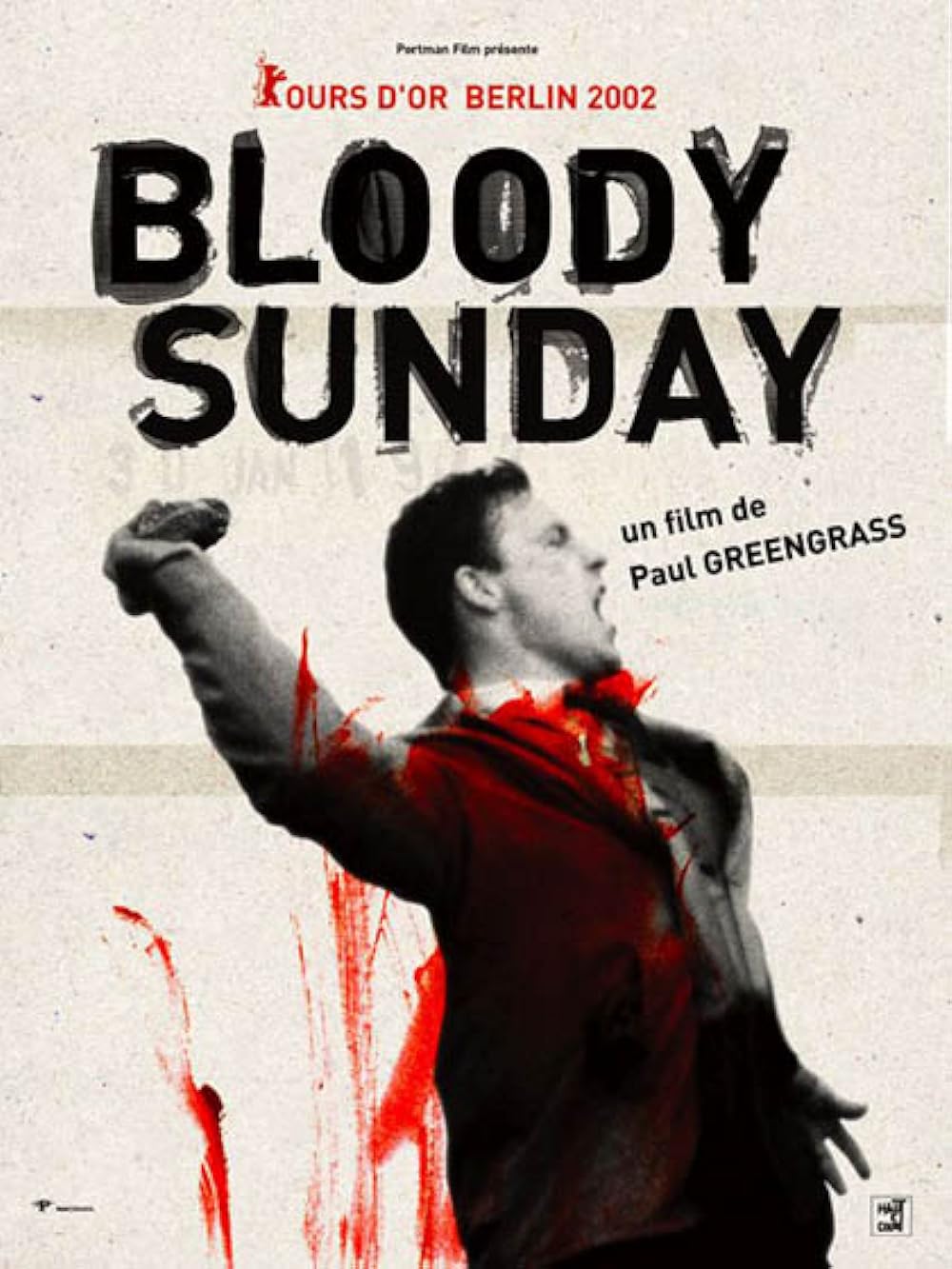
Adaptation cinématographique de la marche de protestation irlandaise pour les droits civiques et du massacre qui s'en suivit, lequel fut perpétré par les troupes britanniques le 30 janvier 1972.
Bande-annonce
Casting
Paul Greengrass
Director
James Nesbitt
Ivan Cooper
Tim Pigott-Smith
Maj. Gen. Ford
Nicholas Farrell
Brig. Maclellan
Allan Gildea
Kevin McCorry
Gerard Crossan
Eamonn McCann
Mary Moulds
Bernadette Devlin
Carmel McCallion
Bridget Bond
Christopher Villiers
Maj. Steele
James Hewitt
Col. Tugwell
Declan Duddy
Gerry Donaghy
Edel Frazer
Gerry's Girl
Joanne Lindsay
Mary Donaghy
Mike Edwards
Soldier 027
Gerry Hammond
Para F
Jason Stammers
Para G
Ken Williams
Para H
Bryan Watts
Para E
Simon Mann
Col. Wilford
Paul Greengrass
Writer
Vous aimerez aussi
Crimes de guerre
1944
La Voix d'Aida
Postcards from London
The Assets
The Hollow Crown
Chief of War
Racines
The Book of Negroes
The Forgotten Army - Azaadi ke liye
Uyanis: Büyük Selcuklu
Sur les ailes de la chance
Toute la lumière que nous ne pouvons voir
Legacy
Manhattan
TURN: Washington's Spies
Sanadamaru
1864 - Amour et Trahisons en Temps de Guerre
Rebellion
Les combattantes
Gunshi Kanbee
Sistas
The Oval
Bel-Air
Commentaires
10 commentaires
source: Bloody Sunday
I rented "Bloody Sunday" after seeing the Paul Greengrass-directed "Bourne Supremacy." I liked that Bourne flick, still do. I do NOT like "Bloody Sunday," in any way whatever. The thing is just downright aggravating to me. I'll never watch it again. If Greengrass, or whoever worked with him, wanted to convince me to feel sympathy for the Irish Catholics, I already did, up to a point. But this movie moved that point not one little bit. Audio and video were both frenetic; unnecessary jangling phones jangled my nerves, and unnecessary jumping cinematic frames jangled them even more. It is a dramatization, for heaven's sake, that much jumpiness is just way over the top, totally uncalled for. The director had total control of what was shot from start to finish, unlike the "documentary" the film wants to pretend it is. It could have been good. It wasn't. It was just plain aggravating. Two out of Ten.
This is a film with a terrible nerve, from the press conferences in the Sunday morning, through the preparations for the march and the preparations of the military, and forward to the scenes in the hospital afterwards. The camera is working in a way, there you definitely can feel the gloomy weather and the excitement. It's also a 1972 feeling about it, which doesn't feel acted, but like a documentary. James Nesbitt is making a tremendous job as the MP and when you notice that this man hasn't got an Oscar, the Oscar institution definitely seems like the stupid joke it is. The only thing you can have against this Paul Greengrass' movie is the tendency in the end, where the relative documentary objectivity in the beginning, moves over to tendency. The unionists and the British government remain the totally bad guys and the catholics are the eternal martyrs. They might have been that this Sunday, but the conflict of Northern Ireland is a little more complicated. However, this is definitely more exciting than most of what you see in the action genre.
A very well done movie. I found it to be a very factual and a very frank account of a terrible time in Irish/British history. When compared to other books and materials I have read about the account in the past few years, I would have to say it was probably about as accurate as it could be. Of course we don't hear the exact language that was used, especially by British commanders during that time, but I think the movie gives a very likely occurrence of what happened behind closed doors. Soldiers that were allowed to speak up, many years after the fact, have themselves, shed light onto what happened during that time.
As I really don't know anything about the events depicted in this film, I can't say whether it's a realistic or biased account of what happened. As "just" a film, I found it to be very good. The documentary style of shooting it works most of the time (the constant fade ins/outs really bothered me though), and the film builds up tension and keeps you watching. The acting is also good. Nesbitt skillfully manages to switch moods depending on who he is talking to, all with remarkable ease. Also, kudos to the actor portraying the commander (or whatever you call it) of the British paras. He doesn't seem to be acting at all, it's like you're really watching a documentary when he is on screen. Towards the end, the film does tend to skip realism a bit, as it seems to side with the demonstrators a tad too much, while showing off all English soldiers as cold blooded killers. On the whole though, a very watchable film. [8/10]
Normally I don't enjoy the handheld documentary style films, as they tend to induce waves of nausea, but Bloody Sunday had me riveted from the word go. That we already know how it's going to end is irrelevant, the pressure building on the day of the march is almost unbearable. Though there's been criticism that the film is slanted towards the republican point of view, I found it balanced, even in the depiction of the soldiers and officers. Everybody certainly looked the part and I went away feeling some sympathy for both sides. Given the close quarters and inflammatory nature of the conflict, it's amazing that bloodbaths like this (soldiers blasting civilians) haven't happened more often in Northern Ireland. It's only now, that retired soldiers have broken ranks and talked about what actually happened, that a film like this can see the light of day.