
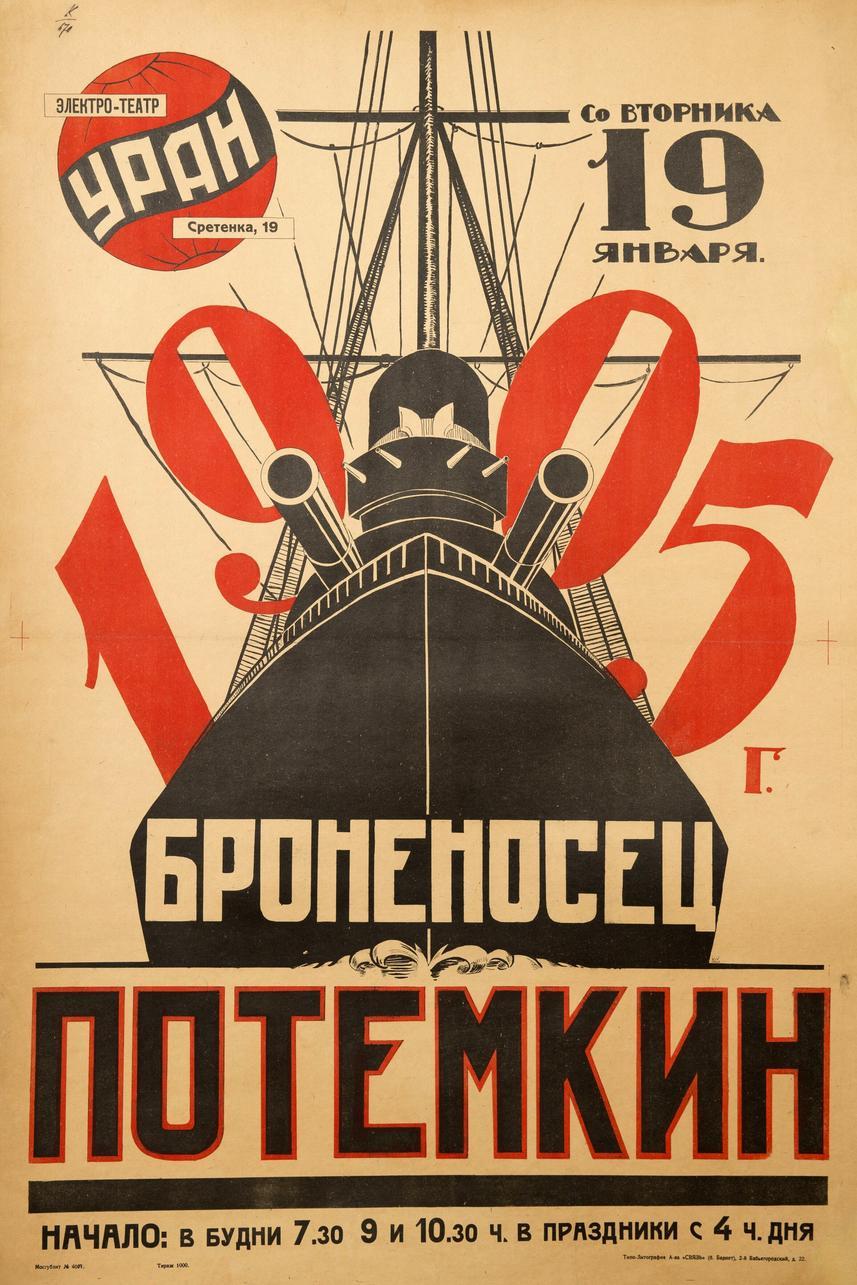
In the midst of the Russian Revolution of 1905, the crew of the battleship Potemkin mutiny against the brutal, tyrannical regime of the vessel's officers. The resulting street demonstration in Odessa brings on a police massacre.
الإعلان الترويجي
طاقم العمل
Sergei Eisenstein
Director
Aleksandr Antonov
Grigory Vakulinchuk
Vladimir Barskiy
Commander Golikov
Grigoriy Aleksandrov
Chief Officer Giliarovsky
Ivan Bobrov
Young Sailor Flogged While Sleeping
Mikhail Gomorov
Militant Sailor
Aleksandr Levshin
Petty Officer
Nina Poltavtseva
Woman With Pince-nez
Konstantin Feldman
Student Agitator
Prokhorenko
Mother Carrying Wounded Boy
A. Glauberman
Wounded Boy
Beatrice Vitoldi
Woman With Baby Carriage
Daniil Antonovich
Sailor
Iona Biy-Brodskiy
Student
Julia Eisenstein
Woman with Food for Sailors
Sergei Eisenstein
Odessa Citizen
Andrey Fayt
Recruit
Korobey
Legless Veteran
Marusov
Officer
Nina Agadzhanova
Writer
Grigoriy Aleksandrov
Writer
Nikolay Aseev
Writer
Sergei Eisenstein
Writer
Sergey Tretyakov
Writer
قد يعجبك أيضًا
جسر الجواسيس
The Delivered
We Go in at Dawn
Pussy Kills
لا تقولي شيئا
رجل نبيل في موسكو
اختطاف الرحلة 601
رجال السكة الحديدية: كارثة بوبال 1984
خيال الظل
Children of the Church Steps
مطاردة
Sleeping with the Enemy
حالة طوارئ إشعاعية
يوسي، الجاسوس النادم
مهرجان أكتوبر: البيرة والدم
Vera
غلوريا
Summer of 36
بيل إير
سقوط الثلج
المبتدئ
بلدة الضياع
Into the Badlands
التعليقات
10 تعليق
A milestone in cinematic history, 'Bronenosets Potyomkin' is one of the handful of great films out there that richly deserves to be called a classic. It was the picture that made Sergei M. Eisenstein a figurehead of film-making at the time. And today, it is still remembered as the wonderful piece of cinema it always has been. 'Potyomkin' is a film that NEEDS to be seen as one entity, not to be picked at. Don't just watch those clip shows where they only present the 'Odessa steps' sequence and then move on to 'Citizen Kane' or 'The Godfather', see it all in it's glorious 75-minute running time to really understand and enjoy it. Don't expect every infinitesimal detail to be perfect though, I mean the acting of the '20s silent era makes 'Scooby Doo' look like a master of understated realism, certain plot points may seem illogical and some of the battle sequences look dated, but it is still an immensely enjoyable movie. The most memorable moments in the film are the mutiny on the battleship, Vakulinchuk's body falling off the ship, the sailor under the tent at the end of the pier, the mother holding her dead child, the baby carriage on the Odessa steps and the lion rising up to roar as further carnage ensues. For each new pair of eyes that look upon it, 'The Battleship Potemkin' comes alive once again.
source: Battleship Potemkin
I first saw this film when it was shown on the BBC for the first time in the seventies. I remember it being a real event, and feeling very sophisticated as I watched it. The reality today is a very dated film that is 90% fiction, with wooden acting and unbelievable events. However, it is of interest to me as a Naval historian and researcher, and the conditions it depicts are typical of the time. Of course, the German High Fleet and the Royal Navy didn't mutiny but conditions on board their ships were similar. It is also of interest for the filming of the small sail boats that go out to the Potemkin with provisions. Hundreds of them and it is an important film record of the type of craft still being used in the 1920s. As for the rest, so much of it never happened but it is etched onto peoples minds so much that people visit Odessa expecting to see a plaque or a statue commemorating the massacre on the steps. Once you know the true history I think the film loses some of its impact but as an example of film making, of its time, it will always be studied and commented on. Definitely worth watching but prepare to be a little disappointed.
The first time I saw Potemkin, I must have been around 12, and I bet it was the first silent drama I'd seen, after Metropolis. I hated it. I saw it recently again, along with a couple of other Eisenstein pictures. While I felt that Strike and October were both superior films, I really liked Potemkin a lot more. Now, also I understand more some of the things Eisenstein was doing with editing and camera work. I would like to point out, to those who say Eisenstein invented "montage", that D.W. Griffith was doing the same thing ten years earlier. Extreme close-ups came around in 1903, with films like The Gay Shoe Clerk. Tracking shots are in a huge number of films predating this film by almost a decade (Intolerance, Cabiria). No, Eisenstein did not invent these visual tools. Nor did he really perfect them (I doubt anyone has truly done that). What he did was try to utilize them to create a stirring and powerful cinematic experience, which he certainly did. One thing I love about Eisenstein's films is his use of "types", really distinctive-looking actors. The citizens of Odessa look fascinating, especially the wealthy-looking woman with the veiled hat. The ship's creepy-looking, bearded and mustachioed doctor was very effective as an evil presence just asking to be overthrown. Eisenstein also provides us with plenty of beefy, sexy sailors, which you really can't complain about. Those opening scenes are pretty hot, if you ask me. So, overall, this is a good film. I like the acting, the camerawork, the editing. However, I wish film professors would stop showing the Odessa steps sequence in their classes. Young students with no understanding of Soviet cinema will watch that and promptly give up on the genre. The scene feels clumsy and disconnected today, and plays on the common misperception that all silent film was overstated gesturing and unrealistic character decisions. At least they're not showing them Earth (I hope).
I did something a little daring tonight when I watched this movie. I attempted to wean myself from silent movie scores. Sure, when this film originally was distributed, a piano score was probably played with it. Oftentimes, the director would choose the score himself (Charlie Chaplin often composed the scores of his later silent films). But most of the music you hear on VHS tapes over silent films is in no way the same music that was supposed to be played when the film was first released. And, then again, there were plenty of silent films that were played without a score. I do not know the history of Potemkin's score, so I decided to watch it for the medium this piece of art was produced within - film. Soon after I turned the music off, unaided (or should I say unimpeded) by the musical interpretation of the emotions on screen, I became utterly attached to the film. Visually, it is easily one of the most stunning of all films. Eisenstein was a master of composition. The editing, possibly the cinematic technique Eisenstein is most famous for (montage), is extraordinary. The mood of this film is anger, and it stirred my passions violently. It takes a lot of effort to enjoy a silent film, especially a drama, but films like Battleship Potemkin prove that this effort is entirely worth it. Come on! You owe it to yourself to watch this film! Your education is incomplete without it.
Eisenstein created the Russian Montage Theory, and this film is his finest example. It took years before someone could utilize his ideas and make them work (The Limey, 1999). Nonetheless, the baby carriage scene really demonstrates the discombobulated nature of RMT. Granted, like most movies, it gets long in some parts, the beauty of the film is amazing. One of the best silent films I have ever seen.