
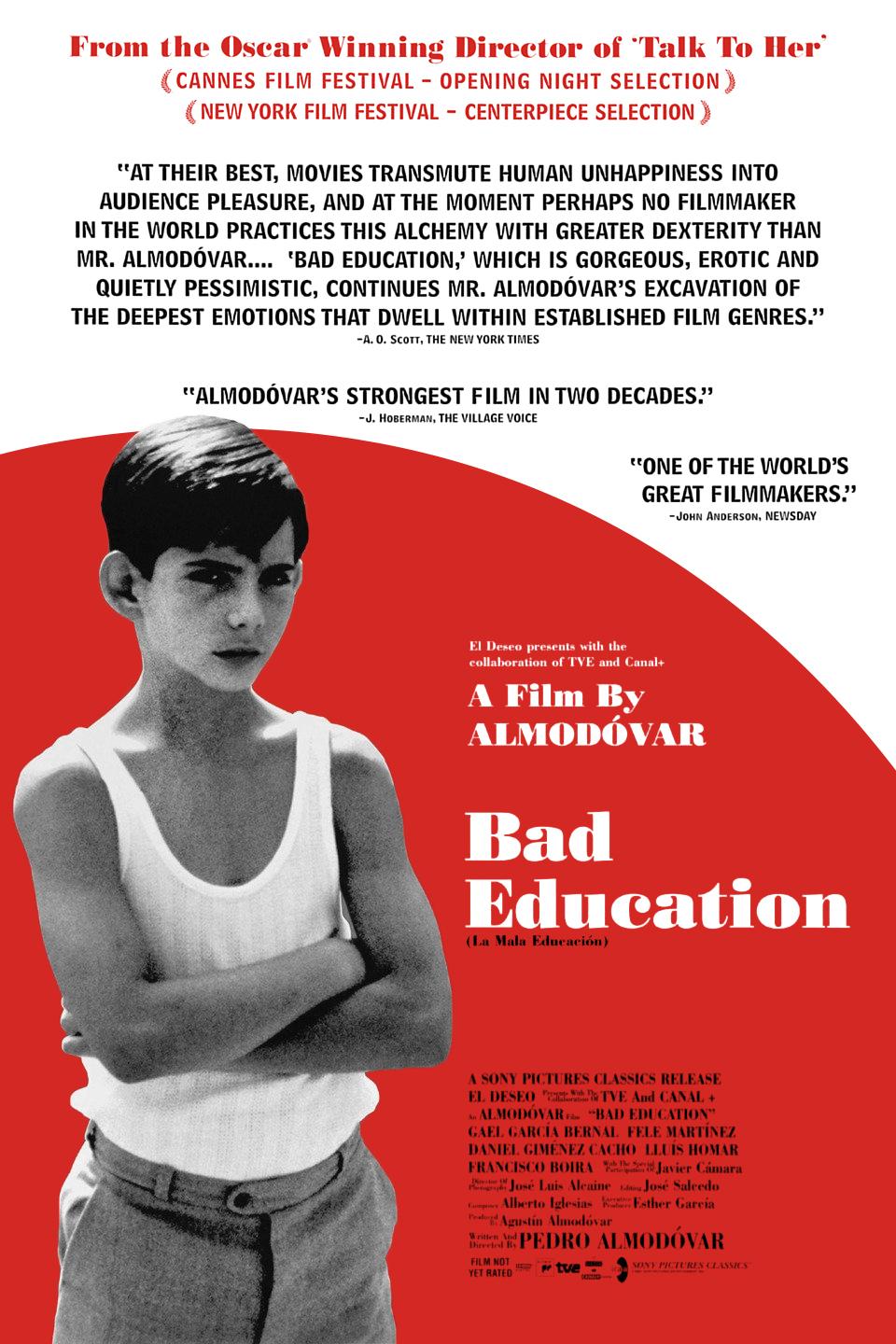
An examination on the effect of Franco-era religious schooling and sexual abuse on the lives of two longtime friends.
Trailer
Pemeran
Pedro Almodóvar
Director
Gael García Bernal
Ángel
Gael García Bernal
Juan
Gael García Bernal
Zahara
Fele Martínez
Enrique Goded
Javier Cámara
Paquito
Daniel Giménez Cacho
Padre Manolo
Lluís Homar
Sr. Berenguer
Francisco Maestre
Padre José
Francisco Boira
Ignacio
Juan Fernández
Martín
Nacho Pérez
Ignacio
Raúl García Forneiro
Enrique
Alberto Ferreiro
Enrique Serrano
Petra Martínez
Madre
Sandra
Transformista
Roberto Hoyas
Camarero
Agustín Almodóvar
Limpiador Piscina
Pedro Almodóvar
Limpiador Piscina
Robert Forcadell
Man in public
Luis Lobos Negros
Motero ochentero
Pedro Almodóvar
Writer
Mungkin Anda Juga Suka
Call Me Alma
Parallel Mothers
Assault on Wall Street
To Live Through Death
Chasing Flavor
Intimacy
Intimacy
Snowfall
Power
Power Book IV: Force
Peaky Blinders
BMF
Ehostela
MobLand
Ballard
Bosch
East New York
The Good Fight
Legends
The Witness
Bandi
The Client List
Crime and Justice
Stumptown
Komentar
10 Komentar
.....this film isn't very good at all. It's tacky, dull and ultimately makes a mockery of it's themes and characters. Paying homage to equally dull and ill-conceived "art" films like Vertigo (neither film has anything interesting to say) is not clever and neither is the way this film turns in on itself through the ridiculous second half. Almodovar is lucky he has the ability to surround himself with good cinematographers, composers and actors, as this film would've be a complete embarrassment without them. It was like a glossy, over-done episode of "murder she wrote". There are so many holes in it. The frames within frames aspect was over-used and obvious, to name but one. It seemed to me that Pedro was not comfortable with this material, it's far removed in form and style from his better work. The film director in the film (oh! how clever) summed it up when he said he was feeling very uninspired at the outset. Maybe Pedro was trying to tell us something? There's nothing worse than an established director making films for the sake of it. I won't rush to see his next one.
In "La Mala Educación", Almodóvar is very serious and too dark and tragic, when comparing to his previous movies. There are many usual elements, such as the attack to the Catholic Church, gays, travesties, homosexual intercourse, child abuse etc., but not in his common ironical, colorful and funny way; instead, the story is developed in a very bitter context. The screenplay magnificently discloses the plot, with a story inside another story, mixing "reality" with fiction; the direction of Pedro Almodóvar is excellent as usual; and Gael Garcia Bernal proves his versatility as an outstanding actor. Although being a great film, I do not dare to recommend "La Mala Educación" for any audiences. However, fans like me of this great Spanish director will certainly like it a lot. My vote is eight. Title (Brazil): "Má Educação" ("Bad Education")
This is the third Almodovar movie I have been unable to sit through. I just don't get it. Pure melodrama. Spanish Soap Opera drek. I find his movies insufferable. Someone please explain why he's considered brilliant. I am not the only one who feels this way. I was with a good friend when we walked out of his last movie. We just kept saying, "What the f*** was that about?" Almodovar is a fraud. And people who keep acclaiming his brilliance are the same people who look at a pile of feces in an art gallery and call it "a commentary on society" or some such bullcrap. It's crap. Just like this frigging movie. BOOOO!
Sitting in a trendily-shabby art cinema, seeing Almodovar's La Mala Educacion on an intentionally modest-sized screen with exquisite sound system (the setup du jour for the repackaged, mainstream-chic experience that art cinema has become), I was filled with two emotions: boredom and rage. Boredom at the painfully mediocre film I was being subjected to - Almodovar gleefully pleasures himself on screen, content in the knowledge that throngs of trendy thick-rimmed glasses-wearing disciples will follow him to the end of the earth regardless of the sloppy writing, thoughtless direction, and textbook cinematography he shiftlessly assembles whilst greedily grabbing for any Hitchcock devices he could manage to steal from the filmmaker's general store. Plot is a lost concept...you can almost hear him in a hackneyed Spanish accent questioning "Plot? What is this...how you say...plot? What a funny word!" Rage, however, at the eagerness with which the trendy Buddies Holly delight in swallowing every ounce of the film whole as per Almodovar's instructions on the side of the bottle. Rage at the haughty smile on the ticket vendor's face as he graciously grants me the ticket to True Cinema. Rage at the disdain upon his face as I loudly denounce the film upon my exit. Bad Education is the perfect example of the commodity that is Art Cinema Gone Wild. The neatly-packaged, inspiration-impoverished per-pound trade good that independent or pure cinema has revamped itself to become. It was a horrible, shallow, confused film that could only conceivably be valued for the opportunity to gaze at sexually ambivalent attractive Spanish men. I spit upon this film, and upon the masses who eagerly applaud it.
n 1980 Madrid, young film director Enrique Goded is looking for his next project when he receives the unexpected visit of an actor looking for work. The actor claims to be Enrique's boarding school friend and first love, Ignacio Rodriguez. Ignacio, who is using now the name Ángel Andrade, has brought with him a short story titled "The Visit" hoping that Enrique would be interested in making a film out of it giving him the starring role. Enrique is intrigued since "The Visit" described their time together at the Catholic school and it also includes a fictionalized account of their reunion many years later as adults. "The Visit" is set in 1977. It tells the story of a drag artist and transsexual called Zahara, whose birth name is Ignacio. Zahara plans to rob a drunken admirer but discovers that the man is her boyhood lover Enrique. Next she visits her old school and confronts Father Manolo, who abused her when she was a boy. She demands one million pesetas from him in exchange for halting publication of her story "The Visit". The story is set in a Catholic boarding school for boys in 1964. At the school, Ignacio, a young boy with a beautiful singing voice, is the object of lust of Father Manolo, the school principal and literature teacher. Ignacio has found his first love and cinema in the company of Enrique, a classmate. One night, Manolo discovers them together and threatens to expel Enrique. In an attempt to prevent this, Ignacio gives himself to Manolo. The priest molests Ignacio, but expels Enrique nonetheless. Enrique wants to adapt Ignacio's story into a film, but Ángel's condition is that he plays the part of Zahara, the transsexual lead. Enrique remains skeptical, for he feels that the Ignacio whom he loved and the Ignacio of today are totally different people. He drives to Galicia to Ignacio's mother and learns that the real Ignacio has been dead for four years and that the man who came to his office is really Ignacio's younger brother, Juan. Enrique's interest is piqued, and he decides to do the film with Juan in the role of Ignacio to find out what drives Juan. Enrique and Ángel start a relationship, and Enrique revises the script so that it ends with Father Manolo, whom Ignacio was trying to blackmail to get money for sex reassignment surgery, having Ignacio murdered. When the scene is shot, Ángel breaks out in tears unexpectedly. The film set is visited by Manuel Berenguer, who is the real Father Manolo, who has resigned from Church duty. Berenguer confesses to Enrique that the new ending of the film is not far from the truth: the real Ignacio blackmailed Berenguer, who somehow managed to scratch together the money but also took an interest in Ignacio's younger brother, Juan. Juan and Manuel started a relationship and after a while realized they both wanted to see Ignacio dead. Juan scored some very pure heroin, so that his brother would die by overdose after shooting up. After the crime, the relationship disintegrates; Berenguer wants to continue the relationship with Juan, but Juan is uninterested. Berenguer claims that he will never let Juan go, and Juan threatens to kill him if Berenguer continues to pursue him. Berenguer attempts to blackmail Juan for his part in the murder of Ignacio. Enrique is shocked and not at all interested in Juan's weak vindications for what he did to his brother. Finally, before he leaves, Juan gives Enrique a piece of paper: a letter to Enrique that Ignacio was in the middle of typing when he died. In the epilogue, it is mentioned that Enrique releases his film later and achieves great success. Despite the grief and guilt of his brother, Juan also achieves success, but was later relegated to television work. Berenguer dies in a hit-and-run (caused by Juan, who was being blackmailed by Berenguer, and thus fulfilling his promise made earlier in the film). Rated NC-17 For Explicit Gay Content .I will never trust any priest again.
Is it an accusation of the Catholic Church or is it the story of a priest who is bound by his religion to strict rules concerning sex and feelings? Is there a theme in the film or is it just a story? Those are a couple of questions I asked myself after seeing La Mala Educación from the Spanish director Pedro Almodóvar. Actually, La Mala Educación exists of three stories which have been interwoven in a miraculous way. Story one: film director Enrique is being paid a visit by a long lost friend. That friend, Ignacio, is an actor and has written a story that Enrique might want to make into a film. Enrique's story is for one part made up by Ignacio's and Enrique's experiences when they were young boys and were living in a Catholic boarding school. Ignacio reads the manuscript and sees the pictures in his head, and that is story two: a transvestite finds an old friend, Ignacio. After having sex, the transvestite steals a manuscript Ignacio wrote about his secret: while in boarding school he was sexually abused by a priest. To gain money, the transvestite blackmails the priest: give me money or I'll publish the manuscript. The priest reads parts of the manuscript. And that is the third story: the experiences of the real Enrique and the real Ignacio while attending boarding school. During that time they discovered the meaning of friendship, love and physical desires. You have to keep up with the film. When your attention wanes you might miss a detail that's important later. When seeing the film, try to remember the names of the characters very quickly. It makes viewing easier. Is La Mala Educación a typical Pedro Almodóvar film? Yes and no. No, since women are not the main theme, as in his other films. No, because it's not an unbelievable and absurdist story. Yes, since the film has some typical Almodóvar characteristics: the transvestite, the junkie that is caught on the lee shore, and the hope people have to reach a better life. More than in other Almodóvar films homosexuality is an important theme. When the film was over you could see the visitors of the cinema thinking: is it a film about the Catholic Church, about emotions and selfishness, about The scenes had to fall in place.
Enrique is a film director working on his new project when an old school friend, Ignacio, arrives looking for acting work. Enrique fobs him off with excuses and Ignacio leaves him with a story he has written called 'The Visit'. The story is based on their childhood together as well as having a totally fictional section where Ignacio (Zahara). As Enrique reads the story it takes him back to his childhood effectively where they fell in love as boys before being separated by Father Manolo who also loved Ignacio. When he decides to make the film of the story it only serves to spark more memories as well as bringing revelations. When I read the plot summary for this film I assumed that it would be difficult to penetrate (pardon the pun) and that I would struggle to follow it. Now that I think back on it I wonder how on earth I managed to follow a film that has threads and characters that don't exist even within the film and it is to the film's credit that it works really well. The film appears to have about three of four stories but really it is only one story that we are being told and a very effective story it is. It is engaging and very well written we care about the characters even as they change and trick us. Only the final 20 minutes appear to be unsure of themselves and it is here that the film drags slightly, but at till this point it is all great. This is not to say it is an easy watch because it isn't. If you are homophobic then this is not the film for you I am used to seeing shows (Oz, 6 Ft Under) where such acts are portrayed but I was taken aback by the graphic nature of the acts here. I don't mean you see anything but it leaves very little to your imagination. This is not a problem it's just that many men may find this difficult to watch. Likewise scenes involving mutual * between young boys is hardly something that one can watch without feeling slightly uncomfortable. However the one thing the film does through all this is deliver good characters. As much as I couldn't watch Ignacio licking his fingers to wet his 'area' and ease penetrate I still liked him as a character. Even more pleasing was the fact that the film never makes Father Manolo a monster; of course there is no sympathy for the man in the film but it could have just made him a lecherous beast who the audience immediately hate a pantomime villain but the script creates a more complex character. The cast do a great job of delivering these characters and they make it work very well even if come of them have to change characters midstream or be one of several actors playing the same character. Martínez plays the most consistent character in the film and he does well with a good part, even if he has a less showy role than some others. Bernal has the most difficult role and he does really well to keep the audience with him while delivering all sorts of roles! If nothing else he is a brave actor and he deserves good parts to do more work like this. I don't know the rest of the actors by name but I enjoyed the other queen in the fictional part and also the guy who played Manolo in the fictionalised and childhood sections. Boira's Ignacio lacks subtlety and is overblown but by his point of the film I think that was the whole point. Overall this is far from most people's cup of tea even those used to seeing art films may find it hard going due to the graphic simulation of the sexual acts within the film. But despite this the film is really well delivered. Many Almodóvar fans have said this is one of his lesser films but I cannot agree when I think of the skill he displays in keeping the difficult narrative together. The characters are mostly well written and the story is engaging even if it flags a little bit at the end.
With 'La Mala Educación' Pedro Almodóvar has surpassed himself. It's a very intelligent film with wisely-chosen actors. Gael García Bernal is simply magnificent in portraying three very different characters. This goes to show that he's not only got looks but also a great talent. It couldn't have been easy for him, especially when doing the role of Zahara! Fele Martínez is also very good as Enrique, Ignacio's beloved childhood friend. A round of applause goes to the young Ignacio as well. One can see the anxiety in his eyes when Father Manolo approaches him. The latter's frustration is very clearly brought out in the direction of certain scenes by Almodóvar. Definitely not a film to miss!