
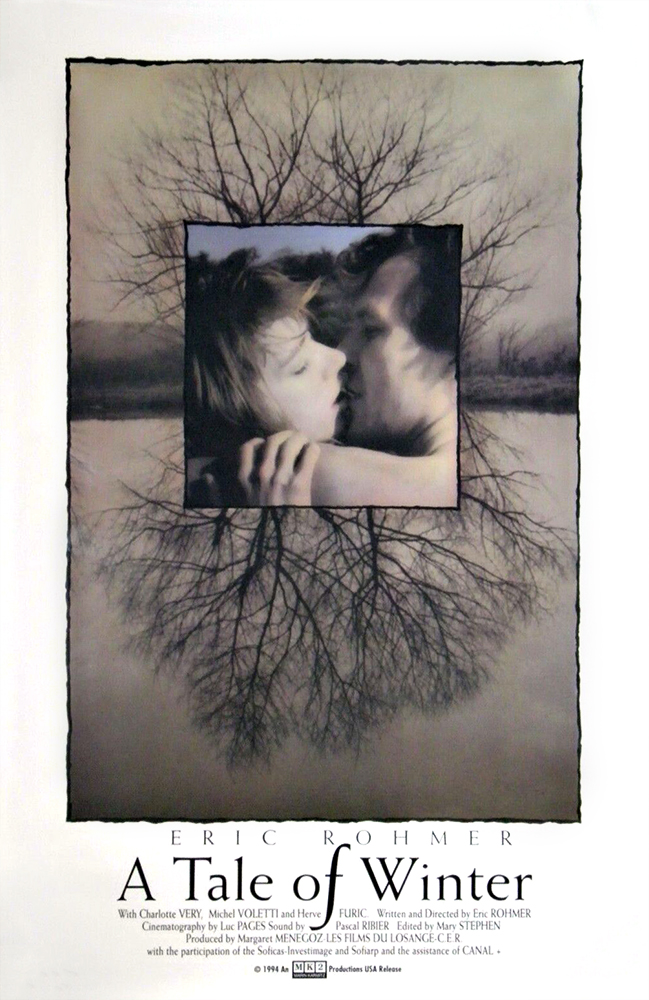
Five years after losing touch with a summer fling, a woman has difficulty choosing between her two suitors.
الإعلان الترويجي
طاقم العمل
Charlotte Véry
Félicie
Frédéric van den Driessche
Charles
Michel Voletti
Maxence
Hervé Furic
Loïc
Ava Loraschi
Elise
Christiane Desbois
Mother
Rosette
Sister
Jean-Luc Revol
Brother-in-Law
Haydée Caillot
Edwige
Jean-Claude Biette
Quentin
Marie Rivière
Dora
Claudine Paringaux
Customer
Roger Dumas
Léontès
Danièle Lebrun
Paulina
Diane Lepvrier
Hermione
Edwige Navarro
Perdita
François Rauscher
Florizel
Daniel Tarrare
Polyxènes
قد يعجبك أيضًا
Acts of Love
Tuberose
Porto
Dream Boy
Skam France
مطاردة اليشم
Lighter & Princess
عاما بعد عام
The Rain in España
Safe Skies, Archer
من نقطة الصفر
Double Helix
عندما التقينا
The Wicked Game
You Are Mine
The Secret of Us
Screw-Up Adults' Sharehouse
My Personal Weatherman
Love for You
Gen Z
Love Story in the 1970s
Overdo
Love Sick
التعليقات
10 تعليق
The second of Eric Rohmer's Four Seasons. This is a beautiful movie. Low-keyed, quite, slow- but not at all too slow. Simple story with complex characters; Interesting to the end. I can't wait to see the other "seasons".
Rohmer's 1969 film 'Ma nuit chez Maud' had explored at great length about "Pascal's wager", which came down to the fact that people willing to bet against enormous odds to attain their life affirming gain (sorry I never read Pascal). This movie is basically a human story built around this Paradox. It did mentioned Pascal once. I find the character of Felicie is well developed and evoke empathy from me. I was a little disappointed at the ending because it doesn't really answer my question, "... but what if I lose?" But I guess like Checkov said the artist duty is "the correct way of putting the question". The question is well put in this film and I can't ask too much. Very intelligent film. Since I don't speak French, at times I feel like reading a book (subtitle) rather than watching a film. But overall I highly recommend it.
Eric Rohmer's "A Winter's Tale" (1992) is not a credible story for me at all. This is especially so with the heroine Felicie. Rohmer has characters behaving exactly opposite to the way people behave in the Real World yet, even more troubling, he seems to try to convince the viewer that this is, indeed, the way that people really do behave, or at least that it all makes sense somehow. As someone with a BA/MA in Psychology, my opinion is that the heroine of this story is a mentally ill person. She has been obssessively professing her love for a man with whom she has lost contact five years ago & knew only very briefly anyway, and manipulates and socially abuses two worthy men who express their love for her, in spite of the fact that they both offer her a realistic opportunity for a secure future for both her and her young daughter. What I find even more amazing is that no one in her life suggests that she seek the professional help that she so obviously needs. After my university education, I spent the next 30 years counseling very troubled people, yet I can tell you that I never encountered someone not only as "sick" as this young lady, but who had as little insight into her "sickness" as she did. The type of deep seated character disorder displayed by our heroine would certainly not have begun with her VERY Brief fling with that now "long lost" lover of five years ago, but would've been evident much earlier, yet nothing of the sort is mentioned. Furthermore, although Felicie does qualify as what some mental health professionals call "the walking wounded" in that she was still able to function in the Real World, there is NO Way that the rest of her life would've been operating as smoothly as portrayed in this film. This is especially so in the bizarre reaction that her two "love interests" Maxence and Loic have to her in spite of the fact that she abuses her relationship with both of them, tells them both that she is still too in love with "long lost" Charles to have a committed relationship with them, and discusses her love for her "long lost" Charles openly with them. In the Real World, any self respecting man would've promptly "kicked her to the curb", yet Rohmer has both of them SO Committed to her that it is SHE who ends her relationship with them. That the Totally UNREAL ending to this tale has Felicie accidentally run into Charles somewhere in the vast metropolis of Paris, and immediately rekindle their love affair, as if those "missing" five years never even happened is just from OUTER Space for me. From my vantage, Rohmer is trying to show us that the mentally ill behavior of Felicie was not "mentally ill" after all, but some kind of "unconditional faith" that can "make miracles happen". Give Me A Break, OK??? That's SO Far in Outer Space that Hubble can't even see THAT far. The ending is little more than a cheap literary "trick" to attempt to salvage a poorly thought out screenplay. In his favorable review of this film, Roger Ebert justifies the anti-logic underlying the storyline as typical of Rohmer putting little importance in the storyline of all his films. However, that doesn't "wash" with me because there is a difference between a weak, or even an incoherent story, as opposed the Unreality that I find here. Furthermore, Rohmer makes a poor effort to use this non-logical storyline as a platform for some abstract level of meaning or symbology. True enough, there are plenty of films in the Horror, Science Fiction, and Avant Garde genres that are even more unreal than this film. However, the filmmakers in those films don't make the pitiful and pathetic effort that Rohmer does here in apparently attempting to convince the viewer that Unreality is indeed somehow Real. joseph.kulik.919@gmail.com
As he grew older it seemed veteran screen-writer and director Eric Rohmer grew a little more romantic and a little less cynical of life and love. His most famous work, the "Six Moral Tales" of the late 60s are expose's of human failings, pomposity and self obsession. Most of the characters are deeply flawed and many, though fascinating in their way, are distinctly hard to like or forgive. In the "Proverbs & Comedies" series of the 80s , the tales of life are a little softer, lighter, the characters more sympathetic and once the 1990's arrive and Rohmer's new "Four Seasons" series finds it feet, that trend has developed further. The FOUR SEASONS stories carry a little more plot and rely less on the fairly heavy philosophy and religious conviction one would have encountered in MY NIGHT AT MAUD'S for example. There is hope where there had been despair. CONTE D'HIVER is a bitter sweet tale of pretty young hairdresser Felicie and the aftermath of a brief passionate affair with the charming Charles. The result is that she bears his daughter but accidentally loses contact with him before he is aware of this. Life for Filicie is then a matter of putting up with a string of second-best lovers in the vain hope that Charles will somehow re- establish contact. The action flits between Paris and provincial Nevers and as always the people the dialogue and the direction are wonderfully natural. The cinematography and editing are spare and unobtrusive and the acting is superb. There is one sequence, a lengthy scene in which Felicie watches , and is moved by, a stage production of a Shakespeare play that drags on far to long but otherwise this films almost skips along compared to some of the directors previous works, where the pace is always very measured and very slow. In all, a delightful film with a good cast headed by the attractive Charlotte Very, one of several excellent young actresses Rohmer cast around this time (Amanda Langlet and Emanuelle Chaulet being the others that spring to mind). Recommended
Like some other reviewers I have no idea how this movie can be rated so highly. The plot is dull and the main female character is ludicrous, childish and stupid, pretending to be smart and having thoughts. Nothing much happens during the movie. Some characters like Maxence dissapear during the movie and their fate is unknown. The ending is sudden and makes little sense.
With the exception of Godard, of whom one was enough, I've seen fewer films by Rohmer than by any French director - this is about the third - and I can't honestly say that I'm in a hurry to see any more. If, as in the case here, I see a DVD in my library that carries a modest rental I'll give him another try but so far I've seen nothing that makes me want to dash out to Blockbuster and rent everything I can find by him. Those Rohmer films I HAVE seen are, to some extent, interchangeable but that's not the same as having a STYLE; in Rohmer's case it merely means that the films are clearly shot with a minimum crew, next-to-no budget and a cast of unknowns all of whom appear to be addicted to Valium inasmuch as there are no violent outbursts, tempers are kept strictly under wraps and in lieu of histrionics we get philosophical discussions. This time around the leading female character indulges in a holiday romance that leaves her pregnant and ironically for a filmmaker who sets such great store on philosophy she refuses to dismiss it philosophically as just that, a holiday romance, as ninety nine out of a hundred would, but persists in viewing it as the love of her life. Despite affairs with two other men, both more than happy to settle down with her AND her daughter, she rejects them both until, in a scene worthy of Hollywood at its schmaltziest she boards a bus and takes a seat facing her long-lost love. WOW! Okay, don't get me wrong, it's watchable but please don't tell me it's anything else.
The script is bad, but good dialgoue could have rescued it. Instead, it made things worse. It's almost like watching a first year lit student collaborate with a first year film student with a very good budget. Even the pacing and presentation are bad, presenting someone making life decisions (for herself and her child), changing jobs, schools, apartments, etc. With absolute banality, as if changing socks, and everyone around her seems to think nothing of it. The behavior of the main character is of someone who is mentally ill, but the movie presents it as normal, not even as someone with a quirky personality. Not good enough to be enjoyed as a serious film, not bad enough to be laughed at as a "so bad it's good" comedy.
Felicie (Charlotte Véry), another of Eric Rohmer's attractive, smart, but terminally indecisive women is still feeling the effects of the abrupt end to her summer romance five years ago. Having mistakenly given her lover Charles (Frédéric van den Driessche) the wrong address as he was leaving for the U.S., she cannot really love other men and holds onto a strong belief that Charles will one day show up and all will be right with the world. Eric Rohmer's second film in his Four Seasons series, A Tale of Winter, is one of his most engaging romances, a film that like the Shakespeare play of the same name, postulates that passion and strong intention can lead to totally unexpected results. The opening sequence shows Charles and Felicie enjoying the sun, making love, then parting at the end of their vacation. The scene then shifts to Christmas in Paris five years later. Elise (Ava Lorachi), the daughter she had with Charles is now four years old and has seen her father only through photos. Felicie has two lovers but none suit her. Maxence (Michael Voletti) is a heavy set, not too deep hairdresser who is moving from Paris to Nevers and wants Felicie to come with him. She loves being with him but is not madly in love with him. After first saying no, she agrees to go to Nevers but once there, has yet another change of heart after an epiphany about Charles during a visit to a cathedral and returns to her mother in Paris. Felicie's other suitor, Loic (Hervé Furic), is a bookish librarian who is obviously crazy about her but whom she just wants as a friend. He is a Catholic intellectual and Felicie is more free-spirited and they engage in typical Rohmerian exchanges about Christianity, reincarnation and the nature of the soul. A new awareness opens up when she visits the theater with Loic to see Shakespeare's A Winter's Tale. When she sees King Leontes bring a statue of his wife to life after being told, ''It is required that you do awake your faith'', her own ability to "awake her faith" is evoked and leads to one of Rohmer's more upbeat and satisfying conclusions.
Rohmer and his Racinian dialogs remind that persons still exist who make movies as objects destined to a higher appreciation. I am pretty certain that his movie requires more than one viewing. I have found it interesting, nuanced and wellhandled. Rohmer's movies are the true hallmarks of contemporary cinema; It is true that today I have sipped CONTE D'HIVER as an antidote; there was a time when, able to like Fellini, Kitano and Griffi, I disliked a Rohmer movie (as well as movies by Mrs. Duras, Tatiand the fact is that I did not identify their cause as art's own)but nowadays I feel so offended and sickened by the current rubbish and so wholly Europhile that I resorted to Rohmer's outing as to an antidote, a balsam. I had this feeling of approvalyes, this is the way, that is how one should film . I sipped it, I got it approvingly. Rohmer and his uniquely charming art are an encouragement and a substantial achievement for those who seek an adult art;as a movie buff, he had earned my respect long ago. Now, he has earned my esteem as a director as well. I would suggest a small history lessonthe very man who made CONTE D'HIVER (and, incidentally, gave me a renewed taste for the Shakespearian play) is the same who praises Hawks and considers him an essential director; so much about the simplistic dichotomy operated between schools, etc.. So, feel proud to exalt Hawks' movieswhy, this is the sanest thing for a Rohmer fan!
Felicie and Charles have a serious if whirlwind holiday romance. Due to a mix-up on addresses they lose contact, and five years later at Christmas-time Felicie is living with her mother in a cold Paris with a daughter as a reminder of that long-ago summer. For male companionship she oscillates between hairdresser Maxence and the intellectual Loic, but seems unable to commit to either as the memory of Charles and what might have been hangs over everything. Film critic Roger Ebert added A Tale of Winter to his Great Movies series in 2001, writing, "What pervades Rohmer's work is a faith in love--or, if not love, then in the right people finding each other for the right reasons. There is sadness in his work but not gloom." Respectfully, the film did not do for me what it did for Ebert. I loved the way it incorporated Shakespeare, which is the source of the film's title, but overall found it rather bland. A straight romance-drama tends to be bland, but that is no excuse for my boredom.