
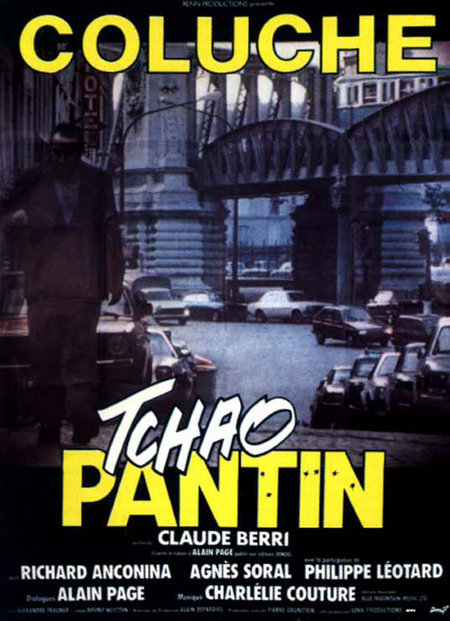
A story of an odd friendship - and the unexpected consequences.
الإعلان الترويجي
طاقم العمل
Coluche
Lambert
Richard Anconina
Bensoussan
Agnès Soral
Lola
Mahmoud Zemmouri
Rachid
Philippe Léotard
Bauer
Albert Dray
Sylvio
Mohamed Ben Smaïl
Mahmoud
Pierrick Mescam
First client service station
Mickaël Pichet
Mickey
Vincent Michel Paul Filliatre
Momo
Annie Kerani
Black Lady
Vincent Martin
Second customer service station
قد يعجبك أيضًا
Call Me Alma
Assault on Wall Street
To Live Through Death
The House
رجل العصابة
Reef Break
The Forest
Defendant
The Promise
سقوط الثلج
قوة
كتاب القوة الثاني: الشبح
الأب الروحي لهارليم
من الأفضل الإتصال بسول
البطريق
Dare You to Death
The Oath
The Waterfront
Legends
Chicago Justice
The Witness
Ludik
Shots Fired
عصابة ويستيز
التعليقات
10 تعليق
"Tchao Pantin "does not bear the scars of the French cinema of the eighties ;not flashy, no intrusive music :Charlélie Couture's score is somber, often threatening ,but never drowns the actors out. This is a night movie ; never the sun shines on this drab suburbian area ; Coluche's gas station is a dead-end ,or worse a tomb , for he tells us so ,he's been thru it all and all he's waiting for death ;"I'm already dead " he repeats several time,par excellence the loser through and through ;It's by far ,Coluche 's best part and behind a grumpy face ,he conceals his despair, his misogyny ,his hatred for the whole humanity ."I 've never spoken to anyone for five years ,says he ,to Bensoussan ,the young dealer with whom he becomes friends (Claude Berri is good at directing an odd pair : it was already obvious in "le vieil homme et l'enfant " (1966)');Richard Anconina with his hangdog looks was the revelation of the movie and has perhaps never found another part as endearing as this one. The rapport both men have is extraordinary and the first part is close to perfect. Because of the disappearance of Bensoussan ,halfway through , the second part is not as appealing ; it suffers from a weak female part (Agnès Soral) as a cardboard punk whose motives are not really convincing and who sometimes has a tendency to overplay ...Even as a dispenser of justice , a man who takes the law in his own hands ,which is questionable, Coluche wins the audience over all the same ;and fortunately , if Soral is disappointing , on the other hand , Philippe Léotard makes his three scenes count : a wistful cop, he's a brilliant counterpart for the principal ,without any overplaying. The second part explains why this pitiful petrol station man has become an alcoholic human wreck,living on rum :first a simple photograph ,then the room nobody can enter ; perhaps Bensoussan would have been ..... Far from the flashiness of the French eighties ,"tchao Pantin" is actually close to the pessimism of the Realisme Poétique school .
In 1984, it was a quite different performer that got the Cesar for best actor, Coluche for "Tchao Pantin". In order to understand this win, one first has to learn who Coluche was. Coluche was an actor who had established himself as a popular comedian before this film. His humour was quite crude, with him being one of the first French comedians that used swearwords to make jokes. He made fun of the establishment, and some of his jokes can be deemed politically incorrect today (for example, in the 1983 hit film "Banzaï", he made a joke by taking an inhaler from a patient while in the hospital, in order to relax). It should come as a surprise, then, that he accepted such a different role in Tchao Pantin. At the time of the film's shooting, Coluche was having problems in his personal life. This enabled him to have an even more intense performance that ultimately won him the award. In this film, he plays a retired police officer, Lambert, who meets a young man in trouble with criminals, played by Richard Anconina. Anconina was at the time one of the newest faces of French cinema, having been revealed through the film "Le battant", with Alain Delon. The pairing of the two actors was done by director Claude Berri, who made "Jean de Florette" two years later. Claude Berri had worked again with Coluche in some films before this one, one of those being the excellent "Le maître d'école" (1981), in which Coluche played a schoolteacher. This movie not only showed Coluche's talent as a comedian, but also exposed the problems of the French school system in the 80s. It's plot was engaging, and all the actors gave exquisite performances. The plot of "Tchao Pantin", though, struggles to get the film going. To my mind it didn't seem to have progressed but a little throughout the whole film, making the end seem a bit abrupt. The story revolves around Coluche's character meeting his only friend in the face of Anconina, whom he loses to a murderer. The ensuing pursuit of the perpetrator by Coluche is all that follows, until he finally gets them, at his own cost. Director Claude Berri tried in this case to make a film noir, but I find his attempt unsuccessful. The film just keeps dragging on, despite the truly impressive performance of Coluche, who clearly deserved the César award. Anconina's acting left me mostly indifferent. Another performance which didn't really have an impact on me was the one by Agnès Soral, who played Anconina's friend, Lola. While wanting to come off as a punk rebel, she actually made the impression of being bored and not caring for anyone except for herself. To me, the causes of her nomination for the César for the best promising actress remain a mystery. While I mostly pay attention to the music in the films, the score of this one didn't leave me a lasting impression. In conclusion, "Tchao Pantin" was a lost opportunity by a good director and a well-paired cast to create an engaging film noir. While Coluche may have deserved accolades for his performance, the total result was the one of a film which set expectations that it ultimately couldn't live up to.
In mid-2016 a friend invited me to check a box of DVDs he had purchased at the market.The first cover to catch my attention was a cool-looking French Neo-Noir that I've never heard of before. Rushing to check the movie, I was disappointed to find no English Subs on the disc,and little sign of the film online. Continuing to try and find a version with subtitles for over a year,I was happily caught by surprise,when a fellow poster on the Fistful of Leone directed me to the place where I could at last say, so long. View on the film: Fuelling up in early 80's France, co-writer/(with Alain Page) director Claude Berri & cinematographer Bruno Nuytten pull Neo-Noir atmosphere through a Cinéma Du Look (CDL) filter of dusty neon blue igniting Bensoussan's moped ride along the underbelly of the city. Dragged away from his dead-end job by Bensoussan,Berri makes Lambert's confrontations with local gangsters crackle with short, blunt force Noir violence, spiked by the ruby red lights of Lola's Punk culture rumbling into their lives. Adapting Page's own novel,the screenplay by Page and Berri brilliantly scrambles Neo-Noir grit to the stylisation of CDL, via the Film Noir loner getting converted to the trio (and in Lola and Bensoussan cases: youthful rebels) being outcast of society,each stuck in a wilderness they can't escape, ruled with an iron fist by separate from each of them, the writers brilliantly make Lambert become the centre of the group by his tough-nosed actions being driven by a desire to keep Lola and Bensoussan safe,which shatters in a freeze-frame final. Stomping into their lives,Agnès Soral gives a whirlwind performance as Lola-at first powered by Soral with a Punk thump against any attempts made to bond with her, which Soral curls into compassion as she learns of Lambert's past. Bringing the trouble to town,Richard Anconina gives an infectious performance as Bensoussan,which sparkles even as he gets in too deep. Famed as a stand-up comedian, Coluche (who died age 41 from a motorbike accident in 1986) gives an amazing performance in his first "serious" role as Lambert,thanks to Coluche capturing how the outsider status has worn Lambert down, until the crossing of tracks with Lola and Bensoussan has Coluche crunch down on Lambert with a determination to say, so long.
Unique because it is the only crime movie made by Claude Berri; unique because this is also the only crime movie - and also maybe drama - in which Coluche played, who was a comedy actor ( on stage before going to the cinema industry) ; unique because it is one of the last crime film of the French industry before the arrival of Olivier Marchal, nearly twenty years later. But in the mean time, in 1997, you had LE COUSIN, made by Alain Corneau, and also J'IRAI AU PARADIS CAR L'ENFER EST ICI from Xavier Durringer. So, after the amazing LA BALANCE, TCHAO PANTIN is the French crime genre swan song before eighteen years; thanks to the TV industry with its silly crime detective series that diverted audiences from the theaters. And unique because it is a very gloomy, poignant and realistic crime movie, that grabs you to the guts, the blood, no one human can stay cold in front such a feature. No one. Philippe Leotard excellent in the ambiguous cop character, the cop using Coluche's character to get rid of the mobsters. And the most poignant thing is the untold link between Coluche's character, who lost in son a long time ago, and who begins to consider Richard Anconina's character as a kind of surrogate son. The audience guesses it, understands this, without the need to explain anything by useless dialogues. And maybe also Anconina looks at Coluche as a surrogate father. That's true story telling, and not bla bla bla.
Lambert is alone. He drinks every night, working at a gas station by night, barely speaking to anybody. One night, Bensoussan, a young dealer, half-Jew, half-Arab, runs into his life. In spite of Lambert's drug hatred, a kind of friendly bond begins between them, even a father-son like relationship. But although we learn more and more about Bensoussan, we still have no clue about Lambert... Soon, Bensoussan's drugs are stolen. As he can't refund his boss Rachid, he's killed by Rachid's henchmen in front of Lambert's. Then, Lambert changes in front of us. While he's on the trail of Benoussan's murderers, killing every one of them, we finally know who he is...err, who he was. But this revenge will be both his own redemption and his fate... The title may be odd : "Tchao" is a mispronunciations of "ciao". "Pantin" means both "Dummy", "Idiot", but Pantin is a small Paris' north suburb town too. Anyway, even French people can't explain the real meaning of the title... I'm writing this as the movie is played on M6... Coluche died 20 years ago and for us, it seems like it was yesterday. We will always see him as a clown, as a nice funny guy, but "Tchao Pantin" is here to remind us that he was an actor, a real great one. Anyway, you can't be disappointed with that film : the storyline isn't very original (revenge), but the characters are so touching and pathetic that they made the movie one of the best French movies of the 80's. Sad but excellent.
Thanks to ARTE TV I could see now Claude Berri's 'film noir' Tchao Pantin (or So Long, Stooge in its English version) starring Coluche in the lead role. The film was made in 1983, at a time when I was busy with changing the course of my life, and no wonder I missed it. It represents a milestone in the career of both Claude Berry who after this film took a three years break in order to create his two best known films - Jean de Florette and Manon of the Spring - very different in subject and style, and also in the career of Coluche who assumes here a more 'classical' and fully dramatic role which could have been a changing point in his career. One year later however, Coluche will die in a motorcycle accident, and this film includes involuntarily kind of a premonitory coincidence as motorcycles and death play a key role in it. The story is quite a typical 'film noir' intrigue, with the key characters - a drunkard gas petrol pump seller who hides secrets of a previous tragic life and a loser type of small drug dealer of Moroccan origin who hides his own secrets among which a shelve full of books he claims to have read all, are getting together in a world were there is not much to attach to but maybe a peer similarly broken soul. There is also a girl in the film, a punk girl (we are in the early 80s, remember) but her role will become more clear only in the second part, after the younger character is murdered and the quiet and withdrawn older man engages on the path of finding the killers and revenging his friends. Typical intrigue, as I said, which has little chances to end otherwise than it ends. As a reader of the 'serie noir' books since childhood I cannot avoid falling under the charm of such stories, especially when they take place in Paris, here a Paris of decrepit houses, or messy small flats, of dangerous streets and dubious bars where everything is trafficked. I was not that surprised to find out that the cinematography belongs to Bruno Nuytten the director of Camille Claudel which I have also seen and written about recently, a film that had an amazing cinematographic look. Coluche seems in this film like having taken inspiration from other Big Silent tough guys in the history of the French cinema, his role could have been played in other times and other periods of their respective careers by screen monsters like Michel Simon or Jean Gabin. I liked the performance of Agnès Soral as the young punk girl whose profile and appearance seems to announce a quarter a century early the character of Lisbeth Salander in the Scandinavian 'Millennium' saga. While the story has been played too many times before and after this film to surprise anybody nowadays, there are many good reasons to watch or watch again this movie.
a film noir. it is the most easy definition for a film who escapes to a clear verdict. because it is one of the films who, after the final credits, becomes a state of emotions. sure, the great merit has Coluche. but he is part of an impeccable story, simple, honest, touching, bitter, about friendship and errors of past, appearances and love, justice and purpose of a broken life. a film like a confession. about yourself and about the others. and about the need to escape from yourself doing the right things in the right manner. a story who becomes a state of soul. this is the most important thing for this film. and the basic motif for who it is different. special. a sort of masterpiece out by ordinaries rules.
Little known outside France but beloved in it Coluche, like Bourvil (of whom the same may be said) excelled at comedy but was more than competent at drama as he demonstrates here. Those who know Claude Berri mostly and/or if only for his international successes Jean de Florette and Manon des Source will perhaps be surprised at the radical change of milieu, from the sunny, well-lit and wide-open spaces of southern France to the dark, murky narrow enclosed world of demi-monde Paris small-time drug-dealers. Coluche is Lambert-no-last-name who is measuring out his life in the litres of gas he pumps as night man at a small filling station; one night a young man of mixed blood, some of it Arab, wanders in to avoid the police - he has an endearing habit of stealing mopeds and motorbikes - and an unlikely bond is slowly forged between the two, easier to understand later with the disclosure that Lambert is an ex-cop whose teenage son died of an overdose. The kid (Richard Anconia) falls foul of his own dealer and gets it where the chicken got the axe and Lambert is moved to avenge him and is himself killed for his pains. Slow to gain momentum it slowly tightens its grip on the viewer and is well worth a look.
***BEWARE: SPOILERS*** Good film by Claude Berri. Lambert (Coluche) is working night-shift at the gas station. He gets to know Bensoussan (Richard Anconina), an Arab kid making money stealing motorbikes and selling them back. A strange bond develop between the two, and when Bensoussan is killed in front of Lambert, the ex-cop will turn vengeful. Cause we learn that the same thing happened to his son. And there's some clues at the end that the cycle of violence will continue, when Lola (Agnès Soral) shoots at the guys that just killed Lambert. There's no happy ending in this one. Definitely not a cheer up movie. Coluche is great. A lot of character in his face. We care for him, as for Bensoussan and Lola. Great lines too. Coluche says to Bensoussan when he learn the kid's a drug dealer: "Prends bien le temps de mourir" - "Take your time to die". Out of 100, I give it 78. That's good for **½ out of ****. Seen at home, in Toronto, on November 20th, 2002.
26 years later, the movie still has a cult on its own in France (and maybe in some other countries, I'm not aware of that). Of course the fact that Coluche, a famous french comedy and stand-up artist, died too soon at 42 (in 1986, 3 years after the movie was released) is no stranger to that... not to mention it was his very first (and last) dark role - a deadbeat gas station employee in Paris seeking revenge -and somewhat redemption- by hunting down the killers who murdered his only friend, a young lowlife drug dealer. Some lazy critics here and there mentioned there was some kind of Melville, Cassavetes and Scorsese influences in the movie but to me, they couldn't be more wrong. Take a close look at it and you won't find any trace of "Taxi Driver" or "Gloria" in it, despite Claude Berri, the director, has tried so hard to put some of these influences in his film. It's basically a classic urban drama in 2 distinct parts (the "bound of trust / friendship" part 1 and the "hunt/revenge/redemption" part 2, seen in many movies before and after this one) but the tremendous ghost-like interpretation of Coluche (who was facing drug addiction and sentimental issues at the time) and the extraordinary master work of D.P. Bruno Nuytten took it all to rocket the movie to critic and commercial success. Even if a few script holes might bother some viewers (especially a detective character -called Bauer- who seems to appear/disappear only to provide informations) the wandering of these shadow-like characters won't be forgotten for a long time and the very ending could ruin your day. Or even your week.