
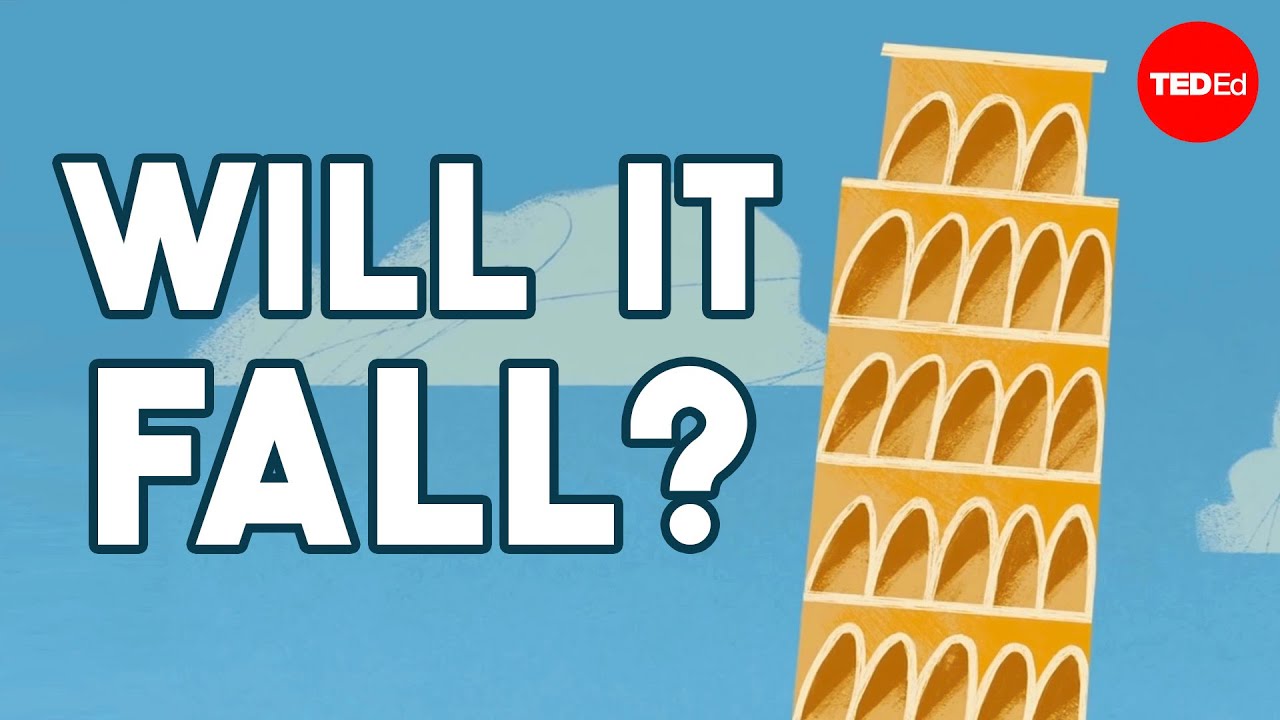
Dig into the 800 year history and architecture of the Leaning Tower of Pisa and find out what gives the tower its infamous tilt. -- In 1990, the Italian government enlisted top engineers to stabilize Pisa’s famous Leaning Tower. There’d been many attempts during its 800 year history, but computer models revealed the urgency of their situation. The tower would topple if it reached an angle of 5.44 degrees— and it was currently leaning at 5.5. What gives the tower its infamous tilt? Alex Gendler explores the monument's history. Lesson by Alex Gendler, directed by Aim Creative Studios. Animator's website: Sign up for our newsletter: Support us on Patreon: Follow us on Facebook: Find us on Twitter: Peep us on Instagram: View full lesson: Thank you so much to our patrons for your support! Without you this video would not be possible! David Matthew Ezroj, Sweetmilkcoco, Raphaël LAURENT, Joe Meyers, Farah Abdelwahab, Brian Richards, Divina Grace Dar Santos, Jessie McGuire, Abdullah Altuwaijri, Sarah Burns, Clement, Hadi Salahshour, FAWWAZ GHUWAIDI, Dino Biancolini, Reagen O'Connor, Nicu Boanda, Cindy O., Karla Brilman, Jørgen Østerpart, Sergi Páez, rakesh Katragadda, Carolyn Corwin, Charlene You, Boris Langvand, Exal Enrique Cisneros Tuch, Carsten Tobehn, Kin Lon Ma, Katie Dean, Ezgi Yersu, Eunsun Kim, Katrina Harding, Gerald Onyango, alessandra tasso, Astia Rizki Safitri, Côme Vincent, Antony Lee, Melissa Sorrells, Rakshit Kothari, Doreen Reynolds-Consolati, Simon Holst Ravn, Manognya Chakrapani, Ayala Ron, Samantha Chow, Philippe Spoden, Phyllis Dubrow, Michelle Stevens-Stanford, Cas Jamieson, Ophelia Gibson Best, Amber Wood and Paul Schneider.
قد يعجبك أيضًا
Hidden Figures: Black History
Let's talk about sex
More money more problems
Cool new tech
CoComelon
SS 1 Biology
Sheriff Labrador - Kids Cartoon | Safety Cartoon for Kids
SS 3 Mathematics
SS 1 Physical
SSS12 Biology
SSS12 Physical
Baby Panda Mechanic | Car Cartoon | Monster Truck | Kids Song | BabyBus
Kids Songs by CoComelon
Learn Colors with CoComelon!
CoComelon & Friends Holiday and Christmas Videos for Kids | Little Baby Bum | Go Buster and More!
Baby Learning with CoComelon - Colors, Shapes and Numbers!
Alphabet (ABC) Songs by CoComelon
CocoMelon | Little Baby Bum | Blippi - Nursery Rhymes & Kids TV Shows
Learn English With Disney Movies
CoComelon - Happy Holidays
Mental health awareness
A Bug's Life
Myths from Around the World
Amazing Animals
التعليقات
10 تعليق
Learn more at https://brilliant.org/TedEd -- To coincide with the 1964 Tokyo Olympics, Japan launched a groundbreaking bullet train that inspired countries around the world to invest in high-speed rail. Today, high-speed trains regularly travel at over 300 km/h, on par with the take-off speed of a commercial airplane. But can it ever be faster than flying? Ning Zhao details the possibilities and hurdles facing high-speed rail transit. Lesson by Ning Zhao, directed by Vicente Numpaque, Dr3i Studio, Hernando Bahamon, Globizco Studios. This video made possible in collaboration with Brilliant Learn more about how TED-Ed partnerships work: https://bit.ly/TEDEdPartner Support Our Non-Profit Mission ---------------------------------------------- Support us on Patreon: http://bit.ly/TEDEdPatreon Check out our merch: http://bit.ly/TEDEDShop ---------------------------------------------- Connect With Us ---------------------------------------------- Sign up for our newsletter: http://bit.l
Learn more at https://brilliant.org/TedEd -- To coincide with the 1964 Tokyo Olympics, Japan launched a groundbreaking bullet train that inspired countries around the world to invest in high-speed rail. Today, high-speed trains regularly travel at over 300 km/h, on par with the take-off speed of a commercial airplane. But can it ever be faster than flying? Ning Zhao details the possibilities and hurdles facing high-speed rail transit. Lesson by Ning Zhao, directed by Vicente Numpaque, Dr3i Studio, Hernando Bahamon, Globizco Studios. This video made possible in collaboration with Brilliant Learn more about how TED-Ed partnerships work: https://bit.ly/TEDEdPartner Support Our Non-Profit Mission ---------------------------------------------- Support us on Patreon: http://bit.ly/TEDEdPatreon Check out our merch: http://bit.ly/TEDEDShop ---------------------------------------------- Connect With Us ---------------------------------------------- Sign up for our newsletter: http://bit.l
Learn more at https://brilliant.org/TedEd -- To coincide with the 1964 Tokyo Olympics, Japan launched a groundbreaking bullet train that inspired countries around the world to invest in high-speed rail. Today, high-speed trains regularly travel at over 300 km/h, on par with the take-off speed of a commercial airplane. But can it ever be faster than flying? Ning Zhao details the possibilities and hurdles facing high-speed rail transit. Lesson by Ning Zhao, directed by Vicente Numpaque, Dr3i Studio, Hernando Bahamon, Globizco Studios. This video made possible in collaboration with Brilliant Learn more about how TED-Ed partnerships work: https://bit.ly/TEDEdPartner Support Our Non-Profit Mission ---------------------------------------------- Support us on Patreon: http://bit.ly/TEDEdPatreon Check out our merch: http://bit.ly/TEDEDShop ---------------------------------------------- Connect With Us ---------------------------------------------- Sign up for our newsletter: http://bit.l
Learn more at https://brilliant.org/TedEd -- To coincide with the 1964 Tokyo Olympics, Japan launched a groundbreaking bullet train that inspired countries around the world to invest in high-speed rail. Today, high-speed trains regularly travel at over 300 km/h, on par with the take-off speed of a commercial airplane. But can it ever be faster than flying? Ning Zhao details the possibilities and hurdles facing high-speed rail transit. Lesson by Ning Zhao, directed by Vicente Numpaque, Dr3i Studio, Hernando Bahamon, Globizco Studios. This video made possible in collaboration with Brilliant Learn more about how TED-Ed partnerships work: https://bit.ly/TEDEdPartner Support Our Non-Profit Mission ---------------------------------------------- Support us on Patreon: http://bit.ly/TEDEdPatreon Check out our merch: http://bit.ly/TEDEDShop ---------------------------------------------- Connect With Us ---------------------------------------------- Sign up for our newsletter: http://bit.l
Dig into the history of the construction of the iconic Brooklyn Bridge and how John Roebling designed a hybrid suspension system to build it. -- In the mid-19th century, suspension bridges were collapsing all across Europe. Their industrial cables frayed and snapped under the weight of their decks. So when German American engineer John Roebling proposed building the largest and most expensive suspension bridge ever conceived, New York City officials were understandably skeptical. Alex Gendler details the building of the iconic Brooklyn Bridge. Lesson by Alex Gendler, directed by Jeremiah Dickey. Sign up for our newsletter: http://bit.ly/TEDEdNewsletter Support us on Patreon: http://bit.ly/TEDEdPatreon Follow us on Facebook: http://bit.ly/TEDEdFacebook Find us on Twitter: http://bit.ly/TEDEdTwitter Peep us on Instagram: http://bit.ly/TEDEdInstagram View full lesson: https://ed.ted.com/lessons/epic-engineering-building-the-brooklyn-bridge-alex-gendler Thank you so much to our patro
Dig into the history of the construction of the iconic Brooklyn Bridge and how John Roebling designed a hybrid suspension system to build it. -- In the mid-19th century, suspension bridges were collapsing all across Europe. Their industrial cables frayed and snapped under the weight of their decks. So when German American engineer John Roebling proposed building the largest and most expensive suspension bridge ever conceived, New York City officials were understandably skeptical. Alex Gendler details the building of the iconic Brooklyn Bridge. Lesson by Alex Gendler, directed by Jeremiah Dickey. Sign up for our newsletter: http://bit.ly/TEDEdNewsletter Support us on Patreon: http://bit.ly/TEDEdPatreon Follow us on Facebook: http://bit.ly/TEDEdFacebook Find us on Twitter: http://bit.ly/TEDEdTwitter Peep us on Instagram: http://bit.ly/TEDEdInstagram View full lesson: https://ed.ted.com/lessons/epic-engineering-building-the-brooklyn-bridge-alex-gendler Thank you so much to our patro
Explore the history of Venice to find out how the infamous floating city was built and how the republic became a hub for trade. -- To escape Germanic invaders, people fled into the Venetian Lagoon in the 6th century. The settlers set out to tame the mudflats and built a foundation in the marshy maze to support heavier, longer-lasting structures. Little did they know, this system of wood, water, and mud would still be supporting an infamous floating city 1,500 years later. Stephanie H. Smith explores the history of Venice. Lesson by Stephanie H. Smith, directed by Sofia Pashaei. Support Our Non-Profit Mission ---------------------------------------------- Support us on Patreon: http://bit.ly/TEDEdPatreon Check out our merch: http://bit.ly/TEDEDShop ---------------------------------------------- Connect With Us ---------------------------------------------- Sign up for our newsletter: http://bit.ly/TEDEdNewsletter Follow us on Facebook: http://bit.ly/TEDEdFacebook Find us on Twitter
Explore the history of Venice to find out how the infamous floating city was built and how the republic became a hub for trade. -- To escape Germanic invaders, people fled into the Venetian Lagoon in the 6th century. The settlers set out to tame the mudflats and built a foundation in the marshy maze to support heavier, longer-lasting structures. Little did they know, this system of wood, water, and mud would still be supporting an infamous floating city 1,500 years later. Stephanie H. Smith explores the history of Venice. Lesson by Stephanie H. Smith, directed by Sofia Pashaei. Support Our Non-Profit Mission ---------------------------------------------- Support us on Patreon: http://bit.ly/TEDEdPatreon Check out our merch: http://bit.ly/TEDEDShop ---------------------------------------------- Connect With Us ---------------------------------------------- Sign up for our newsletter: http://bit.ly/TEDEdNewsletter Follow us on Facebook: http://bit.ly/TEDEdFacebook Find us on Twitter
Uncover the history of the ancient underground cities beneath Cappadocia, which were built during the Byzantine Empire. -- The breathtaking geological formations of Cappadocia are one of the most astonishing landscapes on Earth. Also known as “fairy chimneys,” this impressive terrain hides an equally remarkable feat of pre-modern engineering: a network of extensive underground cities stretching deep below the surface. Who inhabited these cities, and why? Veronica Kalas uncovers the secrets of this buried history. Lesson by Veronica Kalas, directed by Serin İnan, Tolga Yıldız, Kozmonot Animation Studio. Support Our Non-Profit Mission ---------------------------------------------- Support us on Patreon: http://bit.ly/TEDEdPatreon Check out our merch: http://bit.ly/TEDEDShop ---------------------------------------------- Connect With Us ---------------------------------------------- Sign up for our newsletter: http://bit.ly/TEDEdNewsletter Follow us on Facebook: http://bit.ly/TEDEdFa
Uncover the history of the ancient underground cities beneath Cappadocia, which were built during the Byzantine Empire. -- The breathtaking geological formations of Cappadocia are one of the most astonishing landscapes on Earth. Also known as “fairy chimneys,” this impressive terrain hides an equally remarkable feat of pre-modern engineering: a network of extensive underground cities stretching deep below the surface. Who inhabited these cities, and why? Veronica Kalas uncovers the secrets of this buried history. Lesson by Veronica Kalas, directed by Serin İnan, Tolga Yıldız, Kozmonot Animation Studio. Support Our Non-Profit Mission ---------------------------------------------- Support us on Patreon: http://bit.ly/TEDEdPatreon Check out our merch: http://bit.ly/TEDEDShop ---------------------------------------------- Connect With Us ---------------------------------------------- Sign up for our newsletter: http://bit.ly/TEDEdNewsletter Follow us on Facebook: http://bit.ly/TEDEdFa